


On September 16, 1992, the British pound was ejected from the rigid European Exchange Rate Mechanism (ERM) system that it had joined in 1990. In the ERM, the pound was linked to the Deutsche Mark but effectively at too high a valuation, making it uncompetitive. A few days later, Chancellor Norman Lamont tried to sound upbeat, telling journalists that ‘My wife said she had never heard me sing in my bath before,”, suggesting that he was happy to be rid of the ERM. This characteristic gaffe by Lamont was badly received at a time when British industry and households faced a sharp rise in interest rates.
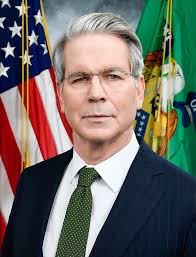
The pound’s exit from the ERM came after painful interest rate hikes (from 10% to 15% in one day) and massive intervention from the Bank of England on one side of the foreign exchange market. On the other side, famously, was the speculator George Soros, who ‘broke the pound’ by selling billions of pounds in the expectation of a devaluation. At the time, a youngish Scott Bessent worked in Soros’ Quantum Fund. Today, as US Treasury Secretary, Bessent is having his ‘singing in the bath moment’.
Bessent has made two interventions in markets in the past month. The first, a historic joint move (the last one was in 1998) with the Japanese authorities to boost the yen. The involvement of the Treasury ensured that Japan was able to buy yen without selling Treasuries, which would have pushed US yields up. In that context, Bessent’s second intervention was a promise to effectively sell short duration bonds, and with the proceeds buy long duration ones, the intention being to push down long-term yields.
Bessent’s moves were greeted with puzzlement and some disdain in markets. Interventions in markets are rare, normally occuring when something is broken or about to break. When they do occur, they need to be large (almost unlimited) to have credibility. Mario Draghi’s announcement that the ECB ‘would do what it takes…and believe me it will be enough’ is the best example. Thus, the Treasury Secretary’s interventions give the impression that something is not quite right, and in this regard, at least three problematic issues are raised.
The first is that Bessent has announced the arrival of a debt crisis, or rather a debt purgatory, a long period where indebtedness weighs on government policy, markets, and geopolitics. The bond market intervention coincided with America’s debt burden topping the USD 40 trillion mark, and the Treasury Secretary has simply succeeded in drawing greater attention to this.
Markets registered this in May when long dated (30-year) bond yields on US, UK and Japanese debt hit levels not seen since before the global financial crisis. Bessent’s intervention shows that governments are now feeling the financial pain associated with this rise in yields and are starting to worry about how to curb it. A particular problem for the US, is that a mixture of geopolitics and AI driven debt issuance, mean that there are fewer natural or passive buyers of its debt.
The second element of note in Bessent’s actions is that they betray a philosophy across the Trump administration that is intensely focused on asset prices to the detriment of economic policy. The president’s active stock trading and public promotion of stock trades, billion-dollar forays into cryptocurrencies, and attempts to shepherd the oil price through social media are all part of this. At the same time, the US has a historically enormous budget deficit, which the rating agency Fitch expects to surpass 7%. In the past a deficit of such magnitude would only occur during a deep recession or financial crisis.
Today, in the context of a record high stock market, and an AI boom, it is a dangerous anomaly. Should something go wrong to pitch the US into a recession, there is no fiscal cushion. Bessent has done nothing to reduce the deficit and his tinkering in the bond market shows that the deficit is not his priority.
Thirdly, the bond market intervention is ill timed because the other ‘wing’ of American financial policy, the Federal Reserve, has a new chief, Kevin Warsh, also a former hedge fund manager. Warsh has a preference for a Fed that communicates less to markets, but he has so far not communicated well. Markets are unsure of his stance on inflation. The added complication is that Warsh prefers a more spartan Fed, one that is less active in bond markets, so the Treasury intervention is a contradiction of this. The other concern is that the Fed begins to suffer from fiscal dominance, which in simple terms means that in making policy, it is looking over its shoulder at the actions of the Treasury, and the sentiment in a wobbly bond market.
With markets still focused on AI, Bessent has unwittingly opened up a macro ‘battle’, which the bond market will surely win.
Have a great week ahead, Mike

