
Spies Like Us

Ursula von der Leyen, the European Commission president, once led a mysterious life. Owing to death threats by the Red Army Faction against her father Ernst Albrecht, a prominent Christian Democrat, and suspicions that she might be kidnapped, she was sent to study in London, under the alias ‘Rose Ladson’. As such, von der Leyen is unfortunately acquainted with the types of security threats that are live across Europe. 

In her State of the Union speech last Wednesday, geopolitics and security had top billing. In particular, Russia’s hybrid war in Europe (from sabotage to manipulation of elections, as we highlighted in a recent note, Russia Risks Rising) is enunciated as the main risk, and institutionalized measures are being put in place to counteract this. A full European Security Strategy will be unveiled this autumn, part of which is a NATO style Article 4 measure, where one European nation (likely including Norway, the UK and Canada) can draw upon the support of others. Indeed, the sense is of a Europe broadly preparing to assume the structures and processes of NATO, in the event that the US disengages from it. 

It is likely that a component part of the new European Security Strategy will be a European Security Council, whose role may be to run crisis management, cross country procurement and to liaise with close EU partners such as the UK and Canada. In keeping with Jean Monnet’s dictum that Europe only moves forward in a crisis, it has required a war in Ukraine, conflagration across the Middle East, not to mention a very unexpected shift in foreign policy by the White House, to get Europe to this point. Given that its EU level diplomatic service has effectively failed, partly because of national level competences and rivalries, the EC needs to take care that the same does not happen in the realm of security. 

One concern, that is so far registering behind the scenes, is a growing rivalry and even antagonism between the French and Germans in the areas of innovation, battle readiness and funding. Another more profound concern is that different EU countries have very disparate levels of competence when it comes to intelligence gathering and operations. 

European nation states have been spying professionally for centuries, and Christopher Andrew’s excellent book ‘The Secret World’ makes this very clear. Some have allowed these skills to wither, and others have had to pivot to meet new challenges. Spain’s intelligence effort was almost entirely focused on domestic threats (separatists) up until the lethal Madrid bombings in March 2004, and thereafter it had to quickly build up an external facing capability. Other nations, from Sweden to Japan, are now augmenting their external-facing intelligence services. 

In this context, the French magazine L’Express has, based on interviews with sixty former spies (including some agency chiefs), scored and ranked Europe’s intelligence agencies, and there is a very good discussion of the process in the Collimateur podcast. The runaway winner is MI6, on 261 points, followed by France’s DGSE on 169 points (judges apparently gave them high marks for their field operations), followed by the Netherlands on 97 points (renowned for their discretion and cyber capabilities). Then, maybe unsurprisingly in fourth is Ukraine’s secret service, given the extent of the challenges it has faced. Germany comes some way behind in fifth, followed mostly by the Nordic countries, Poland and Estonia. 

A number of large countries are well down the list, such as Spain and notably Italy (Estonia gets 27 points as compared to Italy’s 9 points), as are wealthier countries Switzerland and Belgium. Austria and Portugal prop up the end of the list, and the likes of Hungary and Slovakia get zero scores, and according to the authors of the research report, are largely untrusted. Ireland did not feature. There are broadly two axes of strength, London/Paris and Den Haag, and the other to the north (Nordics/Baltics down to Poland). The south of Europe is weak, as are a number of EU members to the east.   

Today, the majority of the intelligence agencies in Europe are united by the challenge presented by Russia, not to mention hybrid actors (gangs and cyber-attack groups) as well as some powerful corporate intelligence teams. There remains insufficient trust between many of them, and the opportunity for hostile actors to target weaker states is significant. Lurking behind the ranking is an ongoing reliance on US intelligence. 

By that mark, Europe’s spies have a long way to go. 

Have a great week ahead, Mike 

The Rotten Heart of Europe

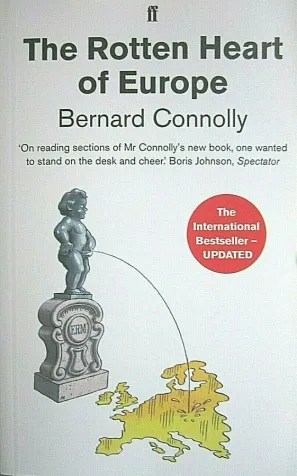
One of the first books I read that helped to explain how Brussels worked was Bernard Connolly’s ‘The Rotten Heart of Europe’, published in 1995. It was a massive hit (in the UK) and hugely controversial. Indeed, a second edition came with a cover recommendation from the then editor of the Spectator Boris Johnson (‘one wanted to stand on the desk and cheer’).  

The book did much to propagate Euroscepticism in British politics, and we might trace some of the roots of Brexit to it. With some irony, Brexit showed that the Commission can function in a forceful way when a crisis befalls it. However, as is well documented the challenge for the EC is to now step up a level and reinforce itself for a multipolar world where it will compete more acutely with China and the US, with at the same time Russia snapping at its heels.  

Connolly’s book came to mind a week ago when speaking at an investment conference. I was joined on a panel by economists and policy makers from Italy, Spain and Portugal, so that together we made up a representative group of the euro-zone periphery countries hit hardest (though Greece suffered the most) by the euro-zone debt crisis.  

Each of the periphery economies has had a remarkable turnaround – Italy is a bastion of political stability, Spain is the fastest growing of the large economies and Greece, Portugal and Ireland are arguably ‘too hot’ in terms of the rate of growth and price inflation they experience. What is telling is the signal from bond markets – yields for Italy, Spain and Greece for example, are below those of France and the UK, and Ireland is nearly on a par with Germany.  

In that respect, the tables have been turned. It is not forgotten how Angela Merkel and Nicola Sarkozy upbraided the lazy Mediterraneans in the 2010’s. Now, the three large countries at the heart of European history – the UK, France and Germany, are struggling, and to unkindly borrow Bernard Connolly’s title, constitute the ‘rotten heart of Europe’ 

They share common problems – sluggish, low growth, an inability to foster sustained private investment, political instability in the face of electorates who are in thrall to the easy solutions of populist parties. The reaction to last week’s triumph of the AfD (Alternative fur Deutschland) in Saxony-Anhalt is an example, and it may mean that Frederich Merz suffers the fate of Keir Starmer should his coalition collapse or his party cast him aside in favour of a younger leader.  

Though the tempo of growth is picking up in Germany, the UK and France, it will not rescue the leaders of the large economies. An additional complexity is that trading partners and allies are turning against them – China is exporting its manufacturing over-capacity to the German consumer and the special relationship that characterized US-UK diplomacy has all but withered away. The prospect that the White House might favour Argentina’s case for sovereignty over the Falkland Islands is a stunning case in point.  

Unlike France, the British and German economies suffer from a similar failure to upgrade their ‘production capital’ – investment in research, skills, new technologies and to an extent, manufacturing capacity. Both are behind France in terms of military power, but France is a leader in over-regulation. The fate of these three great nations has already inspired an endless flow of analyses, ideas and suggestions – the best of which from Mario Draghi, seems to be ignored.  

The sole thought I have to add, is that incumbent, centrist politicians in all three countries appear to ignore the increasingly obvious lesson that the rules of the geopolitical game have changed, and as we have referenced before in this note, we live in an ‘age of predators’, and consequently prey (Starmer). In this regard, new ideas are not the solution, but a change of method is. That method is more singular, less consensus led and aggressive. Edouard Philippe in France and Andy Burnham are its test cases, we will know by next May if they learn this lesson, and if not, Europe is in dire straits.  

Have a great week ahead, Mike  

Debt Purgatory

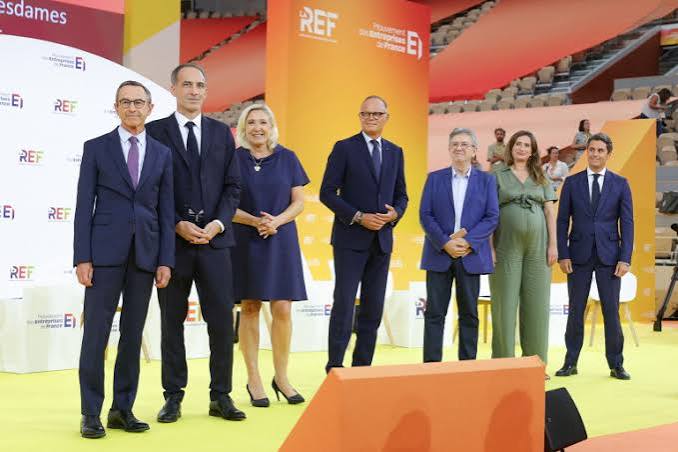
Roland Garros is one of the more stylish and elegant parts of Paris, and not a bad location to discuss finance and economics. Unfortunately, France’s political elite did not rise to the occasion. At the end of last week, (MEDEF), the large French business network gathered the principal candidates for the 2027 presidential campaign to listen to their views on the economy, and in particular their policies to pare back France’s gargantuan fiscal deficit and debt load. With a few exceptions, they disappointed.  

The candidates for the far-left (Jean-Luc Melenchon of La France Insoumise) and far-right, Marine Le Pen of the Rassemblement Nationale, appeared to treat the event as a light-hearted post-holiday chat show, and not a forum to debate the faultline that could pitch the euro-zone into another debt crisis.  

Though France’s presidential election is far off (the first round is on 18 April 2027), international investors need to pay close attention to it, both as a specific risk factor for bonds, foreign exchange and equities, and as a harbinger of what might befall most of the other major economies.  

In this respect, France has at least two things in common with the US. First, its weak finances. The budget deficit has been stuck at 5%, a level historically associated with a recession, and debt to GDP is on course to hit 120% according to the OECD. Second, there is no appetite to tackle this dire fiscal situation. In the US, there is little prospect of corrective tax hikes or spending cuts, and the Trump administration appears to have a fetish for intervening in markets.   

In France, three governments have been consumed by the process of setting a budget, and there is no political nor popular will to set France’s finances on a sustainable track. What is worse is that wild, populist suggestions that France could cancel the debt that the Banque de France holds (as a result of quantitative easing) are being aired in the media. France’s political class and populace are not known for their financial literacy, and the belief in some quarters that debt can be magicked away is dangerous and sets the economy up for a sharp reality check.  

Having witnessed the brutal effect of a debt crisis and the subsequent austerity on the Irish economy from 2010 onwards, French policymakers and its public are badly unprepared for what may come. Government spending at 57% of GDP is comparatively huge, and much of this goes on social welfare (healthcare and pensions).  

Unlike the US, France is not enjoying an AI capital expenditure fuelled wealth effect, and the notion that it might act to structurally boost economic growth is anathema to nearly all of its politicians. In a demonstration of moral hazard, France has accumulated debt at a pace and amount more than any other euro-zone country, without much protest from the ECB. 

Markets however, are reacting. French ten-year bond yields have just passed Italy’s. While long-bond yields in Japan, the US and UK have all broken higher to multi-decade highs, the re-rating of France is troubling. For international investors, France’s changing status, from a core, safe haven, to a periphery market is one of several signals of a coming debt purgatory – a long period where indebtedness dominates markets, government politics and geopolitics.  

For European policy makers, the fact that France is the indispensable nation on geopolitics, defence and military innovation complicates matters because it means that politically, in the context of German underperformance, France is harder to corral into a fiscal straightjacket in the same way the European Commission did with Greece, Ireland and Spain. On the European political stage, there is no-one fiscally credible politician who might stand up to France and avert the potential for contagion across the euro-zone.  

If for instance, both Melenchon and Le Pen make it through to the second round of the presidential election, bond investors will desert France, French bank share will collapse, luxury goods firms will become bargains, and the euro will likely fall. Bond investors will likely rush to the few safe havens the euro-zone offers – Germany, the Netherlands and Ireland as well as assets in ‘old’ periphery countries like Norway and Switzerland.  

More broadly, a continued rise in French yields, in the face of policy inaction (a draft budget is to be presented to parliament at the end of September), will for the first time in over a decade sensitize international investors to the credit risk inherent in government balance sheets. What is intimidating is that here France is in good company, most of the major economies, China, Japan, the UK and the US are as indebted as it is.