

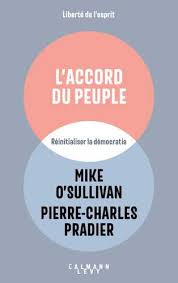
In February 2024 Pierre-Charles Pradier and I launched ‘L’Accord du Peuple’ (Calmann Levy), our argument to bring the apparatus of French democracy closer to the people, and in so doing avoid the stalemates and frictions that seem to convulse France. The book made the case for more participative democracy, greater power for regions, more transparency and accountability of local, regional and national budgets, and we also strayed into the debate on the corrosive influence of social media on politics.
A few months after the publication of the book, Emmanuel Macron’s party was handed a beating in the European elections and in a catastrophic unforced error Macron called a general election, from which he and his many governments have not recovered. During the hasty 2024 election campaign Pierre-Charles and I thought our moment had come but, it seems we had fooled ourselves, there is very little desire in Paris to surrender power to the people.
A lesson, for me at least, is that the roots of governance in France are deep and potentially go back to the medieval period – Paris is the citadel of power, where barons (Edouard Philippe’s ‘Dans L’Ombre’ is worth a read), ‘knights’ and janissaries serve and rise through the system. There is an intense homogeneity across those who populate the system, that is not found in other European countries like Germany. Though, in general as a process, the system works well, it struggles when it is required to change.
To that end, the notion that France is ungovernable (expressed widely in Anglo-Saxon countries) is wrong, it is over governed, and the system of the state excludes most French people. Recent changes to the political system, such as the removal of the ‘double mandate’ that ended a practice where local mayors could also serve as parliamentary deputies, have put more distance between local politics and Paris. Another observation is that France, compared to smaller European countries like Switzerland, Sweden and especially Ireland, is a very low trust country, and this element can make democracy harder to operate.
In that context, protests like the Gilets Jaunes reflected a view that the state is removed from the people. Since then, through the COVID crisis and the Olympic Games, there has been a remarkable degree of calm in public life, which has irregularly been punctuated by outbreaks of vandalism (e.g when PSG won the Champions League). Increasingly, what may once have been political protests, led and managed by unions, are now festivals of wanton violence, of which October 17th is an example. There is still a large cohort of commentators in and beyond France who over analyse and philosophize the reasons behind the vandalism but, there is a growing public consensus that it is reckless, dangerous and damaging to France.
It comes as France has entered a ‘debt purgatory’ (our Barrons article in August set this out), and when the 2027 presidential race is vigorously underway. The seemingly unassailable position of Marine Le Pen reflects both the discontentment of French people with Emmanuel Macron and the ‘establishment’, and relatedly a widespread view that immigration/identity/integration is a political problem that has not been addressed. The strength of this view is such that it ignores Le Pen’s suitability as a candidate, her lack of experience, economic illiteracy and the potential friction that a Le Pen presidency would cause across Europe. Yet, the presidential race is a steeplechase, with plenty of obstacles (recall that this time in 2016 Francois Fillon was the favourite to win the 2017 election).
A Le Pen presidency will surely deepen France’s burgeoning debt crisis, and very likely produce a market event such as a run on the French banks. Such an event may be necessary to convince the French public of the need for drastic reform of their economy. Denial of the extent of the fiscal challenge remains strong.
In this respect, what is striking across the political spectrum in France, is how nearly all of the candidates operate in a restrictive view of the French economy as a redistributive system (tax heavily to spend hugely). This perspective ignores France’s economic strengths in innovation, production and engineering, but also condemns the country to a future of low economic growth. A truly revolutionary, providential candidate, if one is to arrive, would focus more on a complete rewiring of the French economy, though to my earlier point, I suspect that the system may not permit that.
Those commentators looking in at France from afar and drawing the conclusion that the wrecking of the country is yet another expression of French exceptionalism are very wrong. The worrying aspect is that France is simply a showcase to the two problems that beset the world, indebtedness and a crisis of democracy (three is we include the side-effects of climate damage). The US, China, Japan and the UK are as or more indebted than France. Britain has had six prime ministers during the time Emmanuel Macron has been in power. American democracy is faltering, and Washington is dallying with autocracy.
The ways in which individual countries deal with these twin challenges are central to the idea that the world order is in an ‘Interregnum’ phase and will determine the winners and losers of the 21st century.
Have a great week ahead, Mike