


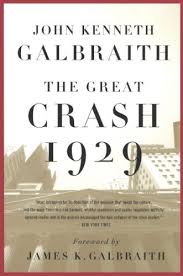
In my summer reading note (‘A Good Read’) an important omission was a couple of books by the celebrated economist JK Galbraith, the ‘Affluent Society’ which is relevant to the many economies struggling with low growth (e.g. UK, Germany), and ‘The Great Crash’, a text that will surely come in handy in the next twelve months.
In this book, Galbraith introduces the term ‘bezzle’ by which he means the rise in fraudulent financial activity as an investment bubble gathers momentum. A slightly different version of this is the rise of what we might call ‘non-traditional’ or opaque forms of financing as the asset bubble gathers pace.
One nuance of the bezzle, is that there is a moment of suspended financial animation, where the investor in the ‘bezzle’ feels rich, thinks he/she is a financial genius and at the same time the bezzle premium starts to accrue to the architect of the ’bezzle’. Falling economic activity and asset prices bring home the truth of the ‘bezzle’ to the investor.
Last week’s note on the intense financialization of the South Korean stock market gave a taste of the giddiness that is building around the AI capital expenditure boom. In this context, investment products, such as leveraged exchange traded funds and ‘single-deal’ special purpose investment vehicles in IPOs like SpaceX are ‘bezzle-like’, and it might be argued that new AI startups that raise capital at a high valuation are also bezzles, if not simply hubristic.
Now, activity in the bond markets and private lending segment is beginning to acquire a ‘bezzle’ premium. For example, last week six of the largest banks and private equity houses announced the creation of a USD 500bn ‘pool of capital’ for Nvidia, to facilitate the buildout of its AI infrastructure. The details of the deal are complex to say the least. This financing package will be considered ‘off balance sheet’, so it won’t immediately show up in Nvidia’s balance sheet, but it will bind the financial and AI industries more closely together (note that a chapter in the Galbraith book has the ironic title ‘In Goldman, Sachs we trust’).
What is interesting is that bond markets are starting to react. Bonds issued by the large AI firms, or ‘hyperscalers’, are beginning to trade at a higher yield, reflecting the market view that they are increasingly risky. For instance, spreads on the index of hyperscaler bonds are now nearly double what they were at the start of the year, and it is much the same for credit default swaps.
This is important in at least two respects. First, it signals that individually some of the hyperscalers (META and Oracle are often mentioned) are running down their cashflow rapidly and building up debt just as quickly. Second, the corporate sector is becoming indebted again (from modest levels), under the spell of AI infrastructure build.
This is concerning as we look towards 2028 (when in my view the AI capital expenditure boom judders to a halt) because public debt levels are already considerable, in fact they have never been higher across the major economies. To that end, public debt markets are also beginning to price in a riskier outlook (long dated bond yields in the UK, South Korea, Japan and the US are at or close to multi-decade highs). Rising real yields (inflation adjusted) tend to be a more cautious signal for markets. Equity markets appear not to notice, or care, but other asset classes like foreign exchange are also signalling trouble in the engine room (the joint US-Japanese intervention in the yen was a case in point).
The net economic effect is a sort of balance sheet ‘bezzle’, to stretch the analogy. In the US, households have never been more exposed to the equity market, and its rise is producing a marked wealth effect. Based on long run valuations, this wealth effect may be close to peaking though the psychic wealth effect remains strong. On the other side of the balance sheet, government debt continues to grow – one third of all the debt that has been issued by the US has come during the Trump administrations, and corporate debt is edging up as AI infrastructure spending gathers steam.
Have a great week ahead, Mike

