

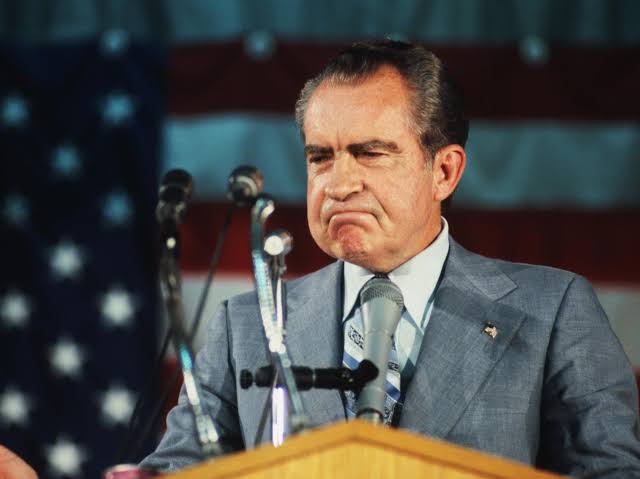
For much of the past fifty years, Richard Nixon, or Tricky Dicky as he became known, was held up as an example of one of the most dishonourable American presidents. In August 1974, Nixon, towards the end of his presidential term, resigned over the Watergate scandal, rather than face a near certain impeachment. The Watergate ‘Caper’ about which there is a very good, new film by Shane O’Sullivan (the cousin), involved a team of clandestine operatives linked to Nixon, breaking into Democratic party headquarters and planting evesdropping equipment. The revelation of the Watergate scandal made journalists Carl Bernstein and Bob Woodward of the Washington Post world famous.
Nixon wasn’t all bad. In the early years of his presidency, he enjoyed very high approval ratings. He, with the help of Henry Kissinger, opened up China diplomatically, pursued better relations with Russia, and ended the draft. Rankings of American presidents (from the likes of the Wall Street Journal, the Siena College Research Institute and C-SPAN) place Nixon on average in about 32nd place out of 47 presidents.
However, there is a strong view that his Vice President, Spiro Agnew, was one of the worst to hold that office. Agnew was known for his venality and had received envelopes of cash whilst in the White House. He is the only Vice President to have left office because of a criminal probe.
Apart from the release of ‘The Watergate Caper’ the reason we need to recall Nixon’s behaviour, is that it is a (low) benchmark that helps us understand how far standards in public life have fallen. Indeed, some weeks ago Vice President Vance stated that ‘If Watergate happened tomorrow, it would be a 12-hour news story”. Reflecting this, the USA is at its lowest point in the Transparency International Corruption Perception rankings, in 29th place (Denmark is the least corrupt country), and corruption is a topic increasingly taken up by commentators, Andrew Cockburn’s book ‘Washington is Burning’ and Anne Applebaum’s Atlantic magazine article ‘Empire of Grift’ are just two recent examples.
Last week, press freedom in the US took a hit and there are warning signs of a similar erosion in the rule of law within the US itself: the Department of Justice has terminated a record number of pending cases and grown notably lax on fraud, procurement manipulation and even criminal prosecutions, and UCLA’s Safeguarding Justice Project surveying elite lawyers, federal judges, political scientists and law professors, finds that the rule of law in America is at its weakest point in at least a decade.
What is dispiriting, is that few people appear to care that American politics is becoming more venal. For example, stock market investors track the share purchases of congressmen and women, who outperform the market with alarming ease. The coming mid-terms will also represent a test.
The other, related question we need to ask, is does it matter for the economy. In general, to parse reams of research from the World Bank, who produce an excellent database of indicators on the rule of law, governance and corruption, and whose regular ‘Governance Matters’ research papers are a worthwhile source.
There is a strong, positive correlation between factors like the rule of law and long-term economic growth. In particular, small, open economies (i.e. Singapore) are an example, and as a disparate group they have made a common cause and economic ‘recipe’ of their attachment to good governance, institutions and the rule of law. Also, award winning research, such as the book ‘Why nations Fail?’ by Simon Johnson and Daron Acemoglu, has helped to reinforce this view. In general, economists have found that corruption lowers growth by reducing investment, the higher costs and uncertainty arising from corruption cause investors to become more circumspect.
The most interesting cases though, are when countries change from being corrupt to ‘normal’, or vice versa. In the aftermath of the post communist era, Georgia made a concerted and now well documented effort to eliminate corruption, with initially impressive economic results. It now ranks 56th out of 182 countries in the Transparency International list, on a par with Greece, but a distance ahead of Russia (157th place).
Then, on the way down, perhaps the best example is Venezuela, a relatively stable, prosperous country up until the advent of Hugo Chavez. Hungary under Viktor Orban, and South Africa, are other convincing cases. None of these examples bode well for the US, where the damage to the rule of law is disguised by the hubris of the AI capital spending boom.
As a parting thought, I recommend readers watch Robert Redford and Dustin Hoffman in ‘All the President’s Men’, the best quote of which is ‘follow the money’.
Have a great week ahead, Mike

