
KOSPI Chaos

Apocalyptic stories are emerging of how retail investors in South Korea have made, and then quickly destroyed fortunes in the country’s stock market boom and bust and, we may soon learn that institutional investors, trading firms and banks have been damaged by the fallout. Korea’s Kospi index, which more than doubled from the end of 2025 to its mid-June peak, has collapsed by over 40% since then, with a one-day bounce of 18% at the end of last week.

The index has become an economic absurdity and its volatility (VKOSPI index) is greater than during any of the financial and economic crises of the past thirty years, the Asian crisis of the late 1990s included. There will be considerable damage to the South Korean economy, but so far, unlike the Asian crisis, there is relatively modest contagion across other markets (despite South Korea having rocketed into the top six equity markets in the world).

The absence of broad contagion is not an ‘all clear’ signal. Rather, South Korea is the latest, lurid event in an epidemic of speculation across the world, that is built on the financialization of real economy companies, assets and technologies. While South Korea’s largest technology firms, Samsung and SK Hynix, have become key elements in the AI supply chain thematic (specifically for computer memory), their performance has been wildly exaggerated by financial engineering.

Brokers have created leveraged single stock exchange traded funds on these firms and others, and in recent weeks, trading volume in these financial products has outstripped volume in the underlying stocks by a factor of four times. Option trading volume in Korea has exploded, as has the creation of warrants and structured products, again based largely on the memory stocks. Now, some 3x leveraged Exchange Traded Funds (ETFs) are down between 80 to 95% from their recent peaks. Of course, the majority of trading activity has come from retail investors in Korea, many of whom have used margin debt.

This might all be a bit of emerging market fun were it not for the fact that South Korea is emblematic of the global investment ecosystem, which is driven by the logic of AI capital expenditure but built on the increasingly wobbly foundation of financial engineering. As an illustration, LongView Economics, the independent strategy house, has constructed a ‘Speculative Fervour Index’, based on leveraged ETF activity, and it has risen sharply in the past year, coinciding with an all-time high in US household ownership of equities.

From that vantage point there are at least three serious policy concerns for the US and for American retail investors, if they choose to listen.

The first is a repeated transfer of risk from institutions to retail investors. Semiconductors was just the latest episode, following the SpaceX IPO and the rise and fall of silver and gold earlier this year. The day retail investors stop believing they can beat the market, they will be furious. US households have never owned more equities, wealth per adult has never been as high in America, and wealth inequality in the US is straining historical comparisons. Repeated shocks to households will soon have economic and political effects.

The second effect is the relation between investment and the economy. In an era where Carlota Perez’s (author of ‘Technological Revolutions and Financial Capital’) concept of ‘production capital’ is gaining traction, and where the rebuilding of industrial capacity in the US and EU is a necessity, the risk is that financially engineered investment instruments squander capital and misdirect it from economically meaningful investment projects. High stock market valuations may convince politicians that everyone is getting rich, but there is a serial misallocation of capital occurring before them.

This leads to my third point, which is the role of policy makers, central bankers and regulators. It used to be the case that market stability was a concern for regulators and central bankers, the South Korean authorities have been late to the scene of the fire. In the increasingly ‘regulation-lite’ environment of Wall St., the dominance of financial engineering (there are more ETFs than stocks now and option trading volumes continue to surge), the risk of sporadic volatility events, and, at some stage, a much greater unwind. It should also be a concern for Kevin Warsh, and this is just one topic he needs to be more forthright on. 

For their part, US investors have carried on where the Koreans have left off. In the past three trading sessions, options trading volumes have spiked, driving equities higher. A volatility ‘event’ may not be far off.

Have a great week ahead, Mike  
Contrarians and Controversialists

We spent a memorable New Year’s Eve on Dursey Island, one of the more remote parts of Europe, whose only point of access to the Irish mainland is by ‘Ireland’s only cable car’, where the principal safety device is a bottle of holy water. In 1602 Dursey was the scene of the massacre of some of the O’Sullivan clan. Some six hundred years before that, it was a staging post for the Vikings.

I am tempted to think that had the Vikings stayed the O’Sullivans could have escaped the slaughter of the Siege of Dunboy, but then again, always optimistic, I contend myself that Dursey – unlike the other Viking island (Greenland) will not attract the attention of the US Navy.

My intention this year is to be as least distracted as possible by the geopolitical strategizing of President Trump, but in the context of a far more ideological cabinet, his thoughts have consequences – not least for how they will encourage the enemies of America and the ‘west’ to behave.

For investors, political and geopolitical risks will likely play a much greater role in developed market asset returns than in any time over the past forty years, and the market reaction to Donald Trump’s victory offers them a wonderful opportunity to take a contrarian view and ‘spend American exceptionalism’.

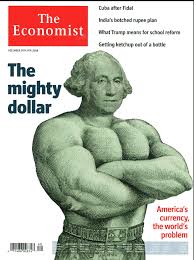
To explain what I mean by that, our starting point in 2025 is that an array of US assets trade at very high levels. Indeed, to recap a phrase I used in December markets are starting 2025 from the ‘wrong place’ in the sense that an enormous amount of capital is tied up in assets (the top ‘7’ technology firms, the dollar, corporate bonds) that trade at all time lofty valuations.

For instance, Bank of America estimates that the dollar is the most expensive that it has been since the early nineties, and valuations for US stocks are close to the highest levels they have reached since the late 1990’s. The top fifteen companies in the US are now worth the same as Chinese and European equity markets together.

Added to that, quite a few assets have exploded in value because of their proximity to Donald Trump – notably the crypto eco-system and Tesla (which has added USD 850bn in market value around the time of the election, an amount equal to the value of its ten nearest competitors).

There is not yet a bubble in the broad US market – many segments such as value stocks (high dividend companies) and small companies have not performed, but there is sufficient capital held in very expensive dollar denominated assets that it demands the attention and action of investors. 

Market analysts do not appear worried – in the time-honoured fashion the major investment houses have released their year ahead forecasts, which suspiciously all cluster around the 10% market, and equally suspiciously no investment house is forecasting a negative year for US stocks. This collective conclusion must have required great analytical power because an independent re-running of these same models points to flat or negative returns.

To that end, investors should take advantage of expensive dollar assets and diversify abroad.

They may be convinced to do so by two developments. The first is the collapse in long term US bonds since the Federal Reserve launched into a series of rate cuts from September onwards. In effect the bond market is signaling that it sees a resurgence of inflation ahead, and it is also likely flagging that the credit worthiness of the US may be deteriorating (in the sense that there is little prospect of the budget deficit and government debt being pared back).

Related to this, the second Trump administration begins in a much worse fiscal place as the first Trump government did in 2016. In the period 1960 to 2016 (with the exception of the Vietnam War) the US budget deficit has always followed the tempo of the business cycle (as proxied by unemployment).

That is to say that the budget deficit shrunk when the economy was strong (low unemployment) and it grew when the government spent more to cushion the effects of recession (high unemployment). 

Today, we have the opposite – unemployment is low and the budget deficit is very high. This implies three risks – that too much spending in a ‘hot’ economy creates inflation, that there won’t be any money left to ‘rescue’ an eventual recession, and that the rising deficit implies rising debt, which bond markets don’t like.

None of these risks, and rising bond yields, appear to worry the US equity and corporate bond market, but they should. A contrarian view might look to sell expensive dollar denominated assets and allocate overseas.

So my message to start the year is – don’t invade Denmark, buy its equity market.

Have a great week ahead, Mike