What Boris should say on Hong Kong

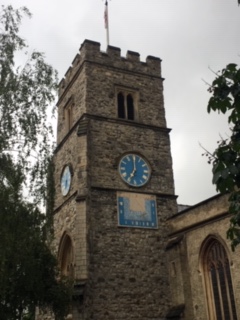
St Mary’s, Putney – site of the Putney Debates

I spent much of last week in London where in between meetings and torrential rain I managed to get down to Putney to pay homage to St Mary’s Church. Those of you who have read ‘The Levelling’ will at this stage know that the nave of St Mary’s is adorned with the following quote ‘For really I thinke that the poorest he that is in England hath a life to live as the greatest he.” It comes from Colonel Thomas Rainsborough, an officer and military hero in Oliver Cromwell’s New Model Army and a leading member of a group called the Levellers.

The Levellers were a prominent mid 17th century group who created the first popular representation of constitutional democracy in the form of their Agreements of the People. Standing in front of St Mary’s I wondered what the Levellers might think of today’s world and its bizarre goings on.

In particular two political events, or rather processes, might interest them – the election of the next Tory leader and by extension British Prime Minister, and protests in Hong Kong, both of which are watershed moments.

To start in Westminister, where Boris Johnson has taken the lead in the Tory leadership race, and with Jeremy Hunt or, my wildcard bet Rory Stewart, as the likely challenger to a Boris centric No. 10. The Levellers liked their politicians to be modest and honest as the following quote shows ‘by woefull experience found the prevalence of corrupt interests powerfully inclining most men once entrusted with authority’. In that respect they would eschew the cult of personality that has infected the Westminster circus.

The Levellers, being a practical lot, would also scratch their heads at the lack of really concrete policy proposals from the major candidates. They would also worry that the spectacle of Brexit has distracted so many in politics from the business of government and that as a result there has been a policy holiday whilst elected officials have engaged in three years of parlour games. This lack of policy leadership is now showing in infrastructure, crime and social cohesion and is an underlying risk for the UK in general.

In that respect most Britons have had enough of Brexit, many will think it can’t get any worse. They may be wrong. Once the Tory leadership contest is over the Brexit circus will start over again. When it does, the risk is that any forbearance the EU showed Theresa May evaporates, and that it takes a tougher line on financial services for example. This will come as little comfort to business people, workers and the Treasury.

One last thought on Brexit, which is that in my view Brexit is really a national crisis of identity that happens to have been channelled towards European politics. One sign of this crisis of identity is the lack of voice and diplomatic clout that Britain has with regard to the situation in Hong Kong.

I recall the television pictures of bowed head of Chris Patten at the handover ceremony in 1997, an image that perhaps said more about Britain’s place in the world than that of China (incidentally one of the interesting elements of the handover was a memorandum that Prince Charles authored on it – there are not many copies in circulation but worth a read if you can find one!).

Indeed, few of the Tory leadership candidates are willing to speak forcefully about the situation in Hong Kong at a time when many natives of the city regard the current protest as a vital test and perhaps the decisive one at that. For those in Hong Kong that I have spoken with, the culture, way of life and public life of Hong Kong are at risk of being subsumed.

From a markets point of view the reaction to protests in Hong Kong has been relatively muted and should remain so given that the extradition Bill has been delayed.  In the event that tensions rise again, the risks are high given that Hong Kong is the fifth largest stock exchange in the world, has probably the most overvalued property market and a currency peg. One might well argue that the economic and sentiment impact of Hong Kong being subsumed by China should be comparable to those of Britain leaving the EU.

Against this background, one news item to watch, beyond the US-China trade dispute, is a speech on US foreign policy (vis a vis China) by Vice President Mike Pence on June 24 at the Wilson Centre in Washington. The last such speech by Pence in October 2018 at the Hudson Institute was I felt, breath taking in its hostility to China, and there is a risk that ahead of the G20, we get a repeat of this.

As a last word, my sense at this juncture is that markets are vulnerable to a resetting of very dovish rate expectations by the Fed, to the realisation that the trade dispute between the US and China is a schism rather than a tiff, and that the earnings season sees recent macro weakness played out in profit and loss statements. Safe assets are very well bid – look at bunds and gold – risky assets are looking complacent.

Have a great week ahead

Mike

From the Banquet at Hongmen to Hong Kong

…as I was saying…regular readers of the Sunday letter will know that I have taken a break from it in recent weeks to recast the note around my forthcoming book ‘The Levelling’, and I hope that some will be happy it is back.

For those of you who are new to my list (please let me know if I should not have you on the list, or if you have colleagues or friends who would like to join it) I will send out a letter each Sunday morning (the one time people have a chance to read something) that mixes history, politics, markets, geopolitics and economics.

Given the intersection of these factors a good place to start this week is the Banquet at Hongmen, which occurred in China in 206 BC. In an age that is in Game of Thrones overdrive the story of Hongmen will appeal to many (indeed there is already a film about it called White Vengeance (2012)). In China, the tale is short-hand for duplicity and assassination and it featured in the Chinese press last week as part of the more popular response to President Trump’s tariff increase on China.

As an anchor point, ‘Hongmen’ serves a number of purposes that of course effortlessly dovetail into the themes of The Levelling. The first is that internal politics matter – Hongmen occurred at a time when the Qin and Han dynasties were contesting power. In this regard, for all that we hear today about the 2020 Presidential election campaign, we hear equally little about political debate within the Communist Party on topics like trade and relations with the USA.

Second, the cycles of the rise and fall of nations matter a lot. China has had many such cycles and America has effectively to complete a full cycle. Some may feel that this comes across in the bravoura of America’s interaction with other countries, but we should also bear in mind the context and patience that China’s history affords its leadership.

A third related point here is that China’s long history has given it a deep culture and sense of civilization. This is lost on some. Kiron Skinner a State Department official has recently tried to cast US-China relations as a ‘Clash of Civilisations’.  This is a lazy use of Samuel Huntington’s work. A better parsing of the situation is multipolarity, where the world moves away from globalization towards a system driven by three large regions (US, EU and China) who do things in distinctly different ways.

In this context, the trade dispute is a marker of China’s rise and the belated realization of America’s elite as to how it should curb this. Tariffs are not at all the apt tool. There are better avenues. For example, America is extremely powerful financially, in terms of the usage of the dollar, depth and centrality of its markets and the power of its banks. Indeed, one could argue that the US is more hegemonic in finance than it is militarily.

Another avenue is leadership in international rules and standards. Many new fields such as artificial intelligence, genetic editing and cyber war have grown so quickly that they have bypassed international laws, philosophies and norms regarding them. One challenge for the US is to take the lead in outlining new standards and laws in these areas. Unfortunately this is something it does not appear prepared to do, especially in areas like climate change. If anything the US is ceding soft power to China.

To jump to finance, the market view of the trade dispute is that some form of resolution will be forthcoming. The drop in volatility on Friday suggested that US markets are moving from being positioned for a risky outcome, to one that is more sanguine. Other Asia centric ones like the KOSPI index South Korea and the Australian dollar will need to strengthen in order to give the all clear.

If a trade deal is struck, it will mark the beginning of a formal rivalry between the US and China, the start of more ‘nation first’ patterns in consumption and corporate investment and the end of bodies like the World Trade Organisation. There may be many more flash points.

Here, many tend to focus on great naval battles of the future in the South China Sea. In my view, one looming touchpoint is Hong Kong, where there is a fierce debate ongoing around a proposal to permit the imprisonment in China of those sentenced by courts in Hong Kong. For a city-state with a very expensive housing market, dollar currency peg and large stock market, this may be one area where geopolitics again ripples through markets.  

Have a great week ahead,

Mike