


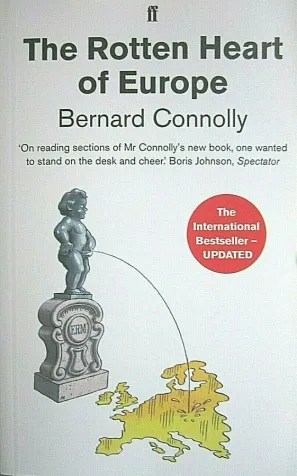
One of the first books I read that helped to explain how Brussels worked was Bernard Connolly’s ‘The Rotten Heart of Europe’, published in 1995. It was a massive hit (in the UK) and hugely controversial. Indeed, a second edition came with a cover recommendation from the then editor of the Spectator Boris Johnson (‘one wanted to stand on the desk and cheer’).
The book did much to propagate Euroscepticism in British politics, and we might trace some of the roots of Brexit to it. With some irony, Brexit showed that the Commission can function in a forceful way when a crisis befalls it. However, as is well documented the challenge for the EC is to now step up a level and reinforce itself for a multipolar world where it will compete more acutely with China and the US, with at the same time Russia snapping at its heels.
Connolly’s book came to mind a week ago when speaking at an investment conference. I was joined on a panel by economists and policy makers from Italy, Spain and Portugal, so that together we made up a representative group of the euro-zone periphery countries hit hardest (though Greece suffered the most) by the euro-zone debt crisis.
Each of the periphery economies has had a remarkable turnaround – Italy is a bastion of political stability, Spain is the fastest growing of the large economies and Greece, Portugal and Ireland are arguably ‘too hot’ in terms of the rate of growth and price inflation they experience. What is telling is the signal from bond markets – yields for Italy, Spain and Greece for example, are below those of France and the UK, and Ireland is nearly on a par with Germany.
In that respect, the tables have been turned. It is not forgotten how Angela Merkel and Nicola Sarkozy upbraided the lazy Mediterraneans in the 2010’s. Now, the three large countries at the heart of European history – the UK, France and Germany, are struggling, and to unkindly borrow Bernard Connolly’s title, constitute the ‘rotten heart of Europe’
They share common problems – sluggish, low growth, an inability to foster sustained private investment, political instability in the face of electorates who are in thrall to the easy solutions of populist parties. The reaction to last week’s triumph of the AfD (Alternative fur Deutschland) in Saxony-Anhalt is an example, and it may mean that Frederich Merz suffers the fate of Keir Starmer should his coalition collapse or his party cast him aside in favour of a younger leader.
Though the tempo of growth is picking up in Germany, the UK and France, it will not rescue the leaders of the large economies. An additional complexity is that trading partners and allies are turning against them – China is exporting its manufacturing over-capacity to the German consumer and the special relationship that characterized US-UK diplomacy has all but withered away. The prospect that the White House might favour Argentina’s case for sovereignty over the Falkland Islands is a stunning case in point.
Unlike France, the British and German economies suffer from a similar failure to upgrade their ‘production capital’ – investment in research, skills, new technologies and to an extent, manufacturing capacity. Both are behind France in terms of military power, but France is a leader in over-regulation. The fate of these three great nations has already inspired an endless flow of analyses, ideas and suggestions – the best of which from Mario Draghi, seems to be ignored.
The sole thought I have to add, is that incumbent, centrist politicians in all three countries appear to ignore the increasingly obvious lesson that the rules of the geopolitical game have changed, and as we have referenced before in this note, we live in an ‘age of predators’, and consequently prey (Starmer). In this regard, new ideas are not the solution, but a change of method is. That method is more singular, less consensus led and aggressive. Edouard Philippe in France and Andy Burnham are its test cases, we will know by next May if they learn this lesson, and if not, Europe is in dire straits.
Have a great week ahead, Mike

