Battle for Budapest

In the days before what is now known as the Iran War, and amidst the horrific suppression of its citizens by the Iranian state, a Dutch diplomat, having arrived at Tehran airport, was stopped and asked to disclose the contents of his luggage. He refused, citing diplomatic immunity, and left Iran, leaving his luggage behind. A subsequent inspection of the luggage in the presence of another Dutch diplomat, allegedly revealed three Starlink modems and a number of satellite phones.

It is not at all clear whether the devices were for ‘personal use’ or for the benefit of Iranian dissidents, but the incident reminded me of the efforts of George Soros to export hundreds of photocopiers into communist Eastern Europe in the late 1980’s and early 1990’s, so that dissident texts could be copied and circulated.

This was the very tip of the iceberg of Soros’ funding of the pro-democracy movement in Eastern Europe, and at one point it was said that he gave more in aid than all the Western governments together. In particular Soros, who studied under the philosopher Karl Popper (author of ‘The Open Society and its Enemies’), was committed to creating an ‘open society’ in Hungary, the country of his birth, and established the Central European University (CEU) in Budapest in 1991. 

Around the mid 1990’s I recall Bill Newton-Smith, a philosopher and Fellow at Balliol College and associate of Soros leaving England to help run the CEU. As he left Oxford, a young student activist called Viktor Orbán had come the other way (in 1990 I think), to begin a research fellowship on the topic of civil society in Europe, sponsored by the Soros Foundation.

Orbán didn’t last long at Oxford, returned home to become a member of parliament and the leader of the main liberal party Fidesz. Orbán has been a central figure in Hungarian politics since then, but in the late 2000’s, underwent a political and moral transformation. At a conference in Prague some years ago, I spoke with a few entrepreneurs who had been early associates of Orbán’s, and who had suspicions as to the motivation behind his change of tack. 

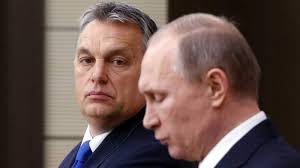
This change pivoted on his relationship with Soros, who Orbán has transformed into a figure of hate for the far-right internationally. Equally, Orbán flipped his view on Russia. He had been highly critical of Russia’s 2008 invasion of Georgia, but soon after, following a visit to St Petersburg to meet Vladimir Putin, Orbán started to change his stance on Russia.

For much of the past sixteen years, Orbán has commanded a large amount of popular support, though his actions and attitude in going against the grain of the EU have cost Hungary – in the last fifteen years, Hungarian GDP growth has lagged that of Poland by 0.8% per annum, tens of billions in EU aid has been withheld, and corruption has become institutionalised under Orbán. Budapest has become a staging post for the Russian security services and teachers, women, judges, amongst others have suffered in ways they would not expect in a normal European country.

In this context, the general election in Hungary (April 12th) could become a critical turning point, and is highly important for the EU. At a broad level, polls point to a victory for Peter Magyar of the Tisza Party, with the majority of the opposition parties in Hungarian politics having swung behind him. However, in the context of extensive gerrymandering, a propensity for ethnic voting groups (Hungarians living abroad and Roma in Hungary) to tilt toward Orbán, and the capture of state institutions and budgets, the outcome is highly uncertain.

Not only is Orbán an ally of Moscow (Orban’s team has been accused of leaking confidential EU discussions to Russian officials, and Orbán holds frequent meetings with the Russian foreign minister), but he has become the darling of the international MAGA movement. Orbán’s campaign been endorsed by Benjamin Netanyahu and Donald Trump, Marco Rubio visited Budapest in mid-February and vice president JD Vance will travel there on April 7th, just before the election.

There are already allegations of impropriety and vote rigging against Orbán, in what will be a hotly contested election, and deep suspicion of social media influence by Russia, not to mention the support of the White House.

EU leaders fear a close election or that Orbán, having lost the vote, will use his remaining days to change laws and appointments to key institutions. The example of Poland is being mentioned, where on taking power Donald Tusk faced years of difficulty in removing hard-right opponents from media and other institutions. 

As such, the EU will have to invest enormous time, energy and capital in remaking Hungary. The short-term gain for the EU will be the absence of the Hungarian veto on European foreign policy stances, notably so in the case of Ukraine.

Should Orbán win, or continue to contest a close vote, a more existential issue faces the EU that will centre around a gathering debate on how to further sanction and potentially expel an EU member that is steadfastly recalcitrant.

Lurking behind the election, is a deeper foreign policy issue for Europe, in the context of several major wars and the disintegration of NATO, the need to combat more fiercely interference in the democratic processes of EU member states.

Have a great week ahead,

Mike 

Mars, Venus or just lost in space?

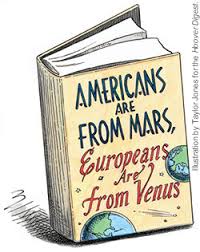
Two recent events have me thinking of a 2003 book by the international relations expert Robert Kagan, entitled ‘Of Paradise and Power: America and Europe in the New World Order’, which started life as a 2002 article in Policy Review. In the foreign affairs world, the book is known colloquially as ‘Mars or Venus’, because the opening sentence goes ‘Americans are from Mars and Europeans are from Venus’.

Kagan’s aim was to explain that Europe and the US had very different views of the world, and that these differences were rooted in culture, history and aims. Europe is the older, wiser and more genteel continent, concerned with roping its social democracy in well made rules, whereas the relatively younger American republic (250 years old this year) was more muscular, in military and financial terms. Kagan’s book, in keeping with the reception given to Francis Fukuyama’s ‘The End of History’ and more recently Graham Allison’s ‘Destined For War’, is better known for its strapline than the detail of its argument, but then again that is the art of the successful author, and one that in comparison, few European international relations experts have cracked.

That, in 2002, Kagan felt the need to state that Europeans and Americans are different, betrayed the long-held sense that they are the same people, in the sense that in 2002, the vast majority of Americans could trace their family history back to Germany, Ireland, Britain and France (in 1960 some 85% of foreign-born Americans were from Europe in vs 10% today).

That much was also clear during the many events in Washington to mark St Patrick’s Day. President Trump invoked his own European heritage (Scottish mother, German father), teased Speaker Mike Johnson as to whether he was a WASP or Italian, whilst Taoiseach Micheal Martin told how a Cork man, Stephen Moylan, a senior officer in George Washington’s staff, is credited with the first use of the phrase ‘the United States of America’ in 1776.

In that context, the ‘Mars and Venus’ argument is ever more relevant today as the divide between Europe and its American cousins widens. While European countries wholeheartedly supported the US in the 1991 Kuwait War (see our recent note) and in the aftermath of 9/11, the doubts that many European governments had over the 2003 invasion of Iraq partly motivated Kagan’s book (the film ‘Quai D’Orsay is very good in this context).

In that context, the polite refusal of nearly all of America’s allies, not just in Europe but also the likes of Japan and India, to send ships to the Strait of Hormuz, is emblematic of a deepening divide, and in recent weeks a good number of American friends have reached out to ask ‘is it us, or is it you?’. My polite response is that ‘it’s the White House’ (noting that most Americans are against this war), but more broadly I feel that one of the great anomalies of our time is that so few Americans realise the damage that is being done to America’s reputation abroad.

So, one might argue that Kagan’s ‘Mars-Venus’ short-hand for international relations has never been more true, and the fact that Europe has done little in the past twenty years to bolster its security, and to deepen its financial markets, gives some weight to American frustration and derision. Equally, the vandalization of shared values (democracy) and institutions (NATO, the United Nations) by the White House causes horror across European capitals.

Yet, at this painful point in trans-Atlantic relations, I wonder if we have reached peak ‘Mars-Venus’, in the context that Europe today is still quite like it was in 2003 in terms of world view, whereas the US is politically and socially very different to that of 2003.

My reasoning is that Europe is finally having the ‘neo-con’ moment that the US went through in the early 2000’s (Robert Kagan was part of that movement), and is starting to rebuild its defences, though it lags badly on capital markets union (now Investment Savings Union).

Oddly, Europe no longer shares the same enemies as the US. Russia should be the prime concern of European security chiefs. It is also troubling that the Trump administration actively supports far-right parties like the AfD in Germany, and the few European nations who side with the Kremlin (VP Vance visits Hungary next week).

As such, Europe’s path and challenge is clear – to remain the sole liberal democratic pole in a disordered world. When Robert Kagan wrote his book in 2003, the natural assumption was that American democracy was a beacon for others to follow, as far as Asia and even across Eastern Europe (Kagan’s wife Victoria Nuland was a senior American diplomat serving in Eastern Europe during ‘the Maidan’ in 2014, where her most famous utterance was ‘f@#k the EU’).

Yet, America’s democracy is now in deep trouble, and one of the sharpest critics of Donald Trump’s approach is Robert Kagan, who warns of the descent towards a dictatorship.

It will be over by Christmas

Mon centre cède, ma droite recule, situation excellente, j’attaque

At the First Battle of the Marne, not so far from Paris, in September 1914, Marshall Foch sent the above, inspiring communiqué to Marshall Joffre (‘my centre is crumbling, my right is retreating, the situation is excellent, I attack!’). The Battle of the Marne was arguably the greatest land battle of the twentieth century and caused over 500,000 casualties. Its strategic effect was to halt and reverse Germany’s lightning attack across France towards Paris and set the scene for years of entrenched warfare. At the time, the Great War was some three months old, and many thought that ‘it will be over by Christmas’.

There are few parallels between the First World War and the Iran War, but there is a creeping feeling that, in the absence of a clear strategy from the White House (see last week’s note ‘Safe Places’), there is a risk that this conflict becomes entrenched.

It is already very costly. In the first week of the attack on Iran, the US apparently spent close to USD 11bn on weapons and munitions, and that is without calculating the human and economic costs. In the context of record public indebtedness, the question is not so much can America win the war, but can it afford it?

Indeed, it seems largely forgotten now that America’s own wars have been associated with indebtedness. That the American Revolutionary War was financed mostly by the French (Lafayette and Beaumarchais), Spain and the Netherlands – indeed in a lesson for policy makers today, Congress had to print money to pay off these loans, which had the effect of causing rampant inflation and devaluing the dollar.  It’s also worth flagging that the American Civil War saw a sharp run up in debt (US sovereign debt in 1865 was 40 times what it was in 1860, according to figures from the Treasury), the consequence of which was a collapse in the dollar, again.

Still, the lesson that wars generally strain finances, seems to have been habitually forgotten.  Some might recall that Larry Lindsey, an economic adviser to George W Bush’s administration left his job after producing what at the time was considered to be a high estimate (USD 200bn) of the costs of the second Iraq War. It turned out to be a conservative estimate, as the Congressional Budget Office put the cost of the war at USD 2.4bn and other analysts have put the total cost at closer to USD 5bn.

Equally, Britain and France are fascinating in many ways – they have very old and rich economies and together have been involved in most wars going back to at least 1000 AD. Britain is a nose ahead of  France in that there is arguably a longer thread of data available about its economy, and it is very well curated by the likes of the Bank of England and the Office for Budget Responsibility, whose note on ‘300 years of public finance data’ is a must read for aficionados of economic history.

If I could sum up those 300 years of data it would be to state that wars drive indebtedness, and then indebtedness itself drives fiscal reform. Between 1700 and 1800, debt to GDP in Britain rose from 25% to close to 200%, during a period that was marked by wars over the Spanish Succession, the Austrian Succession, the Seven Years War, the American War of Independence and of course the Napoleonic Wars (after the French Revolution). As a rough rule, British participation in the many and varied wars of the 18th century led to spikes in defence spending of up to 10%, whilst the more deadly world wars saw defence spending push beyond 50% (of GDP).

More broadly, the Kiel Institute has created a database of conflicts going back over the past 150 years that measures the economic costs of war and they have used this to create a model that scopes the potential economic costs of war scenarios. Though quite chilling in its consequences, their interactive tool is useful, and I recommend it to the White House.

For example, I input a scenario (based on 2023 economic valuations) for a war that takes place in Taiwan and also in China (assuming a dramatic US riposte). The direct economic and capital damages are well into the USD 20 trillion, and that is without counting US military losses and the disruptive effect on world trade, risk appetite, and financial market collateral damage.

So, not only do armies march on their stomachs as Napoleon hinted, but also on their balance sheets.  In this alarming context, geopolitical ‘players’ have two pressing needs. One is to build out their military capabilities, and the other is to reduce debt – in part to allow them the fiscal space to be warlike. With the US now spending over USD 100 bn more on interest payments on its debt than on its military, it is living a strategic contradiction.

Have a great week ahead, Mike 

Persepolis

In October 1971, a time when Mao ruled China, Brezhnev was in charge in the USSR and Nixon president of the USA, Maxim’s, the famous Parisian restaurant closed for two weeks so that staff could prepare the restaurant’s greatest order – the feast organised by the Shah of Iran to celebrate the 2500th anniversary of the establishment of the Persian empire by Cyrus the Great.  

The Shah’s celebration became known as the greatest party of all time (Life magazine called it ‘the party of the century’) and became highly controversial for its lavishness. For instance, nearly 300 red Mercedes were used to ferry guests around a large, tented city and in the end Maxim’s and other establishments sent some eighteen tonnes of food to Iran. Waiters had to open and taste all of the bottles of Chateau Lafite Rothschild 1945 for poison. Many of the world’s royal families attended, as did a range of social and political figures from Grace Kelly to Tito to Haile Selassie, to Imelda Marcos. It’s perhaps no surprise that this display of excess was followed a few years later by the Iranian Revolution.

The spectacle of the Shah’s party, his ties to foreign governments and the cruelty of his secret police and a drawn-out recession contributed to months of protests in the late 1970’s, which then led to the Revolution. One of the best accounts of the Revolution is a somewhat accidental one – Desmond Harney’s excellent eyewitness account of the revolution “The Priest and the King.” At the time, Harney worked in Tehran. He had been ready to leave Iran on vacation, but for work-related reasons he remained, and then witnessed the eruption of the revolution around him.

My other Revolution-related thought is of former Ayatollah Khomeini, who, on disembarking the Air France aircraft that took him back to Tehran on the outbreak of the revolution, was asked by ABC anchorman Peter Jennings how he felt about his return to Iran. “Nothing. I feel nothing,” was the alleged response. It gave a pointer as to the austere image Mr. Khomeini wanted to portray and of his cold single-mindedness. The fact that the man who translated Khomeini’s comments, was executed three years later, was another clue as to what would follow.

The regime that Khomeini created has outlasted many others – perhaps only the late Fidel Castro and especially so the late Queen Elizabeth II of England have seen as many US presidents, German chancellors, among others, pass on and off the world stage. While Iran has until recently been a dominant player in the Middle East from a geostrategic point of view, it has, to be polite, not been an economic success.

Thus, in keeping with the template of revolutions, high prices, scarcity of food and fuel, and a broken economy, are triggering protests across Iran, that have become so vast, that expectations are growing that Iranians may eject their leadership. That moment may not be too far off, but the path to an Iran that benefits its people remains a difficult one.

Not only are its geriatric rulers stubbornly cut off from its people and the outside world, they have historically, to a worrying extent (this was especially the case under former prime minister Mahmoud Ahmadinejad), relied on heightened tension with the US, Israel and other ‘enemies’ for political oxygen. Also, economically, Iran is like Russia in that most of the assets and resources in the economy are held by a small number of people (IRG, business owners, clerics) who form a sclerotic elite around the theocrats. Breaking their hold on the economy will be difficult, even under a new regime.

Neither is regime change obvious. The name of the Shah’s son Reza Pahlavi is circulating widely (in the West) as a possible figurehead, but the story of the ‘greatest party’ and the memories of his brutality are at least two reasons why he will not lead a ‘new’ Iran. At the same time, it is not obvious what individuals or groups might replace the regime, if it came to that.

A further complication is that Iranians are highly distrustful of interventions from abroad, indeed some people joke that Iran is the only country in the world where MI6 is still considered to be a force to be reckoned with. Military intervention by the US or other states may not be welcome.

The EU is slightly less distrusted than the US and the UK, and it should take a more active stance – in terms of further sanctions, asylum for the hundreds of young people who have been jailed, organise the supply of communication technology into Iran (VPN’s, satellite technology), and potentially begin to plan to assist and shape a transition process.

Iran has been weakened economically by sanctions, humiliated by Israel and had its military capability enfeebled but sadly, the state still has an array of resources with which to repress its people.

My sense is that the brutal repression in Iran will continue now (with very little visible public support in the US and Europe), and the economy will weaken further. An opening may come when the Supreme Leader, Khamenei dies – he is 86 and suffers from cancer. This event could provide the cover for a discrete but meaningful shift in policy, and the start of negotiations on sanctions and Iran’s nuclear program, and the beginning of a more promising era.

Have a great weekend ahead, Mike

A Land Full of Vibrancy and Hope

Avid readers of the ‘Levelling’ book will know that some years ago, I wrote

Latin America remains part of the satellite region of the US pole. Sadly, it has been overlooked by Washington. The prime example of this neglect is Venezuela. The country is failing and in the grip of an underreported humanitarian crisis. Economically, this crisis may lead China to take a deeper role in Venezuela and in its oil production. Diplomatically, the lack of a comprehensive reaction from Washington brings to mind an article entitled “The Forgotten Relationship” that Jorge Castaneda published some years ago in Foreign Affairs in which he bemoaned the deteriorating relationship between Latin America and the United States.

Finally, my pleas are heard, and the White House is organizing a rescue (by gunboat) of Venezuela, and possibly much of Latin America.

While it is hard to know how the new engagement between the Trump administration and the fifth largest repository of oil reserves is going to play out, this administration is different to many of its predecessors in taking an active interest in Latin America – note the partisanship with regard to Brazil, generally good relations with Mexico, a chumminess with Milei and the likely support for the new president of Chile.

Despite very active backchannelling between the US military and the Venezuelan army the course that events might take is unclear, and laden with risks – the chaos of popular unrest in Venezuela, the risks that criminals in Venezuela and surrounding countries become involved (and strike in the US), or indeed the risk that other actors or countries use any regime change in Caracas to hurt the US, cannot be ruled out. Another risk is that some of Venezuela’s allies – Iran, China and Russia – become obstreperous, and dig in with Maduro and his cohorts, or that they use any change of government in Caracas to further their own ends. It is worth noting that only last week China launched a policy document entitled ‘Latin America and the Caribbean: A Land Full of Vibrancy and Hope’.

This is a significant risk of the Trump administration’s fetish for a spheres of influence motivated foreign policy. In the recent school boyish ‘National Security Strategy’, which has caused great anguish in the diplomatic parlors of Europe, the document refers to the ‘Trump Corollary’ to the Monroe Doctrine.

For context, the Monroe Doctrine was likely the first coherent, muscular expression of American foreign policy – at the time it was aimed at keeping the Spanish and other pesky European powers out of Central and Southern America. Indeed, the dithering by the large European powers (notably France) over the long running Mercosur trade agreement, suggests that the European dare not go back to Latin America.

The NSS document gives a good deal of attention to Latin America, and this tilt will have the active support of Secretary of State Marco Rubio. Like it or not, Latin America is now in Washington’s sphere.

However, more generally, the establishment of a spheres of influence mindset in international relations may give the likes of Russia and China the sense that they may do as they wish in their own spheres of influence. In the same way that the invasion of Iraq, on the basis of flimsy evidence of weapons of mass destruction, apparently led Vladimir Putin to believe that the West was no longer respecting the rules of the international order, the ‘Trump Corollary’ strategy is a green light for bad policy actors.

That would of course be bad news for Taiwan, and perhaps Vietnam, the Philippines and Japan, who all to some extent count on the notion of a US security guarantee for Taiwan. It may also prove confusing for the US military which, when not loitering off the coasts of Cuba and Venezuela, is organized around the concept of a grand battle in the South China Sea.

Beyond the obvious implications for Ukraine, there are plenty of other open questions – will China take the ‘Stans’ from Russia, and who gets Africa? Russian mercenaries have forced France out of at least seven countries and China has a hand in nearly every African economy. The cancellation of US AID is already having deadly consequences for human and animal life.

A world of spheres of influence might conjure the diplomacy of the Great Game, but it would leave many countries worse off, and the nondemocracies of the world free to abuse their military and economic power.

A forlorn reminder of this was the jailing of Jimmy Lai, the Hong Kong democracy activist last week. Few Western governments were audible in protesting this act, save Britain, which used to count Hong Kong as part of its sphere of influence (Lai has British citizenship). The silent snuffling out of democracy in Hong Kong is the act that brought the curtain down on globalization in my view. An American spheres of influence foreign policy will sow further chaos. 

Have a great Christmas week ahead, Mike (there won’t be a note next week, we return on the 4th January)

The UnRavelling Rule

Amidst the slew of corporate earnings and macro-economic data released in the past week, two developments struck me, both of which give the impression of the tectonics of geopolitics pushing against each other.

First, in the past year the number of children born in the US has caught up with the EU, at close to 3.6 million babies each (though the EU has a much bigger population). For comparison, Nigeria – whose population is less than half that of the EU – welcomed 7 million babies last year.

Second, in recent months the trend rate of consumer inflation in Japan has surpassed that of the US for the first time in decades, signalling a long awaiting shift in the Japanese economy that has been accompanied by a rise in long-run bond yields (a potentially critical development for the international financial system).

These two examples will give a sense of the rise and fall of nations, that is accelerating since the fall of globalisation (which I date to the effective end of democracy in Hong Kong). This rise and fall – think of countries like football clubs – is also associated by an unravelling of the world order. For example, in a recent note ‘Atlas Shrugging’, we detailed how the independence of the Federal Reserve was being undercut by the White House, and the attempt to remove Lisa Cook from the Fed’s rate setting committee confirms that Donald Trump wants to direct the Fed as an engine of his economic policy (as a giant bond buying machine I suspect).

The independent Fed has been one of the pillars of the globalised world system of the past forty years – and the snuffing out of its independence heralds the unravelling of that system. In the same way that the period of globalisation was characterised by low inflation and the absence of major wars – the presence of inflation and conflict today, is a sign that we are moving into ‘something else’.

In that context I find myself playing a mind game which I call the ‘Unravelling Rule’. Very simply, it is to identity the principal factors that have supported globalisation and that are positive outcomes of it and identify if and how they are unravelling. The crisis of democracy is one such trend (the Economist Intelligence Unit’s Democracy Index has fallen to its lowest level in twenty years).

Other certainties are also unravelling – notably the assumption that the USA is an unflinching ally of Europe and many Asian countries, and the possibility that it could even actively undermine them. In this regard, the fact that the Danish government had to summon the US ambassador over the conduct of three Americans in Greenland is troubling and reflects very badly on the White House.

The danger with the ‘Unravelling Rule’ is that in a chaotic world, it is tempting to see unravelling everywhere. It is more obvious though in the case of world institutions – the United Nations, IMF, World Bank and World Trade Organisation, who are frequently ignored by the very large economies, and sometimes badly undermined by them (the WTO is an example). These institutions need to be recast, most likely for the benefit of the populous emerging economies.

On a more speculative basis, there are at least four trends that have marked the past forty years, and that are now worth watching for a change of course.

The first is poverty. It is an underestimated facet of globalisation that it helped a billion people rise out of poverty, according to the World Bank. My concern is that in a world where the major economies (2/3 of the world’s GDP) have debt to GDP ratios above 100%, economic precarity may return, and this time to developed countries. We have already noted (The Road to Serfdom) the extremely high level of inequality in the US and broad economic vulnerability. In Europe, British and French policymakers conjured the spectre of IMF intervention in their economies (it would have to be a new, bigger IMF – which under this White House is unlikely). In that respect the growing disparity in incomes in the UK regions (relative to London) bears watching.

A second is corporate governance and the rule of law as it extends to international business. We have not seen a rule of law or broad governance crisis in sometime, but the rise of decentralised finance (i.e. crypto), the new idiom of the ‘art of the deal’ in the US, and the geopolitically tinged trade relationships that China is developing worldwide. As a global ‘way of doing things’ gives way to more regional or localised approaches, the watertightness of contracts and the oversight of business relationships is something that businesses will need to consider more carefully.

A true litmus test of the ‘Unravelling’ hypothesis will be the role of US multinationals in the world economy. Described as the ‘B-52s’ of globalisation in the late 1990’s by a prominent trade economist, they have shaped the world economy and come to dominate financial markets. I have lost count of the number of charts circulating that declare that Nvidia for example is worth more than the major European stock markets together. Whilst cash rich, they now face a number of challenges – the difficulty of selling into China as it broadens its technological self-sufficiency, and the collateral damage to overseas sales from the Trump trade and foreign policies, and the rise of more specific local tastes in markets like Africa and India.

A final unravelling, and one I would welcome, is for the EU to unleash its nasty side. In the past forty years the successes of the EU – enlargement, holding the euro together and the creation of a European identity (based on borderless travel the Erasmus programme for example). The likes of Poland and Estonia have benefitted greatly from this, and it is fair to say that the UK would be better off ‘in’ than ‘out’. But the emphasis has been largely on soft rather than hard power, and in a ‘harder’ world, the EU will need to take a tougher stance in terms of how it projects itself. 

There are many challenges but three in particular are the potential exclusion of existing and prospective member states like Hungary and Serbia who habitually refuse to act in accordance with EU values and interests, a specifically more aggressive approach to countering sabotage by Russia (and at times China and Iran) in Europe, and then a retaking of the narrative as to what Europe stands for.

Have a great week ahead,

Mike 
The Policeman Premium

I vividly recall seeing Imran Khan give a speech in the mid-nineties, in an era where many sportsmen had what was described as colourful backgrounds he stood out as particularly ‘Bond’ like – at the very top of his game as a cricketer and a ‘playboy’, as the saying goes (at the time he was engaged to Jemima Goldsmith). There are few people who have had such adventurous lives – and Khan’s is interesting for the ways in which he changed tack – towards Islam and politics (he served as Pakistani prime minister from 2018-2022) and his change of fortune (he is currently in solitary confinement in a Pakistani prison).

Whilst Khan’s rise and fall is complex, he ultimately fell foul of the Pakistani security establishment who allegedly became uncomfortable when Khan condemned foreign (US) influence in Pakistani public life. Khan was also the victim of an assassination attempt in 2022, something that has marked Pakistani politics (Benazir Bhutto was assassinated in 2007 and her father Zulfikar was executed in 1977).

In this regard one of the few constants in Pakistani politics has been the ever-present role of the security services in the affairs of the state, and specifically their tactic of creating private armies and terror groups. This has embarrassed them on at least two occasions – the discovery that Osama bin Laden was living in near plain sight in Pakistan and repeated attacks by the Taliban inside Pakistan. Add to that the 2008 Mumbai attacks perpetrated by Lashkar-e-Taiba, and the sense grows that Pakistan has been playing a dangerous game.

In this regard, India’s response to the killing of 26 people in Pahalgam (in Indian controlled Kashmir) took aim, it said, at terrorist infrastructure, in the most serious escalation between the two countries since the very early 1970’s. The subject of this note is not to predict how this conflict will play out – it could be costly, bloody and messy (India has reportedly lost five jets in its initial sortie) but to wonder why this confrontation is happening now and how much of this has to do with the alliances that the two countries have struck.

While India and Pakistan are both members of the Shanghai Cooperation Organisation, Pakistan is the much more active member and very close to China, Iran and Russia. While a lot of Indian hardware comes from Russia, its foreign policy projects the country as an independent actor, India is aiming for a close relationship with the US with whom it may sign a very high level trade deal (it has just completed a modest trade agreement with the UK).

It is very likely that in a different diplomatic regime the Pahalgam attack would have been met with intensive diplomatic engagement by the US, with India whom it regards as an ally and Pakistan, which it funds generously. This has not happened this time, and the tempo of involvement of the White House in this particular regional conflict has not been on a par with other administrations. It is so poor that vice president Vance has declared, in a most un-Kissinger like manner, that ‘it is none of our business’.

Indeed the recent death of Joseph Nye, the political scientist who developed the term ‘soft power’ and who wrote much about America’s engagement with the rest of the world is a reminder that one of the key elements in the old, globalised world order was America’s role as a policeman – with a near monopoly over deadly force and a very active, alert diplomatic corps. An example of this can be found in Brad Hope and Justin Scheck’s book ‘Blood & Oil’ that describes the rise of Mohammed bin Salman as the ruler of Saudi Arabia. For decades the US has steered Saudi diplomacy, and Saudi rulers have guided America in the region. However, the book describes in some detail the lack of strategic direction of the first Trump administration in the military and diplomatic affairs of Saudi Arabia, beyond the organisation of a lavish welcome ceremony for a Trump visit to the Kingdom.

The second Trump administration looks set to entirely do away the role of world policeman, and cynics might say, replace it with the role for rent collector. As such, the geopolitical risk premium will rise, and may help to explain why there are at least two conflicts where basic needs (water) are being weaponised (in Gaza and India/Pakistan). When it played the role of world policeman, the US kept the peace, much to its own advantage.

Now in the context of the very obvious dropping of moral guardrails around international relations, other countries will be less bound by a sense of world order, emboldened by an arms race, and will start to take risks and make mistakes. India-Pakistan is a very dangerous case of this, and one that draws into focus the trade-off between the cost to America’s role as world policeman, and the global ‘peace’ dividend it brought.

Grasshopper

I had intended to write about universities this week but, strolling through the City of London, I was surprised, shocked even, to find myself on Trump Street, and then amused to see that it is joined by Russia Row.

My first thought was that this was part of a grand plan by the British establishment ahead of President Trump’s visit to London in September, the idea being to stage an event at the nearby Guildhall and to then tell the president that a nearby street had been named after him. Trump Street was apparently named so because several trumpet makers lived there in the 18th century, but let’s ignore that for the time being.

Yet, the far more meaningful coincidence of Trump Street is its proximity to Gresham Street.

Sir Thomas Gresham was a trader and financier in 16th century London, at a time when coffee houses in the lanes around the Royal Exchange formed the basis of what is known as the City. Gresham was an important player in Queen Elizabeth I’s economy, and his emblem – a grasshopper – is still present in various parts of the City (there is a giant-sized golden grasshopper on the roof of the Royal Exchange….if you can dare to make it up there).

While Gresham’s imprint can be seen across the City, he is remembered by Gresham’s Law which was named after him and states ‘bad money will drive out the good’. Gresham’s Law which echoes similar observations from Copernicus and other scientists through the ages is founded on the idea that in an economy where coins with the same face value but that are made from different base metals (say nickel and copper) there is a tendency for traders to hoard the coins made of the more valuable metal and to circulate lower quality coins. Bad coins stay in circulation, good ones are re-commoditized. From an economics point of view the law is conditioned on all the coins (of variable quality) having the same face value.

Unlike the 16th century, today, coins have the same physical consistency and in general there is little incentive for people to shave bits off coins (historically coins have serrated edges to prevent this) but broadly the Gresham’s Law is applicable in different domains.

Think of how cheap goods (made under questionable labour conditions) have forced quality players out of markets, or how in the run-up to the global financial crisis, low quality financial institutions offering generous loan conditions caused better quality banks to step back from lending. In both cases, regulation or policing of markets is necessary to ensure that ‘bad’ actors do not gain an advantage over good ones. Social media is another example, where it seems a lot of nonsense thrives at the expense of information.

Additionally, the idea of Gresham’s Law is applicable to politics, where in many countries it appears that political actors with extreme views and extreme modus operandi are forcing out ‘good’ ones in the sense that most normal people would be terrified of a career in politics.

Readers will guess that my argument is leading back to Washington. Bad behaviour, bad ideas and bad policies are infesting themselves in public life, the economy and markets – to the surprise of many ardent supporters of President Trump. What is not clear is whether this will result in an evacuation of capital and talent from the US, or whether there will be a counter-reaction. Gresham’s point in describing how bad money drives out good was to avoid the debasement of the currency (schilling), which when Elizabeth I came to power, was already in a bad state. She appointed Gresham as a finance minister of sorts in 1560, and within a year he had ‘bad’ coins taken out of circulation and replaced them with money made from precious metal, the result of which was a dramatic improvement in Britain’s status as a trading and economic power.

The lesson of this should be very clear today. As a final point, it is interesting to note, from the point of view of coins and money, that the ratio of gold (precious metal) to a cyclical commodity (copper) is the most stretched it has been since at least the 1980’s, suggesting that markets at least are thinking of Gresham’s Law.

Have a great week ahead

Mike

The Road to Serfdom

I was sauntering through the centre of Vienna last Wednesday, admiring its stylish cafes and bars, and Friedrich Hayek came to mind.

Hayek argued against the suffocating role of government (‘central planners’) on the economy and for greater individual liberty, and his arguments still contain a grain of truth in the context of many European economies. Ironically, Austria’s brand-new finance minister had previously worked as an economist for a trade union and might well prove to be an ‘anti-Hayek’.

Hayek was one of the inspirations (after he won the Nobel Prize in 1974) behind what many American libertarians call the ‘Austrian’ school of economics, and his book ‘The Road to Serfdom’ is undoubtedly on the bookshelves of the most ardent members of team Trump, alongside works like Ayn Rand’s ‘Atlas Shrugged ‘.

In the Americas, Hayek is a favourite of the ‘chainsaw’ economists, with a large dollop of irony given the push for total control of the economy by an elite. Indeed, the risk for Americans is that the dismantling of the government led economy in America risks turning Americans into serfs of the private sector. But, this scenario is not yet immediately obvious given the way public attention remains focused on Ukraine and the victims of American tariffs.

In the past six months, a very strong international narrative has spread around the notion of ‘American exceptionalism’. The US is exceptional in a few domains – fighting (military), finance and its multinationals. Donald Trump is using these exceptional pillars to influence other countries and to set in train his vision for a more isolationist America. The response from America’s erstwhile allies has been to rapidly re-arm and re-finance.

An important sign of this was the announcement by Friedrich Merz (with the SPD’s Lars Klingbeil and the CSU chief) of a new defence spending plan, which largely swerves the issue of the debt brake. That German and Japanese bond yields rose suggests that markets are pricing the reallocation of the bill for security as an international public good to America’s former allies.

The return of war as a topic in European debate will alarm many people, and it should not be underestimated. One of my recent notes highlighted how Europe likely faces an ongoing campaign of harassment, sabotage and destabilisation from Russia. The idea that Europe is on its own is now quite starkly taking hold.

While the drumbeat of war will add to stress in our lives, it is not (yet) part of them. For the great majority of people, the geopolitical debate remains one between elites, and so far, does not impact their everyday lives.

This is where European leaders need to pay more attention and try to reset the international narrative. If America is strong in fighting and finance, it is weaker in areas where Europe is strong, and we might say that the two continents are the mirror opposite of each other. In my view, Europe is strong in the areas that matter to most people, most of the time. Specifically, Europe, as a social democracy is the best place to live in the world (6.6% of the world’s population live in ‘full’ democracies), has generally free education and healthcare and its societies are peaceful (according to the UN, the murder rate in the US is 14 times that of Italy). Life expectancy in France for instance, is four years ahead of the USA. Health spending per capita in the US is well over double what it would be for a European country (13k vs. 6k).  

In this context, my counterintuitive argument (to the ‘chainsaw economists’) is that America needs less Hayek, and more ‘Europe’.

The absence of a deep social security system in the US, and the difficulty of accessing decent healthcare at reasonable prices means that a huge number of Americans live in precarity. Demolishing the department of education and cutting state aid to veterans are just two measures that increase vulnerability.

The trend that is emerging, and which will become starkly visible in a recession, is of an American society where a small but important number of households (say 20%) are wealthy enough to live well and access high quality education and healthcare, 40% of households live with the stress of becoming economically vulnerable and a further 30% live in serfdom in the sense that they have no leisure time (Newsweek estimates that one third of American workers has a second job).

Income inequality in the US is at historically very high levels, and the share of total income garnered by the top 1% of the workforce is tipping levels only seen in the 1930’s. Viewed from the point of view of wealth, 38% of the world’s millionaires live in America and over half of the ultra-high net worth (wealth over USD 50mn) individuals in the world are American. Indeed, the top 1% of wealthy Americans own 18.5% of all wealth in America, while the ‘bottom’ 50% of Americans own just 3% of wealth.

As such, the Trump 2.0 programme may not free Americans from serfdom to the government but will make them serfs of a private sector.

As a parting shot, Europe might need a little dose of Hayek. To that end, social welfare systems, state pension plans and healthcare spending may need to be streamlined across Europe as the security agenda becomes more prominent.

Have a great week ahead,

Mike

Un train peut cacher un autre

Adam Smith, though better known now as an economist held the chair of Moral Philosophy at Glasgow and as such it’s fair to assume that he knew a thing or two about the intersection of economics, philosophy and politics, and that often a political crisis is motivated by an underlying economic crisis…hence the title of this note.

Smith lived during a time of mercantilism, which we might describe as a nationalistic approach to trade that aims to maximise the exports of a country whilst keeping imports to a minimum. In this context, Smith wrote of mercantilist nations that ‘their interest lies in beggaring their neighbours’, and the phrase ‘beggar thy neighbour’ has been often used in the economic context, usually when growth is scarce (the aftermath of the Great Depression and the Global Financial crisis)

With mercantilism and ‘beggar thy neighbour’ back in fashion, it is worth returning to Smith’s ‘Wealth of Nations, book IV’ where many of the observations Smith made chime with America today, such as:

‘The sneaking arts of underling tradesmen are thus erected into political maxims for the conduct of a great empire … . By such maxims as these, however, nations have been taught that their interest consisted in beggaring all their neighbours. Each nation has been made to look with an invidious eye upon the prosperity of all the nations with which it trades, and to consider their gain as its own loss. Commerce, which ought naturally to be, among nations, as among individuals, a bond of union and friendship, has become the most fertile source of discord and animosity’.

To that end, beyond the bonfire of American values and diplomatic relationships, there is an emerging, underlying logic to the policies of the White House that China, Japan and Europe need to pay attention to.

I have written many times in this note that the world economy is in the antechamber of a fiscal-debt crisis (listen to ‘Waking up to World Debt’). Unusually, all of the major economies have become indebted at the same time, and the process(es) by which they try to reduce debt at the same time will likely prove extremely hazardous financially.

It seems that the Trump entourage understands this, and that logically the unifying factor behind disparate policies from the creation of ‘DOGE’ to the enfeebling of NATO are driven by a brutal sense of austerity, that starts with the cutting down of all the international public goods that the US has invested in since Bretton Woods.

In this context, the ‘beggaring’ of Europe pushes the bill for European security back across the Atlantic and has shaped the debate in Europe towards greater debt accumulation (for example the debt brake is one of the most contentious topics for the new German government and the EU will soon embark on the issue of EU defence bonds). Japan, South Korea and Australia might be next.

In effect, the White House is using areas where America is exceptional – financial markets, the military and multinationals – to coerce its allies, and in the case of Ukraine to undermine them. Debt might be next.

The closest we have to a template for a Trump grand macro plan is a paper written by Stephen Miran, who may soon take up the role of head of the Council for Economic Advisers. The elements in this plan have popularly become known as the ‘Mar-A-Lago Accord’, which is not unlike the world debt conference idea I have written about in The Levelling, though my version takes place in the recently refurbished Raffles (Singapore).

One of the pillars of the cited ‘Mar-A-Lago Accord is that holders of Treasuries exchange these securities for very long-term loans (that might not provide a coupon). The result would be to restructure the maturity and fiscal burden of America’s debt load. It is a neat idea but will not work in practice. Any debt accord will likely need the impetus of a major financial crisis as a motivator, will need to restructure the debt of all the major economies and will entail a rewriting of financial regulations across the world (for pension funds for example).

In reality, an attempt to enact a Mar-a-Lago Accord, in the same fashion as the debate around NATO, may create aversion (distrust in) to US financial assets and the dollar. Whilst Europeans may not appreciate the extent to which a ‘beggar thy neighbour’ philosophy is driven by US security policy, the White House is underestimating the value that America’s wide ranging financial, diplomatic and commercial infrastructure bring it. An example is that close to 40% of the revenues of large American firms come from overseas.

In the short-term, we are also starting to witness the effects of austerity on the American economy. Though ‘hard’ data on the economy remain solid, the outlook will become very noisy in the next few months as government job cuts take hold and as social welfare cuts (notably in the mortgage industry) sow anxiety. Markets have started to become jittery too, amidst a belief that the administration is much more focused on lowering bond yields (and thus the cost of government debt) than boosting the stock market.

In a scenario where the (US) economy weakens, investors normally turn to Treasuries, but the prospect of a Mar-A-Lago Accord being foisted upon them could lead to a buyers’ strike. The public attack on president Zelensky has disabused diplomats of the intentions of the Trump White House, investors could be next.

Have a great week ahead,

Mike