

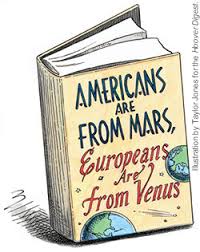
Two recent events have me thinking of a 2003 book by the international relations expert Robert Kagan, entitled ‘Of Paradise and Power: America and Europe in the New World Order’, which started life as a 2002 article in Policy Review. In the foreign affairs world, the book is known colloquially as ‘Mars or Venus’, because the opening sentence goes ‘Americans are from Mars and Europeans are from Venus’.
Kagan’s aim was to explain that Europe and the US had very different views of the world, and that these differences were rooted in culture, history and aims. Europe is the older, wiser and more genteel continent, concerned with roping its social democracy in well made rules, whereas the relatively younger American republic (250 years old this year) was more muscular, in military and financial terms. Kagan’s book, in keeping with the reception given to Francis Fukuyama’s ‘The End of History’ and more recently Graham Allison’s ‘Destined For War’, is better known for its strapline than the detail of its argument, but then again that is the art of the successful author, and one that in comparison, few European international relations experts have cracked.
That, in 2002, Kagan felt the need to state that Europeans and Americans are different, betrayed the long-held sense that they are the same people, in the sense that in 2002, the vast majority of Americans could trace their family history back to Germany, Ireland, Britain and France (in 1960 some 85% of foreign-born Americans were from Europe in vs 10% today).
That much was also clear during the many events in Washington to mark St Patrick’s Day. President Trump invoked his own European heritage (Scottish mother, German father), teased Speaker Mike Johnson as to whether he was a WASP or Italian, whilst Taoiseach Micheal Martin told how a Cork man, Stephen Moylan, a senior officer in George Washington’s staff, is credited with the first use of the phrase ‘the United States of America’ in 1776.
In that context, the ‘Mars and Venus’ argument is ever more relevant today as the divide between Europe and its American cousins widens. While European countries wholeheartedly supported the US in the 1991 Kuwait War (see our recent note) and in the aftermath of 9/11, the doubts that many European governments had over the 2003 invasion of Iraq partly motivated Kagan’s book (the film ‘Quai D’Orsay is very good in this context).
In that context, the polite refusal of nearly all of America’s allies, not just in Europe but also the likes of Japan and India, to send ships to the Strait of Hormuz, is emblematic of a deepening divide, and in recent weeks a good number of American friends have reached out to ask ‘is it us, or is it you?’. My polite response is that ‘it’s the White House’ (noting that most Americans are against this war), but more broadly I feel that one of the great anomalies of our time is that so few Americans realise the damage that is being done to America’s reputation abroad.
So, one might argue that Kagan’s ‘Mars-Venus’ short-hand for international relations has never been more true, and the fact that Europe has done little in the past twenty years to bolster its security, and to deepen its financial markets, gives some weight to American frustration and derision. Equally, the vandalization of shared values (democracy) and institutions (NATO, the United Nations) by the White House causes horror across European capitals.
Yet, at this painful point in trans-Atlantic relations, I wonder if we have reached peak ‘Mars-Venus’, in the context that Europe today is still quite like it was in 2003 in terms of world view, whereas the US is politically and socially very different to that of 2003.
My reasoning is that Europe is finally having the ‘neo-con’ moment that the US went through in the early 2000’s (Robert Kagan was part of that movement), and is starting to rebuild its defences, though it lags badly on capital markets union (now Investment Savings Union).
Oddly, Europe no longer shares the same enemies as the US. Russia should be the prime concern of European security chiefs. It is also troubling that the Trump administration actively supports far-right parties like the AfD in Germany, and the few European nations who side with the Kremlin (VP Vance visits Hungary next week).
As such, Europe’s path and challenge is clear – to remain the sole liberal democratic pole in a disordered world. When Robert Kagan wrote his book in 2003, the natural assumption was that American democracy was a beacon for others to follow, as far as Asia and even across Eastern Europe (Kagan’s wife Victoria Nuland was a senior American diplomat serving in Eastern Europe during ‘the Maidan’ in 2014, where her most famous utterance was ‘f@#k the EU’).
Yet, America’s democracy is now in deep trouble, and one of the sharpest critics of Donald Trump’s approach is Robert Kagan, who warns of the descent towards a dictatorship.
 The Levelling