Riddle of the Funds

A friend who lives in an isolated area and therefore in need of good reading material, recently asked me to recommend some geopolitical oriented thrillers. I immediately thought of decent, new writers in the field like David McCloskey and Charles Beaumont, the interesting recent James Stavridis/Eliot Ackerman books that straddle fact and fiction, as well as the scary ‘If Russia Wins’ by Carlo Masala.

However, many of my favourites are from different eras, Laurence Durrell’s ‘White Eagles over Serbia’ set during the Cold War, and then in a bygone period of great power competition, the works of Eric Ambler and of course, Erskine Childers (‘Riddle of the Sands’ ).

The end of globalization and the onset of great power competition means that those works remain relevant though, if on the fourth anniversary of the war on Ukraine European policymakers wanted reading recommendations, I might well propose a book like Sebastian Mallaby’s ‘The Power Law’, or Azeem Azhar’s ‘Exponential’, and to be cheeky, even ‘The Art of the Deal’.

My reasoning, with Europe (the EU, UK, Nordic nations) finally starting to mobilise its factories and innovators to bolster its war economy, is that there remain several missing elements in the quest to build the industrial champions of the European war economy. Europe’s politicians are very good at high minded rhetoric (there are repeated calls to build the European Google, Palantir and Anduril), and even better at racking up debt, but less gifted at spurring large scale innovation. 

For instance, the response to the hostile American message to the EU at the 2025 Munich Security Conference was the lifting of the German debt brake, while the recent threat to ‘take’ Greenland has prompted multiple calls for the issue of ‘euro-bonds’.

However, with German military spending and defence related industrial production now taking off, the secret to defence and security innovation lies more in business school texts, than in war college. There are a few elements to highlight here.

The first one touches on a perennial problem for Europe, the lack of depth in financial markets. Amidst an epidemic of defence start-ups and fund launches across Europe, there are still relatively few investment funds focused on the kind of later stage investing required to scale security focused companies to a size where they can become part of the growing industrial infrastructure in Europe. This lacuna owes in part to the failure of Capital Markets Union (now Investment Savings Union), such that few pension funds and institutional managers are investors in ‘strategic autonomy’. 

It also reflects a labour market problem – there are simply few investors in Europe who have good knowledge of the defence and dual use ecosystem.

The idea of an ecosystem is the second aspect of the defence investment riddle. A small number of countries have cracked this – the US and France stand out. In the US, like France, the education system provides a rich supply of engineers and technologically capable graduates (e.g. Onera Labs in France), many of whom have a layer of business school training, and in a good number of cases have ties to or experience in the military. 

Ecosystems encompass large firms, divisions of the military and defence establishment (i.e. SpaceForce), as well as sector specialist investors. When the elements of such an ecosystem are connected and work together, they can propel an interesting start-up to a viable enterprise in a few years. A developed pan-European ecosystem does not exist, and its cultivation needs to surmount cultural obstacles (as the recent Future Combat Air System (FCAS) debacle has shown), tax and incentive policy, and a more open approach to innovation from large European firms.

Then, the element that is to my observation missing in many new defence focused start-ups and first-time investment funds is the presence of seasoned business operators who have experience in scaling businesses and advising on how best to navigate the various complex government procurement pathways across Europe.

This is a critical omission in the defence sector because government led procurement can help start-ups survive, but not necessarily grow. This is doubly so in dual-use technologies such as cyber security and hardware (including new materials), where ‘go to market’ is a more important imperative than ‘go to war’. Compared to the US, Europe has a short supply of such operators, and in general governments have not done a good job of encouraging them to become part of the ‘strategic autonomy’ economy.

Europe faces a diplomatic disengagement by the US, a grave security threat from Russia and industrial dislocation by China. As such, Europe’s war economy needs to add up to much more than guns and drones, but must rest on innovation, entrepreneurship and ambitious capital.

Have a great week ahead, Mike
Old Money

A recent book, Samuel Moyn’s ‘Gerontocracy in America, highlights the growing concentration of wealth and power in the much older generations in the US, whilst younger generations face historically high valuations in real estate and financial assets, and how this growing intergenerational divide might be mended. Moyn, in my view, has struck a chord that will become one of the new dividing lines in politics, in Asia and the West.

His book brings demographic change into focus, a slow-creeping risk to economies, society and public life, but whose implications are only just surfacing in the public debate. Despite that, from a popular point of view, the sense in many Western countries is that there are too many people, or rather that infrastructure has not kept up pace with population growth – I am writing this in Dublin, which is an excellent case in point.

Yet, the long-run demographic trends – falling fertility, longer life expectancy and a shift in population composition towards a much smaller working (tax paying) population, will have enormous impacts on society, pension systems and debt loads, to name a few economic issues.

As much was evident in Germany’s recent pension reform debate which was nearly upended by Helmut Kohl’s grandson Johannes Volkmann and a group of other young parliamentarians who voiced the right of the younger generation to not have to shoulder the financial burden of their parents’ generation (under the German system, and many others, the working population effectively funds the retirement system of the older generation)..

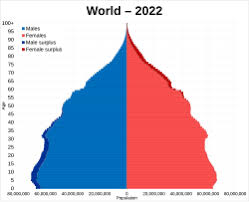
The best starting point on the outlook for demographics is the United Nations World Population Prospects website. and the data – especially in chart form – are quite striking.

The UN data show that as we approach 2100 the world population will plateau and start to shrink. From roughly 2080 onwards the world population growth rate will turn negative for the first time in centuries (wars apart), as the death rate passes out the birth rate. Within the age cohorts, the over 65 group will expand by a billion people in the next thirty years.  

More specifically, at the country level, the US death rate will surpass the birth rate in around 2040, and population growth is likely to only be sustained by immigration. The picture is worse for some European countries – Italy for example is already in negative population growth territory, and the most negative forecast scenario from the UN has the Italian population dropping from over 60 million today to 25 million by 2100 (the same level as when Garibaldi unified the country).

Equally, China, which has been renowned for its economic and population growth, will endure a collapse in the 24–65-year age group, who today number 830 million people and by 2100 are expected to comprise 280 million people. China is projected to be the country most affected by ageing, with its, China’s elderly dependency ratio is projected to surpass 100% by 2080, meaning there will be more people aged over 65 than those aged 15 to 65.

The expected collapse in the working population begs serious questions for the economy – who will pay taxes, sustain pension systems and where will demand for financial assets come from. Markets are not worried, yet.

In general, researchers find that there is a positive link between demographics and asset prices, a finding that is predicated on the rise of the boomer middle class and the coincident equity bull market and fall in bond yields. The idea is that until they retire, working households invest more in real estate, equities and other riskier assets, but then shift to income-oriented assets like bonds as they get older and require income from investments. The oddity in that respect is that despite an ageing population, equities and real estate are very expensive. This may well owe to a growing investment culture, a record level of wealth (USD 500 trillion worldwide) and the prosperity boon that has resulted from globalization.

In this context, old money will become a political target, both in terms of demands for lower inheritance taxes, to more populist measures to tax the ‘old’ and give the ‘young’. For governments who worry about demand for their bonds, wealthier older citizens might make ideal candidates for financial repression (their children would face lower inheritance tax provided that capital spent a period of ‘purgatory’ invested in government bonds – I outlined a similar theme in ‘Patriotic Capital’)

At the same time, pension systems will have to change to accommodate a proportionately smaller number of workers (to pensioners). Private pension systems will become more common, they will invest more, earlier, with a tilt to riskier assets.

Concurrently, I expect to hear more on the need for states to establish sovereign wealth like funds (based potentially on the sale of state assets) to help provide for future pension liabilities. Another concern will be the need for states to cushion the potential blow of AI on workforces (a fund that holds equity in AI firms might be an avenue), at least through a transition period. In the long term, AI and robotics may well allow more older people to work for longer and for more women to enter the workforce. And, I haven’t managed to tackle the topic of later retirement ages and how that will impact the workforce and society.

The effects of demographics are not yet showing up in markets, and are just creeping into the investment industry, but it will become a major fiscal and financial megatrend.

Have a great week ahead, Mike 

Boring, boring

The only positive aspect of the grim France versus Ireland rugby match of a week ago was that, serendipitously, I bumped into three brothers from Limerick whom I’ve known for some time. We re-grouped the evening after the match for a pint and a post-mortem, where the chat turned around sports and politics. Drawing the two threads together, one of the brothers noted that in the last ten years the UK has had more ministers for housing (a whopping 14) than Chelsea FC have had managers (12). Readers will immediately grasp the parallels between the two chaotic worlds.

A couple of days later I had a chance to test the hypothesis at Old Trafford during the United vs. Spurs match (readers should not get the impression that I spend my life shuttling from one event to another). United are hardly a paragon of managerial stability, but I hope that in Michael Carrick we have finally rediscovered someone who recognises how the team should play. However, for much of the match, Thomas Frank, the Spurs manager, faced a barrage of abuse from the crowd, and having taken Spurs perilously close to the relegation zone, he was sacked on Wednesday.

The comparison between football and politics, in Britain at least, makes sense in other ways. Both are seeing an infusion of money, ‘overseas’ capital in the case of many British football clubs, and there is a good case to be made that foreign money has found its way into British politics also. Nick Gill, the former Reform UK man in Wales has recently been jailed for bribery (for spreading pro Russia content), and it is the stated objective of the White House team to involve themselves actively on the far-right fringes of British politics.

Both football and politics have in my view, become duller and devoid of what we might call ‘characters’, and both are in thrall to social media, to the irritating end that many MPs seem incapable of giving a speech in parliament without recourse to their mobile phone.

In one way, they are different. There is less violence in football, on and off the field, compared to the 1970’s and 1980’s, though at the same time public life has become much more unpleasant. Sadly, two MP’s have been killed in the past forty years, with both of those in the past ten years, at the hands of political extremists. Many MPs are leaving politics because of the stresses of the position. This pattern is repeated across many other democracies, especially in the case for female politicians.  

The ire that is directed towards politicians may be one reason that Sir Keir Starmer is now, according to Ipsos and the FT, the most unpopular prime minister in over fifty years, and his Chancellor Rachel Reeves the most unpopular individual to hold that role. The oddity is that Starmer is honest, steady and importantly has not authored a policy disaster like Brexit. Perhaps, his failing is that like his favourite team Arsenal, he is ‘boring, boring’.

Sir Keir has been prime minister for some eighteen months, which eerily for him, is the average span of the Premiership football manager. Interestingly In this respect there are parallels in the corporate world, where the tenure of CEO’s is shortening to about five years for the large US companies according to work at Harvard and some consulting firms. Like footballers but not MPs, CEO’s are also much better paid.

Since the end of last year, Starmer’s Labour party colleagues have been stalking him, as they might a wounded animal. The deep embroilment of Peter Mandelson in the Epstein scandal has given these colleagues (many of whom know Mandelson very well) the cause to up the pace in the hunt for Starmer’s job, and the resignation of his right-hand man Morgan McSweeney, has only encouraged them. Now, there is ‘blood in the water’ and uncharitably toughts turn to who might replace him, and what the political fall out could be. 

A face off between the left leaning Andy Burnham (who does not have a seat in parliament), leftie Angela Rayner and the more centrist Blairite Wes Streeting is likely. An interesting compromise candidate could be energy secretary Ed Miliband, or even foreign secretary Yvette Cooper. My sense is that the British public does not want a more left leaning government, that they are ready for a more EU friendly policy set and that they want the next leader to be decisive. 

There is a high chance that Starmer goes, and that in many respects Labour shoots itself in the foot by dismaying the public, and dividing their own party. By weakening themselves they increase the likelihood that a future government could incorporate a coalition of Labour/Liberal Democrats and the Greens. In itself, this would be a new departure (the only coalition since the War was the Tory/Lib Dem one from 2010-2015).

The UK (and the US) are unique in that they have been two party political systems for nearly one hundred years, at least. The structure of electoral systems has much to do with this. In many European countries, it is relatively easy to set up a political party and gain a foothold in parliament. Doing so in the UK has traditionally been very difficult because of the first past the post system.

However, in the post Brexit era, a number of shifts are occurring, that are quickly coming to a head (especially so last week) that will entirely change British politics, and likely mean that after the next election, coalitions could be the norm rather than the exception.

In the past month, Reform has welcomed several high-profile members of the Tory Party. With local elections in May, Nigel Farage has given Tories a deadline of early May to join Reform and a few others may join (Reform won only 5 seats in the last general election, followed by a number of by-elections, it now has 8 MPs). For context, Reform is at 29% in the polls, Conservatives and Labour on 18%, the Liberal Democrats on 13% and the Greens on 14%).

As such, Reform is becoming the (far) right wing party of choice, though it is unlikely they can muster enough decent candidates to win more than 20% of the seats (as opposed to votes).

In order to enter government, Reform would likely have to enter into a coalition with the Tories, but with the recent defections, relations are at a low (Tories slated Braverman on her move).

Then, on the left, the surprise in British politics has been the rise in support for the Liberal Democrats (they have 72 MPs, in stark contrast to Reform), and the sharp rise in support for the Greens. As such, if the distribution of seats in an election followed opinion polls, the next government might well be a left leaning, ‘Green’ coalition, something that would be common in a continental European country but, a complete break with tradition for British politics.

Starmer’s enemies appear committed to getting rid of him but need to take care that the road ahead is untravelled.

Have a great week ahead, Mike

Funny Money

‘It is not speed that kills, it is the sudden stop’

This quote from a paper on currency crises by economist Rudiger Dornbusch came to mind last week as the price of silver having climbed over 100% in a month, collapsed by 30% in an afternoon. The sudden stop in silver is emblematic of many of the problems with financial markets, but also strikes a chord with some of the deeper changes materialising within the world economy, such as the rising quantum of debt, and recent attacks on Jerome Powell.

As we noted in ‘Grasshopper’, silver used to be a money, though the propensity of some users to mix it with inferior metal lead Sir Thomas Gresham to coin Gresham’s law that ‘bad money drives out the good’. In bulk form, silver and more so gold, was good enough to be a money, and to back up the paper money system until 1971 when the gold standard came to an end (one could present dollars to a bank and demand gold in return).

Without the backing of gold, the reasons people held and used paper (fiat money) were determined largely by important intangible factors – such as the rule of law, policy credibility, quality of institutions, as well as the economic usage of that paper – did central banks hold it as a reserve currency, is it widely traded and are financial institutions happy to use it? On most of these criteria, investors, businesses and central banks avoid China’s renminbi, but for the same reasons have been very happy to use the dollar, and to a lesser extent the euro. But, that might be changing.

First of all, as globalization crumbles, there is a rise in distrust, notably in the dollar. There are two facets to this.

In my notes, I have mentioned the work of Barry Eichengreen a number of times. He is the academic authority on currencies and in a paper entitled “Mars or Mercury? The Geopolitics of International Currency Choice” written with two economists at the ECB, he finds that military and geopolitical alliances are a significant factor in explaining currency strength. The rationale is that a country that is geopolitically well placed is engaged with and trusted by its allies through trade and finance.

Unsurprisingly one of the main implications of the “Mars or Mercury?” paper is that in a scenario where the United States withdraws from the world and becomes more isolationist, its strategic allies no longer become enthusiastic buyers of US financial assets and long-term interest rates in the United States could rise by up to 1 percent (there would be fewer buyers of American government debt), according to the paper. As such the many geopolitical events at the start of the year may now have triggered a move away from US assets.

A related move is that the institutions behind the dollar are also under attack, and from outside at least, look less sure. The mid-term elections and the way in which they are held, will be instructive.

The nomination of Kevin Warsh as the next head of the Federal Reserve is another important development. My instinct, unlike other economists is to put less store on his family background, and suspicions that he might not be independent, simply because any political bias or even more general lack of judgement, will be quickly punished by markets. I agree with stances he has taken in recent years, notably against the ongoing deployment of quantitative easing. The really interesting element of the Warsh Fed will be the partnership he forms with Scott Bessent, and I suspect that this ‘accord’ will focus on creating the means by which the financial sector (notably banks) becomes the driving engine of the economy.

There are other factors at work. China has been aggressively courting its emerging market trading partners to use the renminbi, and this is beginning to show up in currency flows (the renminbi has jumped from 2% to 4% of international trade driven transactions in the last two years, according to a research paper from the Fed). The big shift however is central banks, who for a variety of reasons, mostly geopolitical, have a newfound penchant to hold gold as a reserve, rather than Treasuries.

In this regard, buying by central banks has been the new development in the gold market in recent years, this has been surpassed by the side-effects of the financialisaton of gold and silver. To state it simply, the existence of exchange traded funds (with liquid options markets on these ETFs) has allowed retail investors, and institutions, to speculate on the price of gold. In the old days one had to buy it in barloads, and in Zurich at least, take the No. 13 tram to visit the gold, as we described in a note, Marmite .

The lashings of financial products that have been built around gold and silver have to a large extent transformed them from stores of value, into Frankenstein like speculative assets. The 30% collapse in the price of silver last week had many causes, but most of them can be traced to financial engineering. As such, this is a warning that, in a world with more US PE funds than McDonalds in the US and with more ETF’s than stocks, financialisaton can ultimately be highly damaging.

Another angle on this is bitcoin, a techno-financial response to the growing lack of trust in economies. Some commentators have described it as digital gold, but it looks to have failed the test of being a money and is most certainty not a safe asset. I regard it as a risk asset, in a small, narrow pantheon with art, penny stocks and racehorses. Indeed, its utility as an instrument to transfer money is also diminishing, in a world where stablecoins are more prevalent, and where fintech is getting better (and cheaper) at facilitating transactions. It might be next for a stress test.

Have a great week ahead, Mike