Bushido

One of the favourite books I have received as a gift is ‘Bushido’, the framework of the Japanese code of chivalry. I was given the book in the very early 2000’s, when it was not yet obvious that Japan would stagnate for quite so long and, the talk was still of the collapse in Japanese golf club membership prices

Indeed, one of the remarkable socio-economic trends in Japan up to the mid-1990’s was the startling rise in Japanese gold club membership fees, which in the heady 1980’s Japan, had become a tradeable asset, so much so that an index was created (always a warning sign). During the period 1982-1989 the average golf club membership fee rose by 400%, with a final 190% spurt from 1989 to 1990. Companies such as Ginza Golf Services initially made a lot of money trading golf club memberships and at the peak of the market some were changing hands for close to USD 3mn.

Naturally, this bubble collapsed, and as a nod to the future I flag a blogpost from ‘GolfProp’ magazine that shows that on average entry fees for American gold club memberships have been increasing at a rate of 23% per annum since 2019. Indeed, within the past year the membership fee at Mar-a-Lago has gone up by 43%

Back to Bushido, which as a noble, chivalric code developed in the 16th century, is unlike European ‘Chivalry’ (see Maurice Keen’s book of this title is a must read) in that the idea of ‘Chivalry’ came about much earlier, and largely because of an effort to stop the knights of Europe killing each other in jousts and disputes. Bushido is still part of the mindset of many Japanese, and Japan is increasingly unique as a country where very strong social codes frame behaviour.

To that end, the sense of bushido and Japanese diplomacy will have been taken aback by the unexpected decision by President Trump’s to slap a 25% tariff on America’s main allies in Asia, Japan and South Korea. Japan has always enjoyed close ties to the US (Al Alletzhauser’s 1990 book ‘House of Nomura’ is a very good account of how America helped build the modern Japanese financial and corporate system). I have a sense that another book of that era, Ezra Vogel’s ‘Japan as Number One’, seems to have stuck in Trump’s mind (in the 1990’s he went on CNN to castigate Japan American foreign and trade policy on Japan).

Trump and ‘bushido’ are anathema to each other, and the Japanese will be disappointed by his behaviour, given that Tokyo has always had close relationships with American presidents – though never as close as that with Jacques Chirac who visited Japan over 40 times (for various reasons which I shall not disclose).

The potential rupture in relations between Tokyo and Washington introduces a strategic dilemma for Japan, at a time when its economy is awakening from decades of slumber. Like the UK, Japan’s geopolitical moorings are coming unstuck. President Macron’s state visit to London shows the direction of travel for the UK on security and defence, and whilst it is accelerating defence spending, Japan may end up considering more radical solutions for its defence in the context of Chinese belligerence (in 2024 Japan’s air force scrambled jets 704 times against incursions by Chinese and Russian jets). For instance, Japan is the one country that could quickly build a nuclear weapons programme, if it needed to.

What is interesting in the Japanese case is that as geopolitical uncertainty rises, its economy and financial markets are thawing. The property sector is just reaching levels last seen in the early 1990’s (while Tokyo prices have recovered beyond 1991 levels, the rest of the Japan’s residential market is still below the price point reached then).

Having suppressed bonds yields for a long time, the Bank of Japan is now raising rates, and Japanese bond yields have been pushing higher, and given the size of the Japanese bond market (and the balance sheet of the Bank of Japan), it is driving yields higher internationally, and deserves watching as a medium-term risk to markets.

However, while bond yields are rising in the absence of yield curve control by the central bank, factors that are regarded as engines of the economy – earnings, consumer behaviour and employment are more muted, and give rise to the sense that Japan is either in the ante chamber of a full recovery, or on the precipice of something nastier.  

Tariffs, and a confusing break with the US, could upset the Shigeru Ishiba’s unpopular government (Upper House elections are soon), which is struggling in the context of a very ‘un-bushido’ world.

Have a great week ahead,

Mike  

Grasshopper

I had intended to write about universities this week but, strolling through the City of London, I was surprised, shocked even, to find myself on Trump Street, and then amused to see that it is joined by Russia Row.

My first thought was that this was part of a grand plan by the British establishment ahead of President Trump’s visit to London in September, the idea being to stage an event at the nearby Guildhall and to then tell the president that a nearby street had been named after him. Trump Street was apparently named so because several trumpet makers lived there in the 18th century, but let’s ignore that for the time being.

Yet, the far more meaningful coincidence of Trump Street is its proximity to Gresham Street.

Sir Thomas Gresham was a trader and financier in 16th century London, at a time when coffee houses in the lanes around the Royal Exchange formed the basis of what is known as the City. Gresham was an important player in Queen Elizabeth I’s economy, and his emblem – a grasshopper – is still present in various parts of the City (there is a giant-sized golden grasshopper on the roof of the Royal Exchange….if you can dare to make it up there).

While Gresham’s imprint can be seen across the City, he is remembered by Gresham’s Law which was named after him and states ‘bad money will drive out the good’. Gresham’s Law which echoes similar observations from Copernicus and other scientists through the ages is founded on the idea that in an economy where coins with the same face value but that are made from different base metals (say nickel and copper) there is a tendency for traders to hoard the coins made of the more valuable metal and to circulate lower quality coins. Bad coins stay in circulation, good ones are re-commoditized. From an economics point of view the law is conditioned on all the coins (of variable quality) having the same face value.

Unlike the 16th century, today, coins have the same physical consistency and in general there is little incentive for people to shave bits off coins (historically coins have serrated edges to prevent this) but broadly the Gresham’s Law is applicable in different domains.

Think of how cheap goods (made under questionable labour conditions) have forced quality players out of markets, or how in the run-up to the global financial crisis, low quality financial institutions offering generous loan conditions caused better quality banks to step back from lending. In both cases, regulation or policing of markets is necessary to ensure that ‘bad’ actors do not gain an advantage over good ones. Social media is another example, where it seems a lot of nonsense thrives at the expense of information.

Additionally, the idea of Gresham’s Law is applicable to politics, where in many countries it appears that political actors with extreme views and extreme modus operandi are forcing out ‘good’ ones in the sense that most normal people would be terrified of a career in politics.

Readers will guess that my argument is leading back to Washington. Bad behaviour, bad ideas and bad policies are infesting themselves in public life, the economy and markets – to the surprise of many ardent supporters of President Trump. What is not clear is whether this will result in an evacuation of capital and talent from the US, or whether there will be a counter-reaction. Gresham’s point in describing how bad money drives out good was to avoid the debasement of the currency (schilling), which when Elizabeth I came to power, was already in a bad state. She appointed Gresham as a finance minister of sorts in 1560, and within a year he had ‘bad’ coins taken out of circulation and replaced them with money made from precious metal, the result of which was a dramatic improvement in Britain’s status as a trading and economic power.

The lesson of this should be very clear today. As a final point, it is interesting to note, from the point of view of coins and money, that the ratio of gold (precious metal) to a cyclical commodity (copper) is the most stretched it has been since at least the 1980’s, suggesting that markets at least are thinking of Gresham’s Law.

Have a great week ahead

Mike

Un train peut cacher un autre

Adam Smith, though better known now as an economist held the chair of Moral Philosophy at Glasgow and as such it’s fair to assume that he knew a thing or two about the intersection of economics, philosophy and politics, and that often a political crisis is motivated by an underlying economic crisis…hence the title of this note.

Smith lived during a time of mercantilism, which we might describe as a nationalistic approach to trade that aims to maximise the exports of a country whilst keeping imports to a minimum. In this context, Smith wrote of mercantilist nations that ‘their interest lies in beggaring their neighbours’, and the phrase ‘beggar thy neighbour’ has been often used in the economic context, usually when growth is scarce (the aftermath of the Great Depression and the Global Financial crisis)

With mercantilism and ‘beggar thy neighbour’ back in fashion, it is worth returning to Smith’s ‘Wealth of Nations, book IV’ where many of the observations Smith made chime with America today, such as:

‘The sneaking arts of underling tradesmen are thus erected into political maxims for the conduct of a great empire … . By such maxims as these, however, nations have been taught that their interest consisted in beggaring all their neighbours. Each nation has been made to look with an invidious eye upon the prosperity of all the nations with which it trades, and to consider their gain as its own loss. Commerce, which ought naturally to be, among nations, as among individuals, a bond of union and friendship, has become the most fertile source of discord and animosity’.

To that end, beyond the bonfire of American values and diplomatic relationships, there is an emerging, underlying logic to the policies of the White House that China, Japan and Europe need to pay attention to.

I have written many times in this note that the world economy is in the antechamber of a fiscal-debt crisis (listen to ‘Waking up to World Debt’). Unusually, all of the major economies have become indebted at the same time, and the process(es) by which they try to reduce debt at the same time will likely prove extremely hazardous financially.

It seems that the Trump entourage understands this, and that logically the unifying factor behind disparate policies from the creation of ‘DOGE’ to the enfeebling of NATO are driven by a brutal sense of austerity, that starts with the cutting down of all the international public goods that the US has invested in since Bretton Woods.

In this context, the ‘beggaring’ of Europe pushes the bill for European security back across the Atlantic and has shaped the debate in Europe towards greater debt accumulation (for example the debt brake is one of the most contentious topics for the new German government and the EU will soon embark on the issue of EU defence bonds). Japan, South Korea and Australia might be next.

In effect, the White House is using areas where America is exceptional – financial markets, the military and multinationals – to coerce its allies, and in the case of Ukraine to undermine them. Debt might be next.

The closest we have to a template for a Trump grand macro plan is a paper written by Stephen Miran, who may soon take up the role of head of the Council for Economic Advisers. The elements in this plan have popularly become known as the ‘Mar-A-Lago Accord’, which is not unlike the world debt conference idea I have written about in The Levelling, though my version takes place in the recently refurbished Raffles (Singapore).

One of the pillars of the cited ‘Mar-A-Lago Accord is that holders of Treasuries exchange these securities for very long-term loans (that might not provide a coupon). The result would be to restructure the maturity and fiscal burden of America’s debt load. It is a neat idea but will not work in practice. Any debt accord will likely need the impetus of a major financial crisis as a motivator, will need to restructure the debt of all the major economies and will entail a rewriting of financial regulations across the world (for pension funds for example).

In reality, an attempt to enact a Mar-a-Lago Accord, in the same fashion as the debate around NATO, may create aversion (distrust in) to US financial assets and the dollar. Whilst Europeans may not appreciate the extent to which a ‘beggar thy neighbour’ philosophy is driven by US security policy, the White House is underestimating the value that America’s wide ranging financial, diplomatic and commercial infrastructure bring it. An example is that close to 40% of the revenues of large American firms come from overseas.

In the short-term, we are also starting to witness the effects of austerity on the American economy. Though ‘hard’ data on the economy remain solid, the outlook will become very noisy in the next few months as government job cuts take hold and as social welfare cuts (notably in the mortgage industry) sow anxiety. Markets have started to become jittery too, amidst a belief that the administration is much more focused on lowering bond yields (and thus the cost of government debt) than boosting the stock market.

In a scenario where the (US) economy weakens, investors normally turn to Treasuries, but the prospect of a Mar-A-Lago Accord being foisted upon them could lead to a buyers’ strike. The public attack on president Zelensky has disabused diplomats of the intentions of the Trump White House, investors could be next.

Have a great week ahead,

Mike 
Remember the Washington Consensus?

Does anyone remember the Washington Consensus? Such a phrase might seem odd in today’s world but in the early 1990’s the notion of a ‘Washington Consensus’ was very powerful as a method for globalisation, and hotly debated by the left.

Globalisation worked well because, to be overly simplistic, it was facilitated by a very clear world order that helped to establish the rules of the ‘globalisation game’ and the norms associated with this. At their core, these rules were American, or at the very least they were made in Washington within the institutions that were set up to marshal the post-World War II world order, the IMF (International Monetary Fund), the World Bank and the United Nations in New York. America held the purse strings of these organisations and regular meetings at these institutions became a means of schooling ministers from both developing and emerging economies in the ways of American economic power.

These discussions aired what soon became known as the ‘Washington Consensus’ – effectively an approach to world economic development and globalisation, that was denounced by critics on the left as a neo-liberal policy recipe book. With the benefit of hindsight today, the Washington Consensus was valuable in the sense that it was a consensus, it encapsulated an approach that many countries were content to go along with as part of their first foray into real economic development.

Today, the Washington Consensus is in disarray. The institutions that it was built around, like the IMF are defunct, and others like the WTO have been undermined by both China and the US in recent years. The decision of the US to leave the World Health Organisation is another blow. The ‘Consensus’ is dead because there are now other competing methods as to how countries can develop, and of the independent paths they can take.

Here, an important milestone was Xi Jinping’s China Dream speech, in November 2012, which well before MAGA (Make America Great Again) coined the term ‘China Dream’ during a visit to the National Museum of China. Now, countries like Indonesia or Nigeria can try to follow the classical Western model of development, or China’s non-democratic, state led approach. Or, like Argentina and El Salvador, they can pursue the ‘Trumpian’ model that is taking a grip on Washington, but that is anything but a consensus.

Without going into day-by-day developments coming from the White House, the second Trump presidency can be seen as an early stage in the post-globalisation world order.

Globalisation was based on American economic and political strength and promulgated by the ‘Washington Consensus’ and the B-52’s of American capitalism (multinationals). Eventually globalisation ran out of steam, and events like Brexit, the first Trump presidency and the snuffing out of Hong Kong’s democracy shattered it. We are now in a multi-polar world where at least three large powers (EU, China and the US) do things increasingly differently (look at how they treat AI).

Uniquely, this Trump presidency represents an attempt to do something new and can be seen as an early chapter in the formation of the new world order, and to an extent its success depends on the will and the coherence of the groups of people that are driving the Trump project (from sectors like private equity, innovation and wealthy families). One stark difference with globalization is already clear. Globalization was built on the US being umbilically tied to much of the rest of the world, and vice versa, by flows of ideas, money, trade and people. In contrast, it now seems that Trump 2.0 relies on American exceptionalism, attempting to rise above the rest of the world, and in the process severing the relationships and ties built up since the end of the First World War.

For example, consider the words delivered to Canadians by President Kennedy in May 1961 ‘Geography has made us neighbors. History has made us friends. Economics has made us partners. And necessity has made us allies’ and how remarkably different they are to the way the Donald Trump has treated Canada.

In that context, the rest of the world may increasingly choose to avoid America, and the risk to ‘Exceptional America’, notably with the dollar as strong as it is, is that its financial power ebbs, in the way that of many other empires has. The template for this is expertly laid out in Barry Eichengren’s ‘Mars or Mercury’ paper that analysed the link between empires and their monies, though I feel that in the absence of obviously strong competing currencies, this thesis could take time to play out.

A more plausible side-effect of ‘exceptional’ America, is the advent of a new point of economic gravity, pinpointed at the UAE (United Arab Emirates). This is my ‘Fourth Pole’ thesis – that the UAE together with India and Saudi Arabia has the makings of a new pole of trade and commercial activity, with low regulatory barriers and that encompasses a potentially huge market (Prof Afshin Molavi calculates that there are 2.5bn bn people within five hours flying time of Abu Dhabi). The Mercosur trade deal between Latin America and the EU might also be the basis for a new trade corridor.

The other necessary outcome in a world where America is going its own way, is that Europe stops trying to contain Trump, and takes a far more aggressive stance with respect to its risk environment, notably Russia. The German election in two weeks’ time might be the start of that stance.

Have a great week ahead,

Mike

Druk!

Winter it seems, across much of Europe, has come early. Two instincts that grow as the evenings darken are the inclination to have a tipple in the evening and to watch a good film. One Danish work that captures both sentiments is ‘Druk’ or ‘Another Round’, which won the Oscar for best international film in 2021. I recommend it.

In the film a group of four school teacher friends decide to test the hypothesis of a Norwegian psychologist that humans have a deficiency of alcohol in their blood, and the protagonists undertake an experiment to maintain a ‘warm’ level of alcohol in their blood. It is an experiment I attempt often, but the real lesson today is with central banking.

It seems that central bankers have decided that in the spirit of ‘Druk’, the liquidity in the world financial system is not sufficient and have set out to administer near daily injections of cheap money. The number of central banks changing policy (i.e. to negative) is the greatest it has been, apart from the global financial crisis and the COVID period. In September alone there have been 24 rate cuts from central banks around the world.

Chief amongst these has been the 50-basis point cut from the Federal Reserve and the very dramatic, multiple policy moves by China. In short China has cut rates, infused the banking system, made mortgages cheaper and generally tried to spread liquidity over the emerging cracks in China’s economy. In the spirit of ‘Druk’ it is the equivalent of going on a five day bender in order to cure a serious disease.

Nonetheless, the easing in policy from the Fed and China, together with what will likely be a couple of more rate cuts this year from the European Central Bank mean that the world financial system is flush with liquidity. Chinese markets – hitherto the worst performing markets of a major economy – show the impact and importance of liquidity. The market cap of the Hang Seng index has grown by a quarter in less than two weeks. China has overtaken the US in terms of equity market performance to date.

There is no change to fundamentals – I don’t see this policy move having a decisive impact on the downward trend in Chinese earnings, but that doesn’t matter in the near term – liquidity is coursing through the pipes of the Chinese financial system, and in turn might bring a temporary easing to conditions in the property market.

For all the analysts who devote time to measuring earnings and calibrating valuations, the reality is that in this era of ‘quick to please’ monetary policy, liquidity matters a lot for asset prices. My rule of thumb in constructing a measure of liquidity would encompass money supply, the state of central bank balance sheets, the key role of the dollar and net issuance of debt by treasuries.

The arcane notion of financial liquidity has attracted enough attention that the Financial Times recently ran an article breaking down its component parts. A couple of top-flight economics consultancies run their own measures of liquidity – such as LongView Economics and Michael Howell at CrossBorder Capital. The latter holds that we are on the cusp of a significant upswing in global liquidity.

 If that is true, the implication for markets is ‘Druk’- a persistent giddyiness whilst central banks keep rates low and liquidity flush, amidst an acceptable level of GDP and profit growth. Friday’s job market figures in the US were very strong, suggesting that in fact there was no need for a large rate cut. This is the kind of macro climate we have seen in the mid and late 1990’s, and one that tends to dampen the market implications of turbulent geopolitics.  

From the point of view of asset prices, there are a couple of possible trajectories. Historically, the Fed has started to cut interest rates when the price to earnings ratio on the S&P 500 has been close to 10 times (1960’s to 1990’s). Now, like in 2000, it is in the mid 20’s which suggests that extra liquidity now could run asset prices in bubble territory proper, and cultivate the next bout of inflation, something the central banks’ bank, the BIS, has warned about (helpfully the BIS has taken a counter view to that of its members ahead of a number of crisis).

For the time being, the upturn in liquidity may be most meaningful for capital markets activity and assets in the private economy. They have been in the doldrums. If the ‘Druk’ hypothesis is working we should see a rise in IPO activity into 2025, and intensification in private equity deals and a rise in funding activity (beyond AI firms) in venture.

Then, later in 2025, the hangover will arrive.

Have a great week ahead,

Mike

Building Sovereign Debt Funds

One of the attractions of elections is that they throw up new ideas and policy proposals – and it is not unkind to say that one increasingly gets the impression of politicians throwing suggestions at the ‘policy wall’ to see what sticks. Aggressive tariffs on China and taxes on unrealised capital gains are two examples from the US.  

One idea that Democrats and Republicans share is the proposed establishment of a sovereign wealth fund in the US. In the case of Donald Trump, his aim is to fund it with tariff revenues, whilst the Democrats conceive a sovereign wealth fund that might take stakes in firms in strategic industries, which is a very French idea (recalling the ‘strategic yogurt policy’ of 2005). The flaw in this particular idea, is that there is in fact no money to capitalise such a fund.

In stark contrast, I recall the last time Washington pondered a sovereign wealth fund was at the end of the Clinton presidency, when Treasury Secretary Bob Rubin had in a financial ‘end of history’ moment engineered a fiscal surplus (government earning more than it is spending). At the time, the sense was that surpluses would feed a ‘social security’ sovereign wealth fund, which would allow Americans to enjoy a prosperous retirement.

What is striking is that if you look at the history of America’s financial health, the Rubin/Clinton surplus is an anomalous blip. Since then, the US has registered nearly a quarter of a century of deficits, which irregardless of the level of growth of the economy, seem to get bigger (relative to the economy) every year. These burgeoning deficits are starting to take their toll on the US (and I should mention that many other large developed economies – Britain and France prominently so), as its debt level rises beyond 100% to GDP (expected to hit 122% in 2035). It is a very odd situation. In textbook economics, large deficits tend to exist in times of war, recession or crisis. As such, if any of these occurs, there will be scant room for governments to help the economy (and rescue plans may become a trial of strength of central banks).

That’s not all. Readers will sense that I am writing more and more about indebtedness, and it is indeed becoming a preoccupation of mine. The idea of the ‘Age of Debt’ is that debt is becoming pervasive, and as a factor will weigh on geopolitics, the tenor of political debates and the shaping of the financial markets of the future.

In that context, once we get beyond the rise of election campaigns and into 2025, governments will have to jettison dreams of sovereign wealth funds and instead subject themselves to debt sustainability analysis. It is akin to a household giving up a dream of buying a second home as their bank manager demands that the mortgage and credit card balance are paid off first.

Debt sustainability analysis is one of those arcane activities in economics, and I can count at least three friends who can run their own debt sustainability models, which is not something I should readily admit. The essence of debt sustainability analysis is that the future debt load (and its precariousness) of a country are driven by a set of factors – the rate at which a government spends, the inflation adjusted interest rate it pays, growth and demographics. These factors are inter-related – borrowing that is deployed to productive investment can produce growth and thus reduce the risks associated with debt for instance. Today, the rapid acceleration in the indebtedness of many countries, low growth and ebbing demographics are some of the factors that make debt increasingly unsustainable.

If that was a reasonably technical explanation, the best parallel I can think of to communicate debt sustainability is climate sustainability – or at least both sets of analysis point to a world that is heating up, and where there is relatively little reaction to this. Debt and climate sustainability analyses are long-term processes, and my sense is that governments gladly ignore them, until they become immediately problematic.

That is beginning to happen. France’s bond spread (over Germany) is elevated, and British bond yields are close to 4%. Neither country can afford to increase debt levels. The same is true for Canada. In the US, next February will see the installation of the new Treasury Secretary, and he or she will have the difficult task of telling the next President that there is no money in the kitty.

As such, the establishment of sovereign wealth funds is a distant, fluffy dream for most governments. A violent lesson here is that Ireland had a sovereign wealth fund in the early 2000’s, but it was swallowed up in the consequences of the euro-zone financial crisis, and is only now being re-established.

For those sovereign wealth funds that exist – in Norway or Saudi Arabia – the next trade may not be to buy quoted equities and private equity, but to either buy the discounted debt of developed countries when they have their sustainability crisis, or to engage in private lending to them. When that happens, a new shift in geoeconomic power will be under way.  

Have a great week ahead,

Mike

Samuelson vs. Sahm

Next week the Federal Reserve will very likely cut interest rates, for the first time since the COVID related rate cutting cycle. Recall of course that at the end of this speedy sets of cuts, most of the leading central banks had declared inflation to be ‘transitory’. The Fed cut will come on the back of a series of rate cuts from ‘elder’ central banks – the Bank of England, Riksbank and the Swiss National Bank, as well as the European Central Bank from whom we had another rate cut last week.

The anticipated move by the Federal Reserve is instructive in several respects. Market based interest rates are lower than Fed rates and many investors expect (or rather crave) the Fed to make a 50 basis point cut, as opposed to a ‘standard’ one of 25 basis points. At the weekend, the lead headline in the Financial Times read ‘Investors raise bets on bumper half-point Fed rate cut’.

This is yet another sign of monetary addiction – the result of the conditioning of investors to financial liquidity. In mid-August, following a dip in the stock market, I wrote that the idea of the ‘Fed put’ – the notion that the Fed would react to a fall in asset prices by cutting rates – is very much alive in markets.

The market dip led several seasoned and apparently credible investors to call for an emergency cut in rates. However, the Fed has only ever taken such dramatic action in the thick of deep crises (LTCM/Russian economic collapse, the dot.com collapse, 9/11, the global financial crisis and the COVID crisis). Similarly, it has not begun a rate cutting cycle with a 50 basis point cut, outside of financial crises. There is no financial crisis today (though plenty of mounting financial risks such as very high debt levels), but a crisis of expectations.

That crisis of expectations is at play as investors position for the Fed meeting next week. In my experience, the Fed is, in normal economic conditions, a cautious and slow-moving beast, and it would be untypical for them to begin a rate cutting phase with an outsized rate cut. To do so would suggest that they are in a hurry to correct a mistake of their own making.

To the extent that  investor behaviour demands a 50-basis point cut, this recalls the quip from Paul Samuelson, the first winner of the Nobel Prize in Economics, that the market has predicted nine out of the last five recessions.

Set against this apparent concern by investors (do they fear a recession or desire lower rates?) is a debate around a relatively new economic rule of thumb called the Sahm Rule, named after research by economist Claudia Sahm at the Federal Reserve. Her rule states that when the medium-term unemployment rate rises an impending recession is signalled (the three month average of unemployment needs to rise by 50 basis points). It is a surprisingly simple rule that appears to have prefigured eleven US downturns going back to 1953. Sahm’s aim in establishing a reliable rule was that stimulus checks can be sent out at the outset of recessions (as opposed to waiting for GDP data to indicate a recession).

I am tempted to trump the Sahm Rule with two observations.

The first is Goodhart’s Law, named after Bank of England and LSE economist Charles Goodhart which states that ‘when a measure becomes a target, it ceases to be a good measure’, or more colloquially that fame kills a good model.

More seriously, most of the last ten business cycles were conventional ones, whereas this business cycle bears the scars of reversing demographics, the lingering effects of COVID fiscal policy and labour market distortions (work from home) not to mention the contortions of strategic industrial policy (i.e. the CHIP’s Act, Inflation Reduction Act) and the political ramifications of high inflation and immigration. It is anything but a typical business cycle, and very hard to read.

Somewhat unusually at this stage in the cycle government finances are weak (from France to the US) whilst the large corporates of the Western world are in a generally healthy financial state. Of the major economies, China poses the greatest risk to the downside in the near-term.

With different components of the US economy moving in different directions, my expectation is for a slowdown than a deeper recession (this may eventually come at the end of 2025 if inflation rises again). Equally, I expect the Fed to make a series of rate cuts rather than deep cutting cycle. If that view is correct, the interest rates market will be very volatile, as investors periodically over react to data points and price in ‘booms’ and busts’.

Expect a market tantrum next week with investors complaining that the Fed is behind the curve. Samuelson would tell us that the curve has got it wrong.

Have a great week ahead,

Mike

The End of Globalization

In last week’s note(s) I focused a lot on France, to the exclusion of mentioning other debates that are live around the world. One that preoccupies me is that of globalization – which for most readers will seem so esoteric and distant, that they may rightly care little about it. It is in my view worth stopping to think about the direction of globalization – given the way it has shaped the past thirty years. I sense that as globalization crumbles, we are already starting to miss its notable characteristics – peace, low inflation and international prosperity.

Three things happened last week that have globalization, or its demise, back on my mind.

First at the Rencontres Economiques, I had a row with a former German economic minister who claimed that a new wave of globalization was about to start. This claim seemed fanciful, not least that the German economy is cleaven between a reliance on China, a need to be better aligned with the US, a disastrous energy policy and a fascination with Russia that has still not been broken by the war in Ukraine.

Granted that globalization refers to a world that is interdependent and interconnected, it is wrong to hold that we live in a globalised world when dependencies are shifting (the US and Europe want to be much less dependent on China for instance) while the US and China barely have any political and policy connections, and are, in the minds of many, about to embark on war.

The second encounter that set me thinking about globalization was that I ran into Prof Barry Eichengreen, the international authority on foreign exchange, financial flows and who was passing through Europe on his way back to the US from India, where he had delivered a paper entitled ‘Globalization and Growth in a bi-polar world’. Whilst I believe it impossible to enjoy globalization in the context of a world that is severely divided, I was much more careful to pick an argument this time, given Barry’s great mind.

In the paper he charts how trade (relative to GDP) – one of the tenets of globalization – has faced severe headwinds but remains at high levels and has changed course somewhat (trade and investment flows have pushed out to countries like Mexico and Vietnam). Capital and financial flows have retraced even more, and the Eichengreen paper details China’s efforts to deepen its financial markets and boost the use of its currency (though its political economy is a major obstacle to this).

The Eichengreen paper, based largely on what we see in trade and capital flows, paints a picture of the contours of globalization as we have come to know it, as remaining in place. However, I would add to the argument other metrics of globalization – the flow of people, the flow of tourism and overseas education, the flow of ideas and of political and diplomatic discourse between nations. On many of these criteria, walls are going up, and it is impossible to speak of there being a consensus on one global system or way of doing things. Markedly, most of the institutions of the globalised world order (IMF, WHO, World Bank to name a few) are defunct.

My argument is that globalization is not to be confused with the ongoing growth of trade, or the business cycle, it is a very specific form of interconnectedness of nations and regions that is breaking down. It started with the fall of communism, and mostly likely died with the snuffing out of Hong Kong’s democracy in 2020.

This idea was part of a great discussion I had with Chris Watling of LongView Economics as part of their podcast series. LongView is perhaps the best independent markets and economics research firm, and one of the elements they tend to capture very well is the idea of (short and long-term) cycles of risk appetite in markets and economies. In that context, the idea that we are passing from one long-running economic ‘regime’ (globalization, to something else, was apt. 

The Interregnum will be a period of breaking (down the imbalances that have built up with globalisation such as climate damage and debt) and making (new world institutions and the integration of technology into economies and societies). It will be a noisy, chaotic process and its success is not yet a given.

For the moment, the very least we should do is accept that globalization has passed and start to think about the future.

Have a great week ahead.

Mike

Re-emerging Risks

I started the week chatting with one of the leading experts on globalisation, or deglobalization’ as it is now. He is a little older than me (he won’t mind me saying) but we share much the same formative experiences, notably an internalising of the way the world worked in the 1990’s and 2000’s.

Back then, the big project was the construction of the euro, to the chorus of debates on global imbalances, fiscal strength (Hans Tietmeyer the former Bundesbank chief would be horrified by Western economic policy today). Elsewhere in the late 1990’s forward guidance of monetary policy consisted of analysing the size of Alan Greenspan’s briefcase and there was a healthy debate on whether central banks should act to burst asset bubbles (today central banks seem to trade those bubbles).

The point of this reminiscence is twofold.

The first is to demonstrate that compared to previous decades (and indeed the long-run of economic history) today’s economic landscape is an aberration, out of kilter with most long-term expectations of how economies behave.

The second point is to illustrate that for very long periods, economies follow regimes of behaviour where very different norms can endure for some time. It is often the correction of these norms that triggers large scale shifts in asset allocation, and volatility. One marked echo of market behaviour today, with the early 2000’s is that the equity risk premium (the benefit of owning equities over bonds) has fallen to its lowest level since 2000, and the performance of smaller companies (to very large ones) is the weakest it has been since 2001.

In general, the 1990’s and 2000’s were periods of rising expectations, whereas today that is not generally the case across countries. A notable feature of the sense that ‘things were on the up’ in the 1990’s was the growth of emerging markets.

Indeed, that period has given us at least two economic miracles – the rise of China as an economic and geostrategic power, and the rise of small, emerging states (Singapore and the Emirates). Neither of these ‘miracles’ is given enough credit by the West for what they have done in such a short space of time.

Specifically, last week was highly instructive in the case of emerging economies – three elections registered high market volatility. Mexico has elected a new president amidst fears that the institutions of the state, and its democracy will be further undermined, combined with a leftward tack on economic policy. The peso reacted badly.

India surprised most commentators (the consensus view on Modi has been far too bullish) by failing to ‘ordain’ Modi’s third term in office with a wholesome majority. While this may be positive from the point of view of India’s democracy, it means that the Modi economic steamroller has less momentum.

Then, the failure of the ANC to regain their majority in South Africa should not be a surprise given the failure of that economy to grow much in the last fifteen years (GDP per capita is at the same level as it was in 2010).

In the cases of India and Mexico, markets appear to be pricing democracy very differently – less of it in Mexico is bad, but the checking of Modi’s near absolute power is also bad (at least for the notion that he could have forced through another round of government spending).

Similar to governments across many emerging countries, investors appear to be torn between the strong man model and the Western oriented rule of law one. This is just one parameter where emerging economy governments will be forced to choose – another is between the US and China, and a further one is how to build an economy (and cities) around new technologies and in a more efficient way.

Of the three countries, South Africa is a depressing warning to others, and I see very little hope that it can put in place a coherent developmental model. What is more reassuring is that there are plenty of examples of countries that have made the journey from emerging markets to stable economies – Poland, the Czech Republic and the Baltic states are good examples, and the cohort of Vietnam, Indonesia, Thailand and Malaysia is on its way. Other emerging economies like Nigeria and Argentina are ‘experimental’.

What is also interesting is that emerging markets show that investors are becoming more sensitive to political and institutional risks (institutional investors in Turkey have all but given up). In this respect the important question is whether they start to more severely price in the macro risks associated with some of the developed economies.

If my notional 1990/2000’s investor was to return to the marketplace today, he/she would be confounded by valuations, low volatility and miniscule credit risk, and might start to believe that markets should treat the developed world economies with the same mercilessness it has shown to emerging markets this week.

Have a great week ahead,

Mike

Exorbitant privilege endures

Strong then, strong now

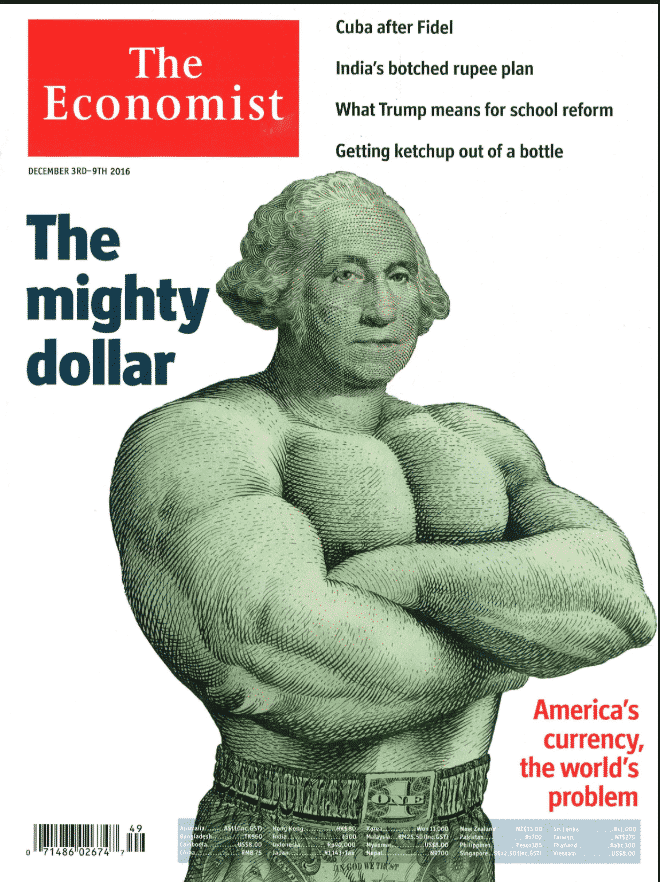
Whenever the dollar strengthens noticeably (and it has just risen to a three year high against the trade weighted basket of other major currencies) commentators usually dust off a quote from former US Treasury Secretary John Connally who, when discussing the strong dollar with visiting German politicians in 1971, said ‘its our currency, but your problem’.

Connally had an interesting career – he was seriously injured in the assassination of John Kennedy and he was responsible for breaking the link between the dollar and gold.

In his remarks to the Germans he most likely had in mind the privileged role of the dollar as the world’s reserve currency, and the reality that America’s trading partners had simply to suffer this ‘exorbitant privilege’ as Giscard D’Estaing put it.

In the context of the trade war, and America’s more singular approach to diplomacy, the recent surge in dollar strength deserves some analysis.

Since the time of Connally – the passage of globalization, the emergence of the euro and the economic rise of China – to today, the dollar has been unassailed as the world’s reserve currency.  With 63% of all of the world’s trade settled in dollars, and similarly about two thirds of all the world’s debt denominated in dollars, the US is arguably far, far more powerful financially than it is militarily.

More importantly, as other sources of American power are diminishing – human development is falling, soft or diplomatic power is in recession, China is catching up in naval, missile and drone military capabilities – the dollar is America’s one remaining source of utter dominance.

One very interesting original, approach to examining the durability of dollar strength comes from Professor Barry Eichengreen, the academic authority on currencies. In a paper entitled “Mars or Mercury? The Geopolitics of International Currency Choice” written Eichengreen and with two economists at the Euro- pean Central Bank (ECB) describes two approaches to valuing currencies.

First, there is the more conventional “Mercury” approach, which gauges currency strength by analyzing variables like interest rates and currency reserves. The second approach, “Mars,” sees a currency as reflecting the standing of a country in the world—the quality of its institutions and its alliances.

Using data going back to the First World War, the paper finds that military and geopolitical alliances are a significant factor in explaining currency strength. The rationale is that a country that is geopolitically well placed is engaged with and trusted by its allies through trade and finance.

Eichengreen and his coauthors have set up a framework to capture the impact on the dollar of US diplomatic disengagement with the world. One of the main implications the “Mars or Mercury?” paper finds is that, in a scenario where the United States withdraws from the world and becomes more isolationist, its strategic allies no longer become enthusiastic buyers of US financial assets and long-term interest rates in the United States could rise by up to 1 percent because there would be fewer buyers of American government debt.

At a strategic level, what is interesting is that despite the chaos being wrought on US diplomacy and America’s diplomatic relationships – Latin America is forgotten, Europe chastised and Asia provoked – there is no sign yet that Eichengreen’s thesis is playing out. Perhaps it is too early to tell.

Perhaps it also has something to do with the fact that much of the rest of the world economy is stagnant – recent data point to the fact that Japan may be in recession and some large European economies are flirting with it. This, and the overeager activism of the Fed make dollar denominated assets attractive keeps the dollar bid. At the same time this draws capital out of emerging economies, a trend manifest in the weakness of emerging market currencies.

In the long run, there are maybe four factors to watch that could make inroads into the dollar’s dominance of finance.

The first two will only become evidence in the aftermath of the next recession, whenever that is. One is the ability of the euro-zone to prove that its financial system can stand up to another downturn (in many ways it is less indebted than the US and China) and grow its economy.

The other, is similarly the financial shape China finds itself in after a period of negative growth, and the kind of steps it takes to build out its financial markets (such as deepening of its bond market and developing its pension system). If it can do so in a way that encourages liquidity and transparency then the share of Chinese assets in international (and Chinese) portfolios will rise significantly, drawing capital out of the dollar.

There are two other wildcards. Should the US continue to disenchant its allies, neighbours and trading partners then the Eichengreen hypothesis will play out, with the Middle East, India and parts of Latin America prone to diversify their currency reserves.  

Then finally, the prospect that central banks may someday introduce digital currencies. This may shake up financial flows, central bank reserves and economic structures, and in turn, might shake the dollar. But, not yet.

Have a great week ahead,

Mike