W.E.N.A

A few weeks ago, it would have been inconceivable to most foreign policy experts that Israeli aircraft could bomb Syria at will with their tanks apparently in shooting distance of Damascus, all the while a new Islamist regime installed itself there. This latest turn in the topsy turvy geopolitical world gives a glimpse of some of the regime shifts to come and the fragility of erstwhile brutal, long-lasting dictatorships.

I absorbed the implications of the event in Abu Dhabi, which in terms of its success and trajectory, underlines the view of some that there are ‘two middle easts’.  At the same time, Abu Dhabi has risen to a point of influence that it will be the lodestar in building the economic structure of the region once a viable peace plan for Israel/Palestine has been found.

The surprise departure of Bashir al-Assad will likely accelerate the reordering of the region and give food for thought to other ‘strongmen’. It may eventually be that a gang of them ends up living out of the Ritz Carlton in Moscow.

Indeed, a couple of academics have tracked the flight of deposed dictators and state that  ‘we find that dictators are more likely to go into exile in states that are close neighbors, have hosted other dictators in the past, are militarily powerful, and possess colonial links, formal alliances, and economic ties. By contrast, fleeing dictators tend to avoid democratic states and countries experiencing civil conflict’. More specifically, in Europe the top three destinations for dictators are Russia, the UK and France!

Despite Assad’s fall, Syria itself is not out of the woods – Hayat Tahrir al-Sham may be media sensitive, but they are also deadly, conservative Islamists. They have manifestly been given a firm helping hand by Turkey, which is re-establishing itself as a regional power.

Turkish foreign policy is an enigma, wrapped in a mystery. In the past I have written how, in the aftermath of the Arab Spring, many countries in north Africa wanted to follow the ‘Turkish model’ of development. Since then, Recep Erdogan has enfeebled the country’s institutions and its economic backbone and has turned a foreign policy that used to be based on ‘no trouble with neigbours’ to one of ‘trouble with neighbours’.

However, Erodgan is a key player now – especially in terms of how he negotiates Russia’s military withdrawal. There remain many open questions, notably how the fall of Syria further weakens Iran and what implications this has for Iraq. Larger regional countries like Egypt and Saudi Arabia will welcome the toppling of Assad and the further undermining of Iran, but now have to face up to the prospect of a regional peace deal where the strength of their support for Palestine will be tested.

If in 2025 a peace deal is struck that keeps in place the two-state formula, then the prospect of a regional economic recovery, led by the UAE (or Abu Dubai as some call it), may not be far off.

Visits to ministries, financial institutions (including Abu Dhabi Finance Week) and infrastructure players, with Prof. Afshin Molavi and several other economists and writers, gave a sense of the ambition of the region.  In particular compared to previous visits to the region, two things stood out as ‘new developments’.

The first is a growing sense of independence on the part of the UAE to go its own way in terms of how it makes policy (as opposed to being a policy taker from the US and the EU). This is evident in finance, infrastructure, labour markets and trade. On trade specifically, the UAE has to be geopolitically ambidextrous in how it builds relationships with the US and China, though when it comes to technology, the sense is that it is very much plugged into America.

The second element worth commenting on is the idea of ‘The Fourth Pole’. I have written on this in the last year, and the idea is that in a multipolar world made up of three ‘poles’ (US, EU and China) there is room for a fourth pole made up of India, the Gulf States and other players across the ‘region’ (which we could define as those countries a five hours flight away from the UAE, which includes some 2.4 billion people across Asia, Africa, Southeast Europe and the Eastern Mediterranean).

The notion of the ‘Fourth Pole’ is gathering pace around the very close relationship between the UAE and India (the very popular Hindu Temple in Abu Dhabi is just one sign), and the web of trade, finance and infrastructure deals they are engaging in across the region. This relationship may not ultimately become as deep as that of the EU countries, but it is beginning to look like a modern version of the ‘Coal and Steel’ community. The risk however, is that they overbuild capacity in the face of a forthcoming economic shock or recession.

As a final word, the best indication that I had that the UAE is feeling both confident and more independent is that some well-connected government advisors have come up with an acronym for the west – W.E.N.A (Western Europe and North America)!

Have a great week ahead,

Mike
From Cranes to Crypto

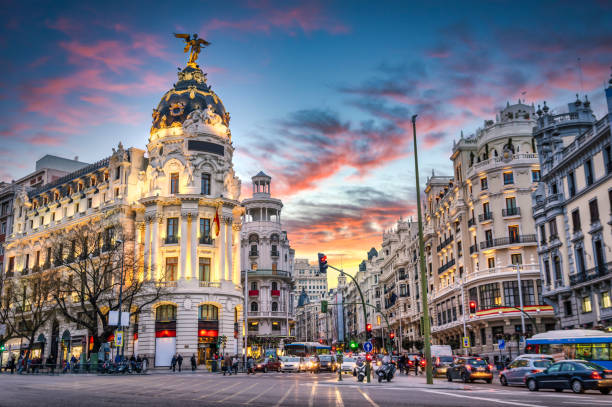
Madrid, Spain cityscape at Calle de Alcala and Gran Via

Regular readers will know that I travel a lot, always with a preference for boats and trains and by air when necessary. Having spent much of the summer without the need for a plane, the next few months will see an intensification of my travel schedule across Europe, the Middle East and Asia.

In most places I will be talking about the economics and politics of a changing world, but the virtue of visiting so many cities (Hamburg to Abu Dhabi for instance) and regions (the Cotswolds to South East Asia) is the opportunity it grants to witness the kinds of growth and development happening in the world, and the measures we can use to compare economic activity across countries.

Here, a few favourites come to mind. In the 1990’s and early 2000’s it was commonplace for economists and investment strategists in the large banks to rush back from trips to Asia with tales of how many cranes they had seen across the skylines of major Chinese cities and estimates of what this meant for the growth of the Chinese economy. Nowadays, those economists sit on a deck chair in the Marina Bay Sands hotel in Singapore, look out onto the bay and count the number of tankers anchored there as a proxy for global supply chain disruption.

Another tell-tale indicator is taxis. A former colleague, friend and reader of this note, with whom I used to travel to Japan in the late 1990’s referenced the length of taxi queues as a proxy for Japan’s then moribund economy (often unoccupied taxi ranks would snake around office blocks).

Then on a visit to a thriving Abu Dhabi in 2012, my taxi driver got lost (on the way to the airport). He apologised, saying it was his ‘first day’. I assumed he meant it was his first day as a taxi driver, but it turned out that it was his first day in Abu Dhabi. I politely took this as a sign of a vibrant labour market and a strong economy.

A risk that travelling economists face, not unwittingly, is that they normally stay in the centre of a city, and often in a decent hotel. I wrote a note some time ago describing this as ‘Grande Bretagne’ syndrome, after the teams from the IMF who oversaw the austerity programme of the Greek economy during the euro-zone financial crisis who stayed in the plush Grande Bretagne and Hilton hotels in the city centre. While this placed them near the seat of power, it meant that they were blind to the brutal impact of austerity across the country.

In general, travelling economists should get out and about. For instance, the quality of public transport in a country is a good indicator of the standard of infrastructure and to an extent, social cohesion and, is also a good way to observe a society. Someone observed that a city in which the wealthy use public transport is a well-balanced one (Zurich is a good example). In contrast, there is, inexplicably, no train from Dublin airport to the city centre, but a ride on the Luas tram will give a very good idea of the dramatic changes in Irish society.

In keeping with this approach, a favourite activity to beat jetlag and to either reacquaint with or discover a city is an early morning run (this week’s schedule took in the Tour Eiffel, the Tiergarten and Madrid (the park was closed due to bad weather)). In that idiosyncratic way, My eyes (and feet) are sensitive to the quality of the road surface, pollution and to the appearance of new buildings and signs of dereliction (Berlin scores on both counts).

There are other indicators of the economic prowess of cities, such as the rise of tall towers (the UAE for instance). In this tech driven age, a new category of indicators might comprise cities that want to become crypto-hubs (UAE, Miami, Zurich, Lisbon) and those that seek to attract large artificial intelligence (AI) firms (OpenAI has just opened an office in Paris).

As a final note on Madrid, I haven’t seen the city as ‘sleek’ or well presented (the 12th was the national holiday), and it must be said, as expensive. Note that Spain now has a slightly lower interest rate (bond yield) than France, and a considerably higher rate of growth than Germany.

The economy appears strong, despite concerns that many people versed about the state of Spanish democracy and its finely balanced political situation – there is likely a contentious budget on the horizon towards 2025.

There were a lot more Latin Americans than I had expected, and this has both helped tourism, and pushed up house prices (to the ire of some locals). Spain’s golden visa system means that it is the recipient of wealthier Latin Americans leaving countries like Venezuela. At the same time, quite a number of Spanish businesses and executives are relocating to Lisbon, which is a warning sign for innovation.

Have a great week ahead,

Mike 

Drinking with Dickens

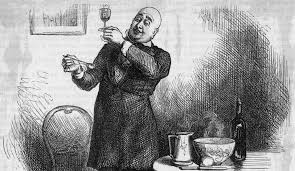
Gin Cup?

An important and iconic book for this time of year is Charles Dickens’ ‘A Christmas Carol’. It is important in that it was written at a time (1843) when the celebration of Christmas was being revived, and where German (Christmas tree), pagan Celtic (feasting) and Christian (Mass) elements of the celebration were fusing together.

Dicken’s book also reinforces the morality tale around Christmas, and partly because of the many film versions of it, I suspect many people associate it with year-end reflections on our society. Like Dickens they vow to ‘honour Christmas in my heart and try to keep it all the year’.

A different and arguably from another point of view, more enjoyable take on Dickens’ work is ‘Drinking with Dickens’, a book written in 1980 by Charles Dickens’ grandson Cedric Dickens. It is essentially a book of cocktail recipes for drinks with exotic names like ‘Smoking Bishop’, ‘Barclays Best’ but in reality is much more than that because it draws on the warmth and conviviality of many scenes in Dickens’ works, and through the recipes it gives a very real sense of the atmosphere of mid 19th century England.

Having come across ‘Drinking with Dickens’ a few years ago I can attest that our drinks trolley is stocked with various gins and angostura bitters. So, confined to home and fortified with more than a few cups of gin punch I sat down to think about some of the potential surprises of 2021.

  • Norway joins the UN Security Council for the next two years and elevates the Arctic to a major geopolitical issue. A titanium Russian flag stuck 14,000ft on the ocean floor beneath the Arctic pole in 2007, goes missing, mischievously stolen by a ‘sub-drone’. Fishing and mineral rights around the Arctic become a topic of hot debate.
  • The electric car boom gives way to a new ‘market craze’, capital begins to flow to genetics and genomics, with a flood of special acquisition vehicles being launched in order to buy into cutting edge startups in areas like genetic editing.
  • As part of its policy of ‘national strategic autonomy’ France opts to favour two French made vaccines for its citizens, but adverse reactions lead to a health and political crisis. Emmanuel Macron’s standing drops in the opinion polls, and the French establishment search for a centre right candidate for 2022.
  • A wave of consumer spending, the side-effects on agriculture of climate change and speculation in lumber prices all conspire to drive up inflation. The US bond market crashes, a pensions crisis ensues, and the Economist magazine proclaims China as ‘the new safe haven’
  • Expectations are high that the Biden administration will focus its foreign policy on China, but it pivots dramatically to Latin America, launching a digital dollar as a way of binding South America to the American financial eco-system, and of reducing corruption and the drug trade.
  • In Asia, Japan, Taiwan and South Korea are forced into daily jet fighter scrambles in order to counter airspace incursions by Chinese fighters. In April a squadron of Chinese Chengdu J-20 fighters is hacked mid-air (in fact the pilots’ head display units are hacked) and the squadron is forced to land in Japan. A major diplomatic incident results.
  • With diplomatic and trade ties with Israel now well established, Mohammed bin Zayed Al Nahyan, Crown Prince of Abu Dhabi, looks to deepen economies ties with India and in so doing, build out an independent geo-political ‘pole’ spanning India and the Middle East.
  • The ‘rule of crowds’ takes hold of policy. The stay at home culture has spawned a new form of policy making where laws, regional budgets and local referenda are driven by ‘crowd voting’ and ‘crowd rating’.
  • Brexit, finally accomplished at the end of 2020 leaves Westminster flat. Without the excitement and urgency of a crisis British politics becomes moribund. Boris Johnson resigns as prime minister and moves to America to become a leading chat show host on Donald Trump’s new television station ‘Patriot TV’.
  • By February, an end to the coronavirus crisis is in sight. Though still proscribed by the authorities, people start to party and revel. ‘Drinking with Dickens’ rises to best seller status and the price of angostura and select gins rockets.

Enjoy the rest of the holidays,

With best wishes

Mike