2025 – The Hangover

I’ve decided to send my Sunday note early for two reasons. Tomorrow morning we head to Cork for holidays and I attach a link with a short list of suggested Christmas reading, and wanted you to have a chance to get to the bookshop (always a more rewarding experience than buying online).

Granted that it is year end, I am often caught up in the swirl of ‘2025’ prognostications on the economy and politics, and while not a great fan of short-term forecasting I thought I would lay out a few themes that will condition markets and economies into 2025.

I wouldn’t start from here.

Financial markets – which are dominated by US equities (over 65% of world market cap), are starting 2025 from a vertiginous place.

Retail investor surveys have never been so optimistic, stock market concentration is at levels last seen in 1929 (the top ten stocks account for 40% of the market) and valuations are stratospheric (a simple measure, the price to earnings ratio, has only been higher in 2020 and 2001). In that respect, many investors might pose the question ‘when is the crash?’. My sense is that absent a damaging trade and supply chain war between the US and China in Q1, we will likely see a very meaningful rotation from US equities to cheaper markets in parts of Asia, but more so Europe (the election of Friedrich Merz as German Chancellor in late February might be the catalyst for this).

The Plaza Problem

A further reason for this is the strength of the dollar, which makes foreign assets cheaper for US investors. Following the election of Donald Trump, a range of key currencies have weakened noticeably – the yen, Brazil’s real, the Indian rupee, renminbi and the euro. Whilst the new Treasury Secretary Scott Bessent will see the benefits of a strong dollar, the weakness of ‘foreign’ currencies is anathema to the worldview of Donal Trump, who dreams of another Plaza Accord (a ‘Mar-a-Lago Accord’) that might reset the competitiveness of the dollar.

The problem with this view, as we head into 2025, is that the weakness of Asian currencies and the euro, relative to the dollar, is driven largely by diverging economic performance. In that context, a Trump administration that runs the economy ‘hot’ risks postponing a grand currency accord. It also risks a resurgence in inflation (and bond yields), which I suspect will be a story for next summer.

China – Japan or Greece?

The one factor that could temper inflation is China, a very large political economy that we know increasingly less about. My bet is that commentators will spend much of 2025 debating whether China is ‘Japan’ or ‘Greece’, in the sense of how the deleveraging of its economy materialises. China will become the risk factor for 2025 – economically, geopolitically and commercially in the way it will respond to the onset of tariffs from Washington.

Despite a recent, aggressive financial stimulus, the Chinese economy is gripped by deflation – in house prices, activity and a fall in entrepreneurial activity. Underlying this is a generalized demand problem.

This year’s plenum on economic policy has not done much to repair the structural creaking of the economy and the worry is that internal ‘reform’ (i.e. a political crackdown) further saps the willingness of entrepreneurs to invest, and equally that Xi is shaping China in the form of a more closed state, that curbs the will of those inside, adopts a singularly selfish approach to those outside, and relies on several great strides in technological industrialisation for the prolongation of the ‘China Dream’.

The contradiction here, and specifically between the three strands to emerge from the plenum, is that in its policy making and economy China needs innovation but is creating a socio-political system that smothers it.  

In this respect, the third plenum and the recent liquidity boost missed a trick in not outlining a Keynesian style stimulus for the economy (or even longer-run structural one). The property market is slowing, entrepreneurs are very cautious and the risks associated with local government debt are rising. While China has so far managed to duck a major recession, the government may have become too complacent about the deleveraging process, and the possibility that this accelerates downwards, dramatically so as was the case for Greece, or tortuously as was the case for Japan.

Bond markets – suffering the hangover from elections

As China slows, the key variable to watch is the Chinese long bond yield, which has been compressing lower in recent months as investors take a dim view of the economy. Elsewhere, there should be plenty of action across bond markets, driven by the fiscal aftershock of elections across the world.

We still have a general election in Japan and the prospect of an election in Germany next February (23rd). In the cases of the US, UK and France, elections have seen bond yields rise in the context of near record indebtedness and very large deficits. 

In that respect, the fiscal hangover begins. Governments across regions will find themselves reined in by bond markets and under pressure to curb spending and in some cases to raise taxes. This pressure alone may eventually tilt economic policy more towards supply side changes, and also change the kinds of issues that politicians focus on such as immigration and identity politics.

Fiscal rectitude may only come to reign after a few bond market tantrums. There are two countries in particular worth watching – France and the US. First, the French budget process has been very drawn out, and with France having to cut its deficit in half over the next three years, it is unlikely that France’s political class, not to mention its public, are ready for deeper austerity. In that way, higher French bond yields will be a fixture in markets and might periodically push much higher.

The other market to watch is the US bond market, which in 2025 may become the limiting factor for equity and other riskier assets. Since the Fed cut interest rates by 50 basis points in September, bond yields have risen and remain stubbornly high. With growth in the US economy strong, and other economies steadying, the risk factor is that inflation rises (though lower oil prices and deflation from China can offset this), driving bond yields higher, or that the desire of the Trump administration to run the economy ‘hot’ provokes a rise in yields. In this sense, the bond market may become Trump’s nemesis. The market reaction to this week’s Fed meeting is a sign of things to come.

This post is a little longer than normal and am now going to ‘down pens’ till you hear from me again on January 12th, when I will focus on some of the risks and potential surprises for 2025.

Have a lovely Christmas and a very prosperous new year,

Mike 

W.E.N.A

A few weeks ago, it would have been inconceivable to most foreign policy experts that Israeli aircraft could bomb Syria at will with their tanks apparently in shooting distance of Damascus, all the while a new Islamist regime installed itself there. This latest turn in the topsy turvy geopolitical world gives a glimpse of some of the regime shifts to come and the fragility of erstwhile brutal, long-lasting dictatorships.

I absorbed the implications of the event in Abu Dhabi, which in terms of its success and trajectory, underlines the view of some that there are ‘two middle easts’.  At the same time, Abu Dhabi has risen to a point of influence that it will be the lodestar in building the economic structure of the region once a viable peace plan for Israel/Palestine has been found.

The surprise departure of Bashir al-Assad will likely accelerate the reordering of the region and give food for thought to other ‘strongmen’. It may eventually be that a gang of them ends up living out of the Ritz Carlton in Moscow.

Indeed, a couple of academics have tracked the flight of deposed dictators and state that  ‘we find that dictators are more likely to go into exile in states that are close neighbors, have hosted other dictators in the past, are militarily powerful, and possess colonial links, formal alliances, and economic ties. By contrast, fleeing dictators tend to avoid democratic states and countries experiencing civil conflict’. More specifically, in Europe the top three destinations for dictators are Russia, the UK and France!

Despite Assad’s fall, Syria itself is not out of the woods – Hayat Tahrir al-Sham may be media sensitive, but they are also deadly, conservative Islamists. They have manifestly been given a firm helping hand by Turkey, which is re-establishing itself as a regional power.

Turkish foreign policy is an enigma, wrapped in a mystery. In the past I have written how, in the aftermath of the Arab Spring, many countries in north Africa wanted to follow the ‘Turkish model’ of development. Since then, Recep Erdogan has enfeebled the country’s institutions and its economic backbone and has turned a foreign policy that used to be based on ‘no trouble with neigbours’ to one of ‘trouble with neighbours’.

However, Erodgan is a key player now – especially in terms of how he negotiates Russia’s military withdrawal. There remain many open questions, notably how the fall of Syria further weakens Iran and what implications this has for Iraq. Larger regional countries like Egypt and Saudi Arabia will welcome the toppling of Assad and the further undermining of Iran, but now have to face up to the prospect of a regional peace deal where the strength of their support for Palestine will be tested.

If in 2025 a peace deal is struck that keeps in place the two-state formula, then the prospect of a regional economic recovery, led by the UAE (or Abu Dubai as some call it), may not be far off.

Visits to ministries, financial institutions (including Abu Dhabi Finance Week) and infrastructure players, with Prof. Afshin Molavi and several other economists and writers, gave a sense of the ambition of the region.  In particular compared to previous visits to the region, two things stood out as ‘new developments’.

The first is a growing sense of independence on the part of the UAE to go its own way in terms of how it makes policy (as opposed to being a policy taker from the US and the EU). This is evident in finance, infrastructure, labour markets and trade. On trade specifically, the UAE has to be geopolitically ambidextrous in how it builds relationships with the US and China, though when it comes to technology, the sense is that it is very much plugged into America.

The second element worth commenting on is the idea of ‘The Fourth Pole’. I have written on this in the last year, and the idea is that in a multipolar world made up of three ‘poles’ (US, EU and China) there is room for a fourth pole made up of India, the Gulf States and other players across the ‘region’ (which we could define as those countries a five hours flight away from the UAE, which includes some 2.4 billion people across Asia, Africa, Southeast Europe and the Eastern Mediterranean).

The notion of the ‘Fourth Pole’ is gathering pace around the very close relationship between the UAE and India (the very popular Hindu Temple in Abu Dhabi is just one sign), and the web of trade, finance and infrastructure deals they are engaging in across the region. This relationship may not ultimately become as deep as that of the EU countries, but it is beginning to look like a modern version of the ‘Coal and Steel’ community. The risk however, is that they overbuild capacity in the face of a forthcoming economic shock or recession.

As a final word, the best indication that I had that the UAE is feeling both confident and more independent is that some well-connected government advisors have come up with an acronym for the west – W.E.N.A (Western Europe and North America)!

Have a great week ahead,

Mike

Moriarty

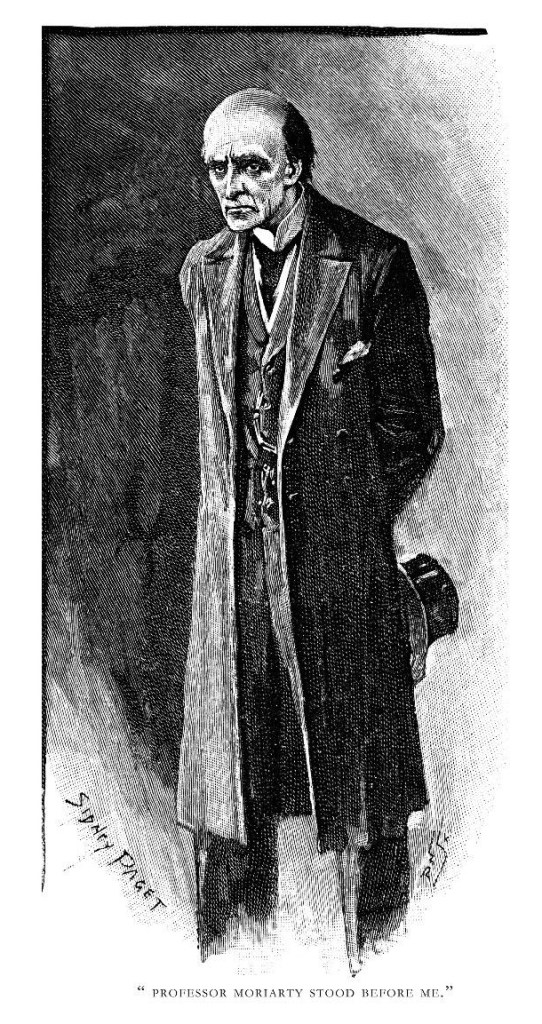
Monday morning started with an early sprint from Baker St to Marylebone train station in London, passing close to 221b Baker St, the fabled home of Sherlock Holmes. However, Holmes was not on my mind, but rather his nemesis, Professor James Moriarty.  I was on my way to a seminar on the future of crime (especially as it concerned robots and social robots) organized by the excellent team at UCL’s Dawes Centre for Future Crime.

The rumour is that Conan Doyle based the character of Moriarty on George Boole, Professor of Maths at University College Cork from 1849 until 1864 (disappointingly his former home on Grenville Place is in a state of dereliction). Boole, one of the great mathematicians, created Boolean algebra which laid the foundations for computer language and is this the structure around which scientists use machines to mimic and ‘improve’ on human behaviour. To that end, Moriarty and the idea of the ‘future of crime’ should be of all the more interest to us in an AI driven world.

Whilst many serious crimes are in abeyance – murder rates in small open democracies (Switzerland, the Czech Republic and Ireland for instance) are very low, and those in the large EU economies – France, Germany, the UK and Italy trend below 1 per 100,000 (the USA is seven times higher), new forms of crime are on the rise, many of them driven by technology.

Mobile phones and social media have become an entirely new vector for crime in terms of the theft of passwords, online bank details, identity theft and the harassment and abuse of people online. Similarly, crypto currencies are the conduit for much criminal activity, and it is believed that confiscations have made the FBI the biggest holder of bitcoin. In addition, the metaverse has opened up an entirely new legal space, where injuries and attacks carried out in an apparently unreal world can have consequences in the real world.

In this context, the issue at stake at the Dawe’s Centre seminar was whether socially intelligent robots can create new forms of crime, that are not yet covered by legal frameworks and for which countermeasures have not been conceived.

It is a terrifying prospect – robots could not only be primed to deliver drugs or explosives but imagine the consequences of robot bodyguards and guard-dogs who take it upon themselves to attack specific targets. In many cases, the prosecution of an assault by a robot would likely follow the logic of charging the owner of a dog (Britain’s Princess Anne was famously prosecuted when her pitbull ‘Dotty’, bit two children). On a more mundane basis, robots increasingly interact with vulnerable humans – the lonely, the elderly and for instance autistic children, and while these interactions are very helpful, they also open up scope for abuse. In time the growing prevalence of sex robots will cause all sorts of controversies.

However, in cases where the robot acts intelligently and autonomously, the law is not clear and frameworks on AI offer only meagre guidance. Robert Harris’ book ‘The Fear Index’ is a good illustration of what might occur when an intelligence ‘bot’ takes over a critical infrastructure, and the use of AI on the battlefield is chilling in its ruthlessness.

Heavy duty robots also permit the exploration, surveillance and protection of faraway places (the deep sea, space and remote parts of the earth) though at the same time they permit mischief by various actors such as attacks on critical marine infrastructure.

It may well be that, as in the case of driverless cars, socially intelligent robots are less dangerous than humans, though the notion itself of criminal robots is cause for concern. For the time being, many of the impetuses to the ‘future of crime’ are human factors. Some of them relate to changes in wealth – such as the rise of powerful oligarchs, and a rich ultra-high net worth class of people who on one hand are targets for crime and on the other hand have the means to dominate others and push their own visions of what society should look like. We may see more of this type of behaviour in coming years.

Then, we really get into ‘Moriarty’ territory when states begin to collaborate with individuals and gangs, as is the case with Russia for instance. States have access to intelligent and often lethal robots and can enable organized criminals to use them – it is not impossible that gangs might start to use drones in contract killings. The other, related area that is increasingly relevant here is corporate intelligence and security (Lewis Sage-Passant’s book on this topic is very good) where many corporate security teams have to combat hacking and other attacks by robots, from criminal gangs, and as was sadly demonstrated in New York last week, assassins.

If Moriarty existed today, and perhaps he does, corporates as well as governments might be his preferred targets, and he would very likely equip himself with robotic henchmen (and women) who could subvert the human world.

The question is, what would Sherlock do?

Have a great week ahead,

Mike