The Diplomacy Crash

US stock market valuations have only been as high as in 2001 and 2020, market concentration is more extreme than in the late 1920’s (the top ten companies now make up 38% of the market capitalization of the S&P 500 index), and money manager surveys show US households to be the most bullish on future returns from equities since the survey began in the early 1980’s.

So, given this precarious euphoria, when is the crash?

My response is that crashes come in unexpected places and times and one idea that has not had much coverage but that might become current is the idea of a ‘diplomatic crash’. By this I mean that a host of countries have invested diplomatically, or in terms of soft power, in institutions, partnerships and causes. The acceleration of a multipolar world by the second Trump presidency will crash the value of many of these diplomatic investments.

An example might be the ‘special relationship’ between the UK and the US, the seeds of which were sown by Roosevelt and Churchill during the second world war (Churchill coined the term in 1946), and later cultivated by Thatcher/Reagan and then the Bushes and Clintons with both John Major and Tony Blair. Today, it is very hard to see any personal chemistry, or philosophical common ground between Donald Trump and Sir Keir Starmer. If the ‘special relationship’ were a stock or even a crypto coin, its value would be at a historic low.

In more detail, the idea of the ‘diplomacy crash’ came to me the night before I voted in Ireland’s general election. Ireland is a very quirky, even eccentric country from a geopolitical view in that unlike many other European countries there is close to no debate in Irish politics on defence and security, and its defence capability is miniscule compared to benchmark countries like Norway and Sweden.

In that context Ireland, like many other mid-ranking developed countries, is about to suffer a diplomatic crash. It has, correctly, invested heavily in the UN and the rules-based order. Some of the pillars of this order, like the World Trade Organisation – effectively built by an Irishman (Peter Sutherland) – are in a state of dereliction. It may well be the case that the UN ceases to be effective in dispute resolution between states, world health policy and great power coordination.

In addition, together with Spain and Norway, Ireland has spent significant geopolitical capital supporting Palestine (all three countries recently recognized Palestine as a state). Here, it cannot be ruled out that a grand peace deal is made in the Middle East, between Israel, Egypt, the UAE and Saudi Arabia, whose goal is to create greater investment and commercial flows between these countries and strategically disable Iran, but whose outcome is to render the ‘two-state’ solution unachievable. This new, harsh reality would leave the humanitarian led foreign policies of many European countries well ‘off-side’, compared to the stance of the Trump administration.

Ireland is just an example here, and there are plenty of other crashes in diplomatic capital – Germany’s trade policy with China, and potentially Japan’s relationship with the USA, France’s relationship with Africa and in general the cultivation of the rules-based order by democracies.

In finance, when a market crash occurs, investors become structurally risk averse, run for safe assets and generally retract positions. This might be the same in diplomacy. The risk then is a more unsure, less engaged diplomatic world, and worryingly one where the international rule of law is ignored.

In Europe, reflecting the lessons of the euro-zone financial crisis, this may imply that EU foreign policy becomes more consistent across countries (though perhaps not yet unified) and more focused (Katja Kallas is perhaps the most forceful foreign policy chief that the EU has had). In addition, new policy coalitions and leadership groups will form, notably so in the case of the Nordic and Baltic states on defence and immigration.

The EU also needs to stop geopolitical hedging by its members. Hungary under Viktor Orban has become notoriously close to Russia, and whilst Serbia had tried to play both sides it seems more comfortable as a bona fide EU nation (it is an accession state).

Once Ireland’s election result is clear, the first task for its leaders may be to choose sides – solidarity with Europe and active participation in the EU defence effort, or a singular, eccentric relationship with the Trump administration.

 Have a great week ahead,

Mike

Profiles in Courage

John F Kennedy, who died this week 61 years ago, is famous for many things, but a lesser known accomplishment is that he won a Pulitzer Prize for a bestselling book entitled ‘Profiles in Courage’, that told the stories of eight American political figures (mostly senators if I recall) who took morally courageous stands on issues that went against the views of their parties and popular opinion. An example was John Quincy Adams’ decision to break from the Federalist Party (over foreign policy).

Like all things Kennedy, the book was a dazzling success, but also had a few magical ingredients. It is generally accepted that Ted Sorensen, adviser and speechwriter to Kennedy, contributed much of the book, or in his own terms, he wrote ‘many of the words that made up the sentences’. Equally, the book did not make it through the formal entry process for the Pulitzer, but was nudged into the competition by Joe Kennedy, the president’s father.

As an aside, in the context of the recent presidential election, it could well be argued that Joe Kennedy was a Trumpian figure…or that Trump is simply following the ‘Patriarch’s; example (David Nasaw’s book of this title is very good). Joe Kennedy accomplished more as a businessman than Trump, but fell short in his political career. Instead, he groomed Joe junior(killed in the second world war), then John, Bobby and Ted.

One of Joe senior’s achievements was his appointment as American ambassador to the UK, but his term was cut short because of his perceived stance on appeasement. With some irony, Joe senior had encouraged the publication of his son’s Harvard thesis as a book.

‘Why England Slept’ queried the ‘soft’ stance of the British government towards Germany in the lead-up to the war and argued that if Britain had re-armed earlier and taken a more robust stance with Germany, the second world war may not have happened, or at least might have taken a different path (the book was a great success and the British royalties were given to the city of Plymouth which had been badly bombed by the Luftwaffe).

Though Robert Kennedy junior may now take the ‘Kennedy’ limelight, the message of JFK’s books echoes in today’s world. In a couple of years’ time, someone might write ‘Why Europe Slept?’ in the sense that Europe has let its guard slip on security and not built defence infrastructure to keep up with the threat of Russia.

In a week where a Chinese vessel is suspected of cutting a telecoms cable between Germany and Finland, when the first EU defence and space commissioner has been confirmed (Andrius Kubilius’ first task is to compile an inventory of Europe’s defence supply chains) and where an intercontinental ballistic missile has apparently been used on Ukraine, there is a sense that Europe is still not ready for the worst.

The idea of ‘profiles in courage’ is even more pertinent. In a multipolar world, where countries and companies have to ‘take sides’, where America will arguably become more transactional and less relationship driven in its foreign policy and, where democracy is being eroded from within and afar, moral courage will be at a premium.

One unfortunate example here is Olaf Scholz’ moral capitulation in calling Russia’s president last week, ostensibly to lay the groundwork for a peace deal. Scholz likely had the upcoming German elections in mind, but his call was rewarded with an intense bombardment of Kiev.

This has left Scholz even more discredited. Up until this week there was now a growing debate around his future as SPD leader and the prospect that he could be replaced by Boris Pistorius, the popular defence minister. Pistorius has declared that he does not want the leadership tole.

This is a pity for Germany, because having Pistorius in place as Social Democrat leader by the time of the election might boost the party and would also make a coalition with the CDU easier to form and more ideologically consistent. As it stands, the polls show the CDU/CSU with some 32% of the vote, the SPD on 16%, AfD at 19% and Sara Wagenknecht’s party at 7%. At that rate the CDU-SPD coalition might need to take on a smaller partner, but in effect Merz would be the dominant partner.

A Merz lead coalition could be a real change for Germany, could reignite its economy and remake its energy policy, and may turn it into a more robust geopolitical player vis a vis Russia.

My advice is that Merz, and his compatriots at the head of the SPD both read the works of John Kennedy. 

Have a great week ahead,

Mike

Distance

If any readers travel to Singapore, I can recommend they visit the Botanic Gardens to sense the dawn break. A badly adjusted body clock brought on by jet lag meant that I found myself jogging around the Gardens at 5.30am on Monday and Tuesday mornings – uplifted by the sounds, smells and sights of this mini paradise.

My few days in Singapore, principally to speak at the Founders Forum gathering, allowed me to gauge the Asian reaction to the prospect of a second, more menacing Trump term in office.

I did so armed with the memory of a May 2016 visit to Singapore where I had asked a gathering of some 300 people to compile a word cloud (using their mobiles) of thoughts and emotions they associated with Donald Trump. The result was harsh, and very few of the participants that day thought Trump would be elected as president in 2016, and just as few thought that Brexit would happen.

To my mind the event was emblematic of the certainty of the era of globalization, and the ways in which this was smashed by events like the first Trump presidency, Brexit and the smothering of Hong Kong’s open society.

Singapore is one of the most important places to observe these changes from – it is highly globalized (the DHL Connectedness Report highlights it as the most globalized country in the world), delicately balanced between the Chinese commercial and American worlds, and institutionally one of the strongest countries (though it is one tenth the size of County Cork, it has an active army nearly ten times the size of that of Ireland). As a leading ‘micro-power’ it has an even greater stock of soft power.

As such Singapore will acutely feel the rising tensions between China and America especially in terms of the technologies it uses, investment flows and diplomacy. For context, the soon to be secretary of state Marco Rubio has laid out the faultlines in the relationship between China and America in an interesting document entitled ‘The World China Made’.

Indeed, several prominent politicians in Singapore such as prime minister Laurence Wong have declared the end of the ‘golden era of globalization’. My guess is that in the Trump era, Wong and colleagues will have to tread incredibly carefully diplomatically. Economically, it is clear that Singapore’s role as the wealth hub of Asia, or its ‘Geneva’ is gathering pace, and also obvious that its economy is benefitting from the growing prosperity in countries like Indonesia.

There are two other aspects of my visit that are worth stressing, less for what they say about Singapore but more for what they tell us how the ‘West’ is perceived.

First, with regard to Europe, in two separate meetings I was asked if I thought the euro would survive. This greatly surprised me as not only do I think the euro is a solid, though not yet perfectly formed currency, I have not been asked that question in Europe in nearly ten years. It suggests that Europe still has a reputational problem, or that at very least its ‘message’ is not reaching Asia. Conversely, it seems that there are too few Asian voices in the European media – connecting us to what is happening in cities like Singapore and Hong Kong.

The second reflection, which also resonates across Europe, is that for the first time in at least a century, an American presidency is being launched that has a manifestly threatening and aggressive stance towards the rest of the world.

America has historically been the builder of relationships, alliances and institutions (Pax Americana) and its (soft) power has been built on this. The tenor of the Trump cabinet is increasingly clear, and many of the appointees appear to have been selected on the basis that they did bad things in the past, or that they are prepared to do bad things to others in the future.

This is the great unknown for the USA, that its new posture towards the rest of the world causes it to lose influence and friends. 

Have a great week ahead

Mike

Empire

Donald Trump will be president of the United States for a second time, defying those who thought his first term was an anomaly and who considered that the American people still care about the rule of law. He will preside over the 250th anniversary of US independence, the next Olympics and World Cup.

This is an election result of such great consequence that it will decide whether America’s hegemony is renewed, or that its empire fades like so many others have done through the ages. Fittingly, I woke up to the news of Trump’s victory in Vienna, a city that knows a thing or two about empires. In that context, an interesting and possibly underread book is ‘The Hapsburg Way – 7 rules for turbulent times’ by Eduard Habsburg, known formally as the Archduke of Austria and now a career diplomat for Hungary.

Of Habsburg’s seven rules, the most important are ‘Believe in the empire, and your subsidiarity’ and ‘Respect law and justice’. Trump will likely not do well on these counts, nor does he score on ‘Be Catholic’ though the Catholic church has chased his coat-tails through the electoral campaign. He does better on ‘Get married and have many children’ and ‘Be brave in battle’.

The book is full of interesting snippets, such as that the first governor of Texas (in 1691) was installed by the (Spanish) Habsburgs. In that respect the only blemish in the book is the foreword, written by Habsburg’s boss Viktor Orban, who this week held court over his European counterparts in Budapest, in the wake of the Trump victory.

While I think that Trump will be much more disruptive for Asia and Europe, and that his presidency will see an unprecedented re-shaping of the Middle East, a great deal of media attention is devoted to his impact on Europe and NATO. Overall, the reaction is far too alarmist and the vision of world leaders cowering before Trump gives little acknowledgement of his and America’s vulnerabilities.

Despite this, with near comic timing, only hours after Trump’s victory was confirmed, the squabbling German government fell apart, a development that has been simmering for some time.

Germany will likely have an election next March, and this is good news. Scholz’ ineffective and indecisive government will be thrown out (Scholz may also be replaced by Boris Pistorius at the head of his party), and Germans will vote in a centre-right government, if polls are to be believed. There is very strong appetite on the part of German businesses to restart the economy, unblock planning laws and rethink energy policy. This much was very clear to me when speaking with investors and businesspeople in Hamburg (after Vienna).

If a new centre-right government transpires in Germany, this should re-engage the political engine at the heart of Europe between France and Germany. But there is a small chance that Emmanuel Macron will not be president of France in a year’s time. Macron, who this week compared Europe’s fate to ‘herbivore in a climate of carnivores’, is fantastically unpopular in France and it cannot be discounted that the Rassemblement will try to bring him down in 2025. Similarly, there is a risk that far-right parties in Europe are emboldened by the Trump victory.

Apart from the travails of the German and French leaders, there is a shift of power going on across Europe – in favour of Poland and Italy, and towards the Baltics/Nordics. The sense is that a Trump led US will bring about the end to the Pax Americana, which may initially leave Europe more vulnerable diplomatically, though ultimately it will become more independent (to America’s disadvantage). Arguably the loser here is the UK, stranded offside the EU, and at odds with Trump and his vice-president.

A Trumpian America, if true to the caricature, will leave Europe as the last bastion of democracy and independent institutions. This is a great challenge and one that most people are not ready for. In events I speak at, a trick question I pitch to the audience is to ask how many of them (usually accomplished, educated people) would enter politics – in most cases there are few volunteers. If European democracies are to be renewed, politics must re-civilise itself and to quote Eduard Habsburg, politics also needs more brave people.

Another area to watch is institutions. Donald Trump already politicized the Supreme Court and might well do the same with the Federal Reserve. On Thursday the Fed, oddly in my view, cut rates, but the press conference after the meeting was dominated by Chair Powell denying that he would resign if Trump requested, he do so. As America’s institutions may become more politicised, and world institutions like the UN and WTO become less relevant in a Trumpian world, Europe needs to ensure that the independence and competence of its institutions is pristine.

Returning to the topic of defense, perhaps the most interesting confirmation hearing (by the EU Parliament) of EU commissioners designate was that of Andrius Kubilius, the Lithuanian, first defense commissioner. His first task will be to deliver a paper (in 100 days from now) on the state of defense procurement, the integration of defense supply chains and the opportunities for a more intensive commitment to space technology. In his commentary, he revealed that a pan-European missile defense shield could cost up to Eur 500bn. So, we should brace ourselves for the issue of EU war bonds to pay for this.

To end this note with a very big picture view, in the context of the theme of the ‘Levelling’, Trump’s first victory was a wrecking ball to globalization. This second one shatters it completely and will try to remake America and the world order with a narrative and vision (‘tariffs’, ‘deportation’, ‘loyalty tests’) that will deglobalize. Politically, Trump has sold Americans a political vision based on the Leviathan (the people surrender their liberty to a singular leader in return for protection). Europe is still a ‘Leveller’ type system (bottom up democracies). Of the two approaches, I am with the Levellers.

Have a great week ahead,

Mike

No-one will save you

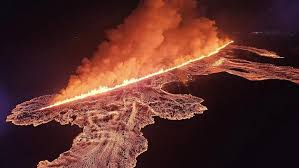
A headline in last week’s Guardian caught my eye. It read ‘No-one will save you’ and detailed the bubbling awakening of a volcano near Grindavik in the south of Iceland. Granted that we were in the area, we drove down to have a look. My family didn’t share my ‘lava-lust’ and luckily for them the police were still in place and roads to the volcano were closed.

However, the ‘no one will save you theme’ is also relevant to Iceland in the financial sense, in the way it represents a rare example of a small, powerless country that resolved its banking and debt crisis by itself, in a very painful but ultimately productive way.

Some readers may recall that in the mid 2000’s Icelandic entrepreneurs were making headlines with bids for leading British retailers like Hamleys and Karen Millen. That a small, fish led economy of some 350,000 people could produce such brash, adventurous capitalists has less to do with Iceland’s Viking and Celtic heritage than the over supply of cheap money from its banks.

At the time, Iceland vied with Ireland for the title of ‘biggest banking sector’ (relative to GDP). According to a presentation deck from Mar Gudmundsson, the Norwegian who took over as head of Iceland’s central bank post the crisis, the Icelandic banking sector grew by a factor of three times between 2004 and 2008. Specifically, Iceland’s banks, the likes of Glitnir, Landsbanki and Kaupthing (all AAA rated of course) were growing their balance sheets at a rapid rate (to a near record 10 times Iceland’s GDP) and bankers travelled from London to sell them new, genius investment ideas.

Like Ireland, Iceland became admired for its ‘model’ economy, and took advantage of the fawning of other Nordic countries and bodies like the OECD to sell more ‘Glacier bonds’.

There are plenty of colourful stories about the exploits of Icelandic bankers at that time, but to cut a long story short, when the global financial crisis struck in October 2008, the Icelandic banking system quickly collapsed.

As a small, open economy with meagre financial resources, the fallout was dramatic and painful. In the aftermath of the crisis, the Reykjavik stock market fell by 90%, the corporate bond market cratered and the currency (Icelandic krona, ISK) by 50%. Many households had borrowed in foreign currencies and as a result saw the burden (in ISK) of their mortgages soar. On paper, Iceland’s debt to GDP hit 700%.

A classic banking bubble was soon followed by a deep, textbook ‘bust’ (one economist Hermann Schwartz summed it up as ‘Iceland came late to the global party, drank too quickly, and hit the floor rather harder than larger economies’)

What is most interesting about Iceland is the way it resolved its crisis, largely by itself and through the will of the people. This might sound obvious or even trite, but when I compare it to the fallout from Ireland’s economic blow-up whose causes were very similar to Iceland’s banking crisis, Iceland has demonstrated a far greater degree of reform and accountability in its public life. In a world of heavily indebted nations the example of Iceland is one to bear in mind.

Like other European countries at the epicentre of the financial crisis Iceland was gripped by protests. Reform came quickly. The long-serving prime minister, Geir Haarde lost his job (his last speech to the nation ended with the words ‘God save Iceland’), and the governor of the central bank was forced out of his role.

The new government, and to a large extent the Icelandic people are considered to have largely taken ownership of the resolution of the crisis (think of the public opposition to pension reform in France as a counter example). Some thirty-six bankers were tried, sent to jail and fined, a development that is in stark contrast to other crisis hit countries.

Iceland suffered a brutal financial shock, and a deep hit to the real economy (output dropped 15% in two years), though this was ultimately less severe than the damage done to the Greek and Spanish economies, one reason for this being the manner in which the drop in the ISK made Iceland attractive as an exporter and tourist destination (the curiosity of tourists was also piqued by the explosion of the Eyjafjallajökull volcano and the use of Iceland as a location for Game of Thrones). .

A number of financial reforms also helped, the financial regulator was given extra powers, notably to protect deposit holders and new, domestic economy focused banks were created. The government refused to assume responsibility for debt owed to foreign nations and investors (many of whom were in the UK which placed Iceland on a terror watch list). Fiscal austerity was imposed, under the watch of the IMF, but this was less onerous in its conditionality than that imposed on Ireland, Greece and Spain.

The result of this reform and readjustment process was that the Icelandic economy began to recover some three years after the crisis started, and according to Iceland’s central bank GDP growth had caught up with the recovery of the US economy by 2018, surpassing that of the euro-zone.

Whilst it is a small, idiosyncratic economy, there are some clear lessons from Iceland in terms of how an open economy might deal with a multi-faceted banking, debt and currency crisis.

Very broadly, the key elements involve prioritizing the domestic economy, domestic banking  deposits and the free functioning of the financial system,  the sense of justice and accountability that comes from ‘regime’ change and the arraignment of guilty bankers, the absence of overly punitive austerity, and the presence of a stabilizing mechanism (in this case the currency).

As I write, Iceland’s economy seems to be thriving, with a new focus on biotech, geothermal power and climate-tech.

France, Germany and the UK should pay attention.

Have a great week ahead

Mike