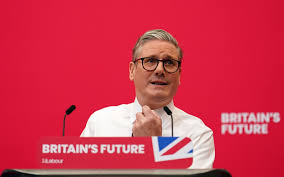
Is Labour Ready?

Rishi Sunak’s sodden, tragi-comic, and surprise announcement of a UK general election was an amusing episode in a so far uneventful ‘year of democracy’.

The announcement was a boon to headline writers, who had fun with phrases like ‘Drowning St’. My attention was piqued by the background music ‘things can only get better’ (D:Ream), which added to the farce, but which British political aficionados will recognise as the song that was also used by Tony Blair’s New Labour party in their 1997 election campaign.

At the time, I was finishing my studies and happened to be in London on the day of the election, and vividly recall walking past Downing St, where the sense of a new era was palpable. Today, the challenge for Keir Starmer is whether he can spura new era of growth and renewal in the UK, or whether his party simply turns out to be ‘not the Tories’.

In the late 1990’s, Blair’s government, bolstered by a very strong front bench, had spent a long time preparing for government, and once in power made a series of dramatic policy moves (see our recent note ‘Does debt smother politics?). By comparison, the most important question for the July 4th election – with the Tories 21 points behind Labour in the polls and destined to be wiped out (some 100 sitting MP’s, mostly Tories, will not stand this time) is, how ready are Labour?

Whilst the election announcement has taken many Tory MPs by surprise, my sense is that Labour would also have much preferred a November election – they still must find candidates for over 80 seats and faces a few awkward spots such as Islington North where Jeremy Corbyn will stand as an independent. Indeed, the fact that both the Tories and Labour are logistically unprepared for a July election might benefit the Liberal Democrats, which opens up a small chance of a coalition government (importantly electoral reform would be the price of this).

To date, Keir Starmer’s Labour has given relatively few details on its program, partly to allow space for the Tories to slip up and partly not to skew the debate on the outlook for the economy. This will be Labour’s greatest challenge.

When Blair came to power in 1997 the British economy was bigger than that of China and India together, the world was under the steam of globalization and debt to GDP in the UK was close to 40%. Today, China regards Britain as a ‘little island’ (nothing wrong with little islands!), globalization has come asunder and debt to GDP is 100%.

I suspect that if there are early, dramatic wins for Starmer, they will be in tax (cutting back exemptions for the wealthy and potentially a wealth tax), corruption (standards in public life), and institutional reform (end of the House of Lords?).

Revitalising the economy will take longer, notably because Labour will initially stick to the UK’s fiscal rules and take pains to avoid any early volatility in the pound and gilt markets. In order to enact its plans for technology and ‘green energy’ investment Labour will most likely have to create partnership with international institutional investors.

Outside of these areas it is not clear to me how Labour can immediately reverse the damage done to educational, social services (NHS) and the fabric of small towns and cities, exacted by the Tories. It will require a level of imagination, funding and policy continuity not seen in British politics for decades.

In foreign policy, Labour’s approach will be a much less contentious one – relations with Ireland (which have deteriorated since Johnson) will be much warmer, and the approach to the EU will most likely be less confrontational and more collaborative. Whilst David Lammy (shadow foreign secretary) has spent a decent amount of time in the US, courting Republicans and Democrats, the scenario of a Trump presidency and a Labour government is a high probability one, but a configuration that would stretch the notion of a ‘special relationship’. 

In defence I expect little headline level changes to Britain’s commitments, but the shadow defence minister John Healey will likely re-organise the military command and HQ, and importantly spend a good deal of time reorganising defence investment and procurement so that it gives ‘value for money’. 

In the next few weeks, Labour faces twin, urgent challenges – mobilising the party across the UK, focusing on making inroads in the south and Scotland, and then preparing for government in the context of a gargantuan challenge.

The good news is that the summer holidays start just after the election which I suspect will mean that the effective policy launch of the new government will kick off in September.

Have a great week ahead,

Mike
Not Alright

Since I last wrote on the rise of the far-right in ‘Spode’, they have become marginally more popular though importantly not more powerful and, worryingly more dangerous. In Germany, there has been a spate of arrests of members of AfD (Alternativ fur Deutscheland) and in Slovakia Roberto Fico who is regarded as part of the European far-right has been attacked in a brutal reminder of how violent public life is becoming. Then the Netherlands has finally formed a government, with a far-right ‘dirty and nasty’ twist, in the sense that it upends environmental policies and takes a much tougher stance on asylum and immigration.

The European elections in two weeks’ time will emphasise this. With the polls settling ahead of the vote, the far-right (I&D group) and the very conservative right (ECR) will garner about 22% of the vote.

My expectation is that compared to this time last year, the far-right does better than expected in France, less-well expected in Germany, and very poorly in Italy (as the Lega near implodes). To that extent, the far-right (and extreme-right) is now a fixture on the political scene in the West. We should also take this as a reminder or even confirmation that the world is increasingly troubled by the spectre of the 1920’s, when war, nationalism, extreme politics and economic volatility brought globalization to an end and shattered the world order.

On the optimistic side, I had the pleasure to moderate an event last Thursday on the rise of the far right in Ireland. Ireland is interesting because it is the Candide of nations in that it has hitherto been blissfully untroubled by issues like immigration and the far-right that have beset other European countries, but that are now live issues in Irish politics as both immigrants and politicians suffer violence.

The far-right is problematic in several ways – they sap the energy and momentum from democracies (witness the damage that the likes of Steve Bannon, Itamar Ben-Gvir and Matteo Salvini have done to their countries), there has never been a successful far-right government in a democracy (Italy’s current government is currently ‘acting’ centre-right), and the narrative of the far-right counts homophobia, misogyny, racism and intimidation as its core behaviours.

Now that I have that off my chest, what can governments, policymakers and citizens do to diminish the allure of the far-right? Unsurprisingly there are no quick fixes, and we could bracket the assembly of policy recommendations into four segments.

The first is resources, largely in the form of the allocation of housing and shelter to both immigrants and ‘natives’ in the context of very tight housing markets across Europe (according to the FT the UK has the highest amount of homelessness in Europe because the supply of ‘shelter’ by government and local authorities has dropped sharply).

The second is to address the political narrative around the far-right. In Ireland’s case, a series of very sudden socio-economic changes have occurred, many of them due to deglobalization (refugees from wars, Brexit) and the implications of these changes has not at all been thought through by politicians. As such, the political narrative needs to capture and frame these changes, set out strategic (and not knee-jerk) reactions to them, and then open up a civilised debate around them. Of course, the far-right does its best to poison this debate.

Then thirdly, several experts I met mentioned the role of ‘on the ground’ coaching and engagement of younger people through the arts or sports, so that they do not succumb to violent behaviour associated with the far-right (last month two 19 year olds were arrested in Dublin for what appears to have been the racially motivated murder of a Croatian man).

Then fourth policy focus is the array of external factors acting to undermine our democracies – the role that Russia and China have in undermining Western democracies, and the side effects of social media on younger voters (the EU has just launched an action against META under the new digital services Act in this regard), and of course the careless vandalization of democracy by the likes of Donald Trump and Boris Johnson.

The mention of Johnson leads me circuitously to some good news.

Arguably, Brexit was the outcome of the enticement of the right by the far-right into a bad policy. There is now a consensus that it was a bad idea, at the enormous expense of a broken economy and the withering of Britain’s international reputation, but potentially also with the boon that Britain has discovered that a lurch towards ugly ‘far-right’ politics (such as Rishi Sunak’s unworkable Rwanda policy) doesn’t pay off. Later this year, Britain will very likely vote in a centre-left government against a wider backdrop of a move to the right in Europe. Other countries shouldn’t try to learn this lesson the hard way. 

Have a great week ahead

Mike

Central BAInking

When central banks fall down, they often call other central bankers to help out. The Riksbank asked Mervyn King, governor of the Bank of England up to 2013, to examine its forecasting ability over the course of the 2010’. More recently, the Bank of England whose own forecasting went askance (nothing to do with the practices instilled by Mervyn King of course), asked former Fed chair and Princeton professor Ben Bernanke to cast an eye over its methods.

Bernanke delivered his report a year ago, where his broad conclusion was that central banks in general had performed poorly at macroeconomic forecasting, chiefly because of the series of large global shocks the world has experienced (and I would add the resulting ‘shock and awe’ response of central banks). In the specific case of the Bank of England, Bernanke painted an unflattering picture of a fusty institution where software systems are embarrassingly outdated, data sets are poor and staff resources are badly managed.

One clever solution to all this might simply be, in this age of AI, to ask ChatGPT to forecast growth and inflation. I did so, and it told me to ask the Bank of England.

In fact, central banks are already using what is popularly known as AI. Some central banks in emerging nations like Indonesia use it to scan the public reaction to their monetary policy, and many economists have been using machine learning and probabilistic models well before AI became popular. Indeed, there is growing thought leadership on the use of AI in central banking by bodies like the Bank for International Settlements (BIS).

In some fields, central banks use AI to help oversee the supervision of financial institutions. The ECB has launched the Athena project, which uses AI to help banking supervisors scan millions of documents, so as to help regulators spot anomalies. An extension of this focus is central bank monitoring of fintech firms who themselves use AI to allocate credit and investment strategies to individuals and households.

In the recent past I have referred to the growth of this segment of the banking industry, especially that over one third of ‘unicorn’ level companies in the UK are fintechs and many of these are involved in AI driven lending.  This raises many challenges for supervisors, not simply the difficulty of grappling with new datasets (and their provenance) but also in terms of trying to understand the construction of the AI models that drive fintech services.

In the context of the finalisation of the EU AI Act this year, the use of AI in finance is one of the areas where central banks and supervisors have some catching up to do. Imagine when stock exchanges and certain institutions start to use quantum computing in trading and research.

To my knowledge, the use of AI in central banking seems to be grounded in the assumption that AI driven outcomes are produced to aid, but not replace, the economist/supervisor. I call this the ‘One Man and his Dog’ approach, where the human is assisted in a complex task by a clever, adaptive non-human actor (it used to be a dog but now it’s a computer). It would be a mistake for central bankers to take a more machine centric approach. However, a few obstacles remain.

To tally with Prof Bernanke’s verdict on the Bank of England, IT systems at central banks and data management capabilities are behind the best in the private sector, and the market for intellectual labour is in a bubble as far as AI relevant skillsets are concerned. As a result, language model technicians are unlikely to work in central banks – though my own experience is that today the best economists are also very good at modelling and also deploying AI models.

Data is perhaps the biggest hurdle. I came to economics and econometrics at a time when ‘proprietary data sets’ were hand input into excel spreadsheets from corporate accounts, or from clunky Datastream codes. Today the world is awash in datasets that help to explain the behaviour of households and companies – if central banks could be fed this data they would, potentially, be a lot wiser than they are now, though the risk is that they might become too data sensitive.

The temptation then for the next generation of central bankers will be to use the muscle that their supervisory powers give them to obtain high frequency glittering datasets from payment companies, buy now pay later start ups, and option pricing datapools from the institutions they oversee, and clean and analyse these for the benefit of monetary policy and fraud detection. Some central banks, such as the Bank of Canada are active here, but this trend is a developing one. These high frequency datasets can potentially be very interesting in reading economic shocks, and the response of economies to the monetary policy that follows shocks.

There are at least two more considerations.

First, relatively few economic commentators have drawn the link between central bank digital currencies and AI. Central bank digital currencies, if implemented, could generate huge datasets in the financial behaviour of households, which might then be better used to fine tune monetary policy. In an ideal monetary world, central banks would make small, high frequency and economy specific adjustments to policy through their digital currency frameworks (under this every household would have a bank account with the central bank), according to the AI driven models, with a goal of fulfilling their monetary objectives.

Second, central bankers, a fairly conservative though not unsophisticated lot, will have to learn to change their mindsets and communication techniques if they are going to deploy AI to their advantage. That might just be the biggest obstacle.

Have a great week ahead,

Mike 

Handbags

The last time that Xi Jinping visited France (2019) Emmanuel Macron presented him with a 1688 copy of ‘An Introduction of The Analects of Confucius’. Xi is back in Paris this weekend, his fourth visit, placing France alongside Kazakhstan and South Africa as Xi’s favourite destinations after the US (five visits) and Russia (nine).

As such, the question on my mind is what book Macron should give him this time?

He might start with something on Germany, notably Fritz Stern’s ‘Gold and Iron’ to remind us of what a strong chancellor sounds like (Bismark coined the notion of ‘blood and iron’) and indeed to highlight the link between capital and diplomacy. This is relevant because the first dilemma for Macron is how to steer Olaf Scholz toward a tougher political view on China, given that the German economy remains heavily dependent on China. Macron and Scholz had dinner together (spouses included) in Paris on Thursday.

We don’t know what was discussed – the installation of Mario Draghi as a replacement for Ursula von der Leyen, and Germany paying France to broaden its nuclear deterrent to an EU level – are two possibilities. China’s stance towards Ukraine, its deepening alliance with Russia and the ‘dumping’ of Chinese electric vehicles are topics that were most certainly broached. The mystery is Scholz’ insistence on continuing with a visit to the Baltic states on Monday (6th May) when he could have accompanied von der Leyen and Macron to greet Xi. It might be that Germany just wants to keep its ‘special’ relationship with China to itself.

Macron might reflect that at least by having von der Leyen there, the case will be made to Xi that visiting Hungary and Serbia, two ‘bad’ actors, at the same time as France is very bad diplomacy by China. It shows that either China is very far away from a cultivated form of soft power, or that it is now so committed to its relationship with Russia that it cares less about what Europe thinks of it.

At the same time, China has lost Italy as a member of the Belt and Road group, and most of the Baltic and Eastern European states regard it with deep suspicion. Macron should dig out a copy of ‘White Eagles over Serbia’ by Lawrence Durrell to make the point that any influence operations out of Serbia will be contested.

If he is feeling imperial (often), Macron might offer Xi a copy of Claude Martin’s ‘La Diplomatie n’est pas un dîner de gala – mémoires d’un ambassadeur’, all 946 pages of which are a reminder of the grandeur of French diplomacy, China’s humble origins and of course how far it has come, spurring demand for French handbags. I should say that, nice caricature as it is, handbags don’t make it into the top ten of French exports to China.

In that respect the substance of the Xi visit will likely be about the ways in which Europe will derisk but not decouple its trade relationship with China. At this point, I suspect that from the point of view of sensitive technologies, much of the de-risking has happened, and that EU-China trade relations are bottoming out (I expect little warmth at the diplomatic level). Both regions will for the time being regard each other as a ‘hedge’ should Donald Trump be re-elected in November and restart a series of trade disputes. Europe does not see China as a close or natural ally, but it may also be useful to preserve civil relations with it lest American politics takes a wrong turn.

To return to the question I mentioned at the top of the note, perhaps the book should be on economics, specifically asset price bubbles and speculation, an original 1841 version of Charles MacKay’s Popular Delusions and the Madness of Crowds’. An even better idea might be some of the original pamphlets (I know where to find them) relating to the scheme of John Law, the Scotsman who blew up the French economy in 1720. It is a tale of financial engineering that few countries have surpassed, with perhaps, the exception of China.

With best for the week ahead

Mike