Age of Debt

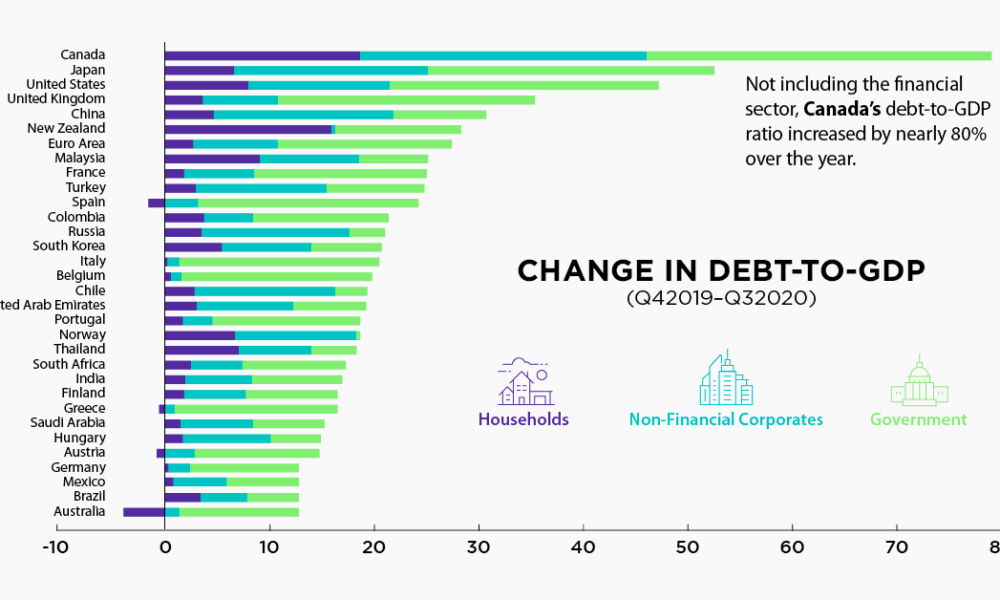
The beginning of the week was market by three, similar warnings, each of which add to the drumbeat of alarm over rising debt levels. In France the official government deficit was found to be higher than expected and contributing to a creaking burden of debt, then Larry Fink the head of one of the largest financial institutions warned of the ‘snowballing’ levels of debt accumulation, finally and perhaps most dramatically the Congressional Budget Office in the US has also been highlighting rising debt levels, and in a chart that will likely be repeatedly shared across the media, mapped forward the rising debt to GDP of the US government.

Rising debt is a pre-occupation of mine as many readers know (do listen to Waking up to World Debt). It will be impossible for the world economy to grow at a sustainably high rate until the mountain of debt that the large nations have accumulated is reduced. In recent notes I have started to cover how high debt levels will change politics, and on how indebtedness is part of the equation of great power rivalry.

Several other ‘truths’ are becoming clear.

Nearly fifteen years on from the global financial crisis, it seems that the policy community has largely forgotten the lessons of the crisis. I have re-examined three important books written during and in the aftermath of the crisis (Gary Gorton’s ‘Misunderstanding Financial Crises’, Raghuram Rajan’s ‘Faultlines’ and Mian & Sufi’s ‘House of Debt’), and in general the recommendations and lessons drawn out in those books remain ignored by the policy community. Debt has become an economic way of life. For reference, the UK public debt has gone from GBP 500bn before the financial crisis to GBP 2.6t trn today.

An remarkable facet of the rise of indebtedness is that it is correlated with other ‘crises’. For instance, there is a parallel between the growth of indebtedness and climate damage – average global temperature and indebtedness have grown in tandem (driven by the growth of infrastructure and industry in China in particular), and warnings of impending crises go unnoticed.

One reason for this is the adaptation of the economic system to both climate change and indebtedness, and the fact that policy makers are so far insulated from the consequences of each of these risks – the assumption is that central banks can now control bond market volatility, and so far catastrophic climate events happen ‘only’ in emerging countries.

While a scan of the long-run of economic history, and most finance textbooks would suggest that we should be in the antechamber of a debt crisis, this does not seem to be the case, and the adaptation of the economic system around debt is one reason for this. The prevailing assumption now is that the world economy can operate ‘normally’ in a climate of very high debt levels, and to coin a term we are in an ‘Age of Debt’.

The idea of the ‘Age of Debt’ is something that deserves greater attention, and as a framework it could have several characteristics. Here are a few.

One potentially dangerous trend is the rise of the ‘debt’ industry which is to say the emergence of a decent number of private credit firms in the US in particular, who can lend in a more liberal way than regulated banks.

A corresponding trend is the rise of fintech firms focused on lending (of the Top 100 most promising technology companies in the UK, according to Sifted, over a third are in the fintech sector and a good number of these involve digital lending). The ‘buy now/pay later’ service is a growing feature of many large fintech platforms. Many of these companies will use AI on scraped data and credit histories to decide which consumers are worthy of running up high personal debts.

The rise of the ‘debt industry’ is simply building debt distribution pipelines beyond the banks that have become heavily regulated as a result of the global financial crisis. To an extent they are doing what banks cannot do, and in some cases doing it better than the incumbent banks. To another, they are simply layering more risk onto the financial system.

An interesting element of this, is that the risks associated with rising debt are arguably becoming centred around individual countries. Up to 2007 the global financial system had become interconnected, which is why contagion spread across the international financial system. The global financial system led to enormous deleveraging and retrenchment of banks from overseas markets. This is reinforced by the growth of the ‘debt industry’ as lending focused fintechs and private credit providers are, to my calculations, operating within borders. The upshot of this is to make national financial systems riskier. 

In time, the ability of national financial systems to work through debt will be a marker of the rise and fall of nations in the 21st century.

Have a great week ahead, Mike

Are we there yet?

Just two years ago, Germany’s Chancellor Olaf Scholz made a speech in the Bundestag organized around the theme of the ‘Zeitenwende’, which to translate means a period of transition or regime change, or more scientifically a paradigm shift (in geopolitics). It marked a high point in Scholz’ chancellorship. Ever since he has done everything he can to not live up to the challenge of the Zeitenwende, and on my last recent visit to Berlin, I found business people and policy makers despondent.

Germany is not alone in going through its Zeitenwende. Taking an international view, the phrase I increasingly use is ‘Interregnum’, a word inspired by the period between the two King Charles reigns (Charles I was captured in 1647 and then Charles II was ‘restored’ in 1660) when England experimented with a republican democracy.

The Interregnum represented an interruption of the established order of things, and a period of turmoil and some experimentation. Ironically, the initial phase of the 17th century Interregnum was initially a period of democratic innovation, and aptly, today we enter a geopolitical Interregnum in the company of the third king Charles.

To reiterate, my view of the Interregnum is that it has three phrases at least and here I am heavily influenced by Thomas Kuhn’s Logic of Scientific Revolutions. The first centres around the crises of the old, crumbling order notably in debt and democracy, the second phase around social, legal, and economic superstructures built around new technologies (AI, quantum) as well as the evolving contours of the multipolar world order, and then thirdly, the acceptance and coalescence of new world institutions, governments, and companies around this new world order.

In this context, the question that the under-siege German Chancellor might like an answer to is ‘how long will all of this take?’ or even ‘are we there yet?’ as impatient children might demand of their parents on a long trip.

A first step is to date the starting point of the ‘Interregnum’. Granted that the era of globalization started with the fall of communism (the Berlin Wall) I would bookend it with the July 2020 imposition of the National Security Law by China on Hong Kong, effectively snuffing out Hong Kong’s democracy, and emblematic role as a hub of globalization.

Without going into elaborate detail as to how long the ‘Interregnum’ could take, there are various literatures that might help point the way. One that is popular in the US is the ‘Fourth Turning’ idea as outlined by Neil Howe and William Strauss, that posits that cycles in geopolitics and economics are consistent with 80 year human cycles (broken down into four twenty year phases). So, by their estimation, the next, positive geo-economic phase will start in the late 2030’s.

That date is consistent with other rules of thumb. Samuel Huntington’s waves of democracy theory points to febrile periods of close to twenty years between the peak of one wave of democracy and the start of the next wave. In addition, if one of the two major economies – the US or China was to endure a debt crisis, that is a process (rather than event) that could – to use history as a benchmark, take a good seven years to resolve itself.

The idea that an economic or specifically a debt crisis could shape the ‘next world order’ is consistent with the ideas of Minsky and Kondratieff cycles. Another associated literature would suggest that long run geopolitical ‘paradigms’ are associated with empires (the first wave of globalization was driven by the British Empire). Empires tend on average to last for 250 years, with Rome being the most impressive. America’s empire, built around an unrivalled financial infrastructure, military power and corporate giants, remains intact, but we should worry that Donald Trump may soon play the role of Nero.

The length of paradigms or regimes is something I want to devote more time to, but my instinct is that we are only into the first two years of a near fifteen year ‘Interregnum’.

One interesting aspect of this is the alarming reversal of many upward trends in progress that we had come to take for granted – China’s fast economic growth has stopped, human development and longevity in the US has turned down. New trends and players are emerging – Poland is the most exciting economic and political player in Europe now, the Baltic states are geopolitical micro-powers and Saudi Arabia is shifting from a strict Islamic state to an authoritarian, ‘luxury’ power.

Meanwhile, in Germany, the question is can it endure another fifteen years of Zeitenwende?

Have a great week ahead,

Mike

How to be ‘Bigly’

A few weeks ago we wrote of the ‘Bubble Brewing’ in large US technology stocks. Since then some tech stocks like Tesla have struggled, but the leader in the ‘bubble’ pack Nvidia has powered on though it is becoming more volatile, such that on a given day it rises or falls by the same magnitude of the market capitalisation of well-known European firms like Volkswagen (Nvidia is worth over USD 2 trn, while Volkswagen is worth a paltry USD 65bn).

The disparity in size between what many would consider a giant of European industry (Volkswagen employs 670,000 people half of whom work in Germany) and a fast-growing tech company (Nvidia has roughly 26,000 employees) leads many people to demand that Europe should have its own giant companies. This is not itself a coherent strategy. In the US, the technology giants have become so large as to at very least be oligopolistic, and in some cases monopolistic.

Only the veneer of great power competition where tech giants are part of the competitive arsenal of the great powers makes this level of concentration acceptable (by the way the ten largest companies in the US have the largest share of the stock market since…1929).  

While Europe doesn’t have this problem, a better way to frame the ‘we need to be bigger’ question is to ask what can be done to allow European companies to scale more easily – that after all is the essence of technology led businesses.  With a new European defence procurement strategy being put in place, the EU AI Act in force and a supporting ‘supercomputing’ strategy drive its infrastructure, this question becomes even more pertinent.

When I think of firms that have successfully scaled across Europe, many have done so by mergers and acquisitions (drinks and spirits) and most are in industries with tangible products that appeal across cultures (luxury goods, payment technologies and drinks, again). In most cases, the difficulty in scaling lies in distribution networks – financial services being a good example.

There are many reasons why it is difficult to scale firms across Europe – the lack of deeper capital and venture markets is one. A more telling reason is the cultural and legal complexity of operating across countries with distinct ways of doing things. Within this, the vast majority of European firms – even those fast growing tech firms – tend to have an unavoidable cultural imprint, and these ‘imprints’ make it extremely difficult for firms to go from the ‘national’ to the ‘pan-national’.

For example, whilst many French politicians speak to the idea of pan-national champions, virtually no large French companies have ‘foreigners’ as CEO’s (and few women also). For most executives, the ‘national’ rather than ‘European’ corporate politics matters, in the same way that most European politicians would value a seat in their national parliament more than the European parliament.

What then needs to be done to build large pan-European corporate champions?

First, a few clues come from countries in the geographic and cultural hinterland to the EU. The UK, for instance, used be home to large firms – banks, oil companies and a few tech giants – which is widely regarded as a free-market capitalist economy. The UK should have more mega cap companies but it appears that the shock of Brexit, a longstanding neglect of education and public services and the degradation of the labour market, have undercut its attractiveness. Two other countries that come to mind in a more positive sense are Canada and Switzerland.

Canada doesn’t have any mega-cap companies (it has a bunch of large banks, railway companies and miners) but the breadth of its investment ecosystem strikes me as one for Europe to emulate. It is one of the few economies (it has the same population as Poland and 10 million less than Spain) to have a range of successful venture, private equity, infrastructure, and agriculture investment firms and very large pension funds, thanks mostly to progressive pension and tax laws.

Switzerland is perhaps a beacon for Europe. Despite the fact that it has a population that is only 12% of that of Germany, its stock market is just half the size of that of Germany (Switzerland has a more impressive stock market to GDP and population ratios than the US), and Switzerland has a range of large global firms such as Nestle and UBS. There are a few elements for Europeans to focus on, notwithstanding the fact that Switzerland is very much the exception.

One is that Switzerland has a well-developed capital markets and a large pool of savings capital (a lot of it comes from outside Switzerland), a developed financial markets eco-system, a lively market for executive labour, high levels of research and development and heavy investment in education (front skills based apprentice schools to top flight universities like ETH). Digesting the Swiss recipe for success, and that of other countries might lead to the following suggestions.

The Swiss example might point to the need for greater private funding (through endowments) of universities, spread across departments so that developments in physics are matched by the legal and philosophical frameworks that should accompany the deployment of new technologies. It might also point to better funding of pensions and the ability for pension funds to invest in a wider range of asset classes. There is also a need for the European Investment Bank to make greater equity investments, and potentially greater coordination between corporate venture capital firms across Europe.

More generally, Europe needs to think about corporate governance on a pan-European level, to reiterate a recommendation we made in ‘The Levelling’

One such proposal would be to harmonize the processes involved in setting up a business. The European Union could establish an EU-level process whereby entrepreneurs could adopt an EU template for setting up a business such that it would take the same amount of time to establish a business anywhere in the European Union. The EU entrepreneur template should ideally make the early stages of the life of a business as uncomplicated as possible and it could be a basis to harmonize laws across specific topics, such as bankruptcy, prosecution of corruption, and labour laws. This would be a much more meaningful reform than deeper political uniformity’. 

This proposal could for example be established under the EU Horizon programme, and with deeper pools of capital might be the beginnings of a cadre of European corporate champions.

As a final comment, perhaps the greatest obstacle to policy action on building corporate ‘champions’, is that there are no votes in this as a political issue in Europe, and therefore little impetus for change.

Have a great week ahead,

Mike

Does debt smother politics?

An early, formative career experience of mine was an internship in the City of London, where I sat a few metres away from the office of Gavyn Davies, then (and now) a very prominent economist. He was instrumental behind the scenes, in spurring some of the early policies of the New Labour government of the 1990’s, such as the radical move to give the Bank of England its independence.

At the time, one of the great tasks of City economists was the parsing of the Budget. Budgets were great set pieces affairs, dramatized by Chancellors like Ken Clarke sipping whiskey as he delivered the Budget. Trolleys of sandwiches (and a few whiskies) would be delivered to economist’s desks as they made sense of the Budget and then transmitted their views to gilt, currency and equity investors. The Budget was a frontpage story for nearly all newspapers.

Today, the Budget is a whimpery affair. The speed of telecoms, pre-releases and the spinning and whispering of press secretaries mean that the interesting detail reaches markets and the press well before the Chancellor stands up. In addition, bond markets today are more sensitive to inflation figures and the manipulation of central banks, so they are less sensitive to fiscal tweaking.

As Jeremy Hunt delivered his Budget, there were effectively two ‘elephants’ in the room.

The first is that this year is an election year (possibly May but more likely November), and the second is that the sense checking by the Office for Budget Responsibility that accompanied the delivery of the Budget, made it very clear that the scope for fiscal manoeuvre (the Chancellor is constrained by a fiscal framework) is very limited. In particular (depending on how we measure it), government debt to GDP is close to 100%, a historically high level and one that should set alarm bells ringing.

The very limited set of options open to Jeremy Hunt was a perfect illustration of how, when government debt hits record levels, policy choices are severely curbed.

A report by the respected Institute for Fiscal Studies the day after the Budget made this very clear, even a recent BBC 4 radio interview with Hunt’s junior minister Laura Trott laid bare the fact that few senior politicians have a grasp on the UK’s indebtedness problem.

What is happening in the UK, Europe and in the US, is that debt is smothering politics in the sense that the financial burden that high levels of debt produce (in the context of high interest rates), reduces the policy options that governments have.

To an extent, reflecting the euro-zone crisis, governments are now the wards of bond markets (and their own fiscal rules). To stick with the example of the UK, though it is much the same for neighbouring countries like France, Jeremy Hunt brandished GBP 10bn worth of tax cuts, but he will spend eleven times that on debt interest payments.

I do not think enough attention is given to the ‘debt smothering politics’ thesis, but we can start to think of its implications.

Against a backdrop of elections throughout 2024 and a broader ‘democratic recession’, the idea of debt dominating fiscal policy may cause further disenchantment with politics. It might also drive politicians to focus much more on identity politics and polemic issues like immigration (as is the case in France and Italy) and to become speculative and populist on economic policy (expect talk of ‘taking chainsaws to debt loads’).

A less pessimistic view is that much reduced fiscal space means that there are fewer means to ‘buy off’ voters (Jeremy Hunt’s budget was a case in point) and that as result political leaders are induced to reform public services and possibly, public life, along the lines of the playbook introduced by the ‘Troika’ to Greece and Ireland in the aftermath of the euro-zone crisis.

In turn the debate may turn to economic growth and what the UK for example, might learn from neighbouring countries like Ireland, or even how economic and financial reform in the aftermath of the Napoleonic Wars (debt was extremely high) permitted the English economy to outperform the French one.

Before we arrive at that rosy scenario, I suspect that the first port of call for debt-burdened politicians will be central banks. Notably the Bank of Japan has swallowed over half of the national debt market, which has reduced the short-term consequences of indebtedness, but increases the risk of an ultimate, existential crisis.

In an indebted world there will be greater pressure on central banks to compromise themselves and act in ways (i.e. control the level of bond yields) that reduce the political consequences of indebtedness. In this respect the US could prove interesting if Donald Trump becomes president.

He doesn’t like taxes, and is unlikely to want to raise them, but cutting them may lead to a rise in bond yields. As result, one of his first moves may be to replace Jerome Powell with a more overtly political Fed chair (markets may not like this either). If that doesn’t work, he might start to threaten to chainsaw the national debt. America might then have the crisis Trump deserves.

Have a great week ahead

Mike

All Creatures Great and Small

Over a week ago Emmanuel Macron’s team attempted to show how ‘close’ he is to the people and the ‘terre’ by arranging a set piece meeting with up to thirty farmer’s groups at the Salon de l’Agriculture. However, there were two problems. Only a couple of those groups turned up, and another protest group stormed the pavilion where Macron was holding forth, leading to an enormous scrummage with riot police.

In the context of a country where to paraphrase Charles de Gaulle, it is near impossible to govern any country that produces 258 cheeses, there is an important link between politics and food, and by extension farming. In recent years, French politicians have in general failed to live up to this bond – infamously in 2008 when Nicolas Sarkozy insulted someone (‘casse-toi pauvre con’) at the Salon.

Jacques Chirac stands out as a president who visibly enjoyed the Salon, lingering at the stands, tickling calves, eating and drinking everything put in front of him. In recent years I have taken a Chirac-ian approach, consuming agricultural amounts of wine, beer, cheese and meat at the Salon, so much so that in early February I receive multiple invitations from the viticulteurs and agriculteurs of France, asking me back to sample their wares.

Last Friday, as I strolled through the vast setting of the Salon, I wondered about the relationship between food and politics.

In diplomacy, food is deployed to seduce and impress (witness the French state dinner for King Charles last year), or to disappoint (the culinary highlight of a joint German-French cabinet offsite, hosted by Germany, was herring sandwiches). Stalin used to apparently invite Communist Party officials to dinner, get them very drunk, and then hoover up the gossip and secrets that they spilled.

Underlining the link between politics and food, there is a group called Les Chefs des Chefs, a very exclusive gathering of the personal chefs of heads of state, and their slogan is ‘if politics divides people, a good table brings them together’. An infamous incident that haunts the group is George H Bush’s vomit into the lap of the Japanese prime minister at a state banquet in Japan (in 1992), an act that the Japanese refer to as ‘Busshu-suru’.

In the wider world, the food and drink we consume is driving important social changes, some of which I referred to in last week’s note ‘The Great Retreat’ that charted the mostly negative, historic ways in which human interaction is changing.

Markedly, in Europe’s ‘northern’ countries – from Ireland to Germany, the typical shopping basket contains 44% processed foods, as compared to roughly 15% in Mediterranean countries. There is a strong correlation between the consumption of processed foods with obesity and cardio-vascular diseases.

In addition in the ‘south’, households spend more time eating and drinking (mostly together). Research by the OECD shows that the French, Spanish, Italians and Greeks spend close to two hours per day eating and drinking per day, as opposed to a meagre hour for the Americans, Canadians and Dutch.

Against this backdrop, one might think that farmers in France and Italy are happier than their European counterparts, but they have been prominent in sacking the Salon and spreading slurry in Brussels during recent protests. For those of you interested in a dark account of agricultural life, do read ‘Michel Houllebecq’s ‘Seratonin’.

Many of the protests across Europe are driven by smaller farmers, disillusioned at national and EU agricultural policy, together with the purchasing power of large super market chains and the political power of ‘large’ farmer groups. Our own experience in the beer industry is illustrative of how difficult it is to succeed, in the absence of a big distribution network, for example.

It is fashionable to blame globalization for the apparent demise of farming as a profitable small business activity, but I suspect that the high interest rates, inflation and price variability of the post-globalized world will be more difficult.

I have two observations to add from an investment point of view, one is the rise of the agtech sector in Europe – which will help some farmers with data analysis, market places and DNA for fruit crops for instance, the other is how very few professional agriculture investors there are and that surely there is greater scope to have more investment managers focused on this space (notably those with good impact credentials).

In the future, to parse my conversations with French famers, the future will be to, where possible, allow less produce to be processed, and more to be specialised and branded – an example is the very good Toonsbridge buffalo mozzarella from Macroom, County Cork, not a traditional ‘buffalo’ stronghold.

Have a great week ahead,

Mike