The Great Retreat

Whenever I walk down the street, I can’t help thinking of René Barjavel, a science fiction writer, who when asked (in 1947) to imagine what the future might look like conceived of a vision (then made into a short film ‘La Télévision, l’oeil de demain’) where human life was dominated and disrupted by handheld ‘television’ devices, to the extent that people walked through streets bumping into each other as they watched their screens.

The guiding thesis of Barjavel’s work related to the undermining of civilisation by technology, something that is now becoming more apparent as a widespread trend.

We are at a point in the very long run of history where many established patterns of human behavior are being subverted…in what I call the ‘Great Retreat’. That is to say that in general people – in the West and Asia are retreating from established norms of behaviour, and specifically are retreating from traditional social interaction. These deviations from trend are occurring in the way we socialise, the effects of what we consume on our bodies and perceptibly the ways in which we organise our lives.

Here are a few snippets to illustrate – there is growing documentation of the effects of a loneliness epidemic and researchers are linking this to higher rates of Parkinson’s and cardiovascular disease, a large cohort of adults and young adults in countries like Japan living in effective celibacy and this is also a factor in China whose population is now in a structural decline whilst in the West the birth rate in England & Wales is the lowest on record, a tripling of worldwide obesity since 1975 according to the World Health Organisation to these extent that the Centres for Disease Control and Prevention puts US obesity prevalence at 42% – something that has contributed to a vertiginous drop in life expectancy.  

In brief, in many countries human body shapes and cardiovascular health are changing for the worse, they are interacting less with each other, consuming more information from ‘manufactured’ or non-human sources (the average American checks their mobile device 159 times a day) and are breaking with the cycles of life that have defined the human race over the past three thousand years.

There is a sense that these trends represent a new departure compared to the established social patterns of the past two hundred years, but they also coincide with much lower poverty globally, generally greater longevity (except the US) and broadly greater wealth.

However, there is also the unavoidable impression that the above trends are correlated, and in the view of someone like Barjavel perhaps, are provoked by over industrialisation (of foodstuffs and lifestyles), over-financialisation (of real estate) and over digitisation.

The effects of the ‘Great Retreat’ are already being felt in politics – higher levels of abstention and radical ‘left/right’ voting in many countries and large differences in voting intentions between younger and older generations, and in work patterns (my hunch is that for younger workers the trend towards working from home is altogether less productive).

This sets up a significant task for policy makers, especially those who grow up during the ‘Great Retreat’ and who may not question its long term effects (such as falling birth rates).

In the context of a more laissez-faire approach, a dystopian society threaded together by social media, with high levels of wealth and health inequality could arise, but there might also be a tech led path that could continue to solve the side-effects of obesity and low fertility rates.

In a typical European model, a policy approach might well involve the introduction of ‘civics’ courses in schools on the importance of diet, use of social media, primacy of democracy as well as greater sanctions on disinformation. On the human side, pension and tax systems may well see revolutions that incentivise higher fertility and city planning will, in an ideal world, start to incorporate the need for greater sociability.

Either way, the conception of the ‘Great Retreat’ as a policy idea is not yet upon us but it might be an idea for one of the dwindling world institutions like the WHO or UN to take up.

Have a great week ahead

Mike
Gorky Park

At the end of last week’s note on Russia’s tactic of ‘Maskirovka’ I touched on another favourite of the Kremlin, ‘kompromat’. I was tempted to mention the Ritz Carlton Moscow, the scene – allegedly – of some epic ‘kompromat’, and joke that whenever I stayed there, I was always in bed early, out of trouble as it were.

One reason I got to bed early in Moscow was that I like to make early morning runs through the city, often from Red Square through Gorky Park, which I think locals found amusing as there is not much of a running culture in Moscow.

One run I will not forget came in the aftermath of the murder of the reformer and former deputy prime minister Boris Nemtsov, seeing clusters of flowers on the Bolshoy bridge where he was gunned down. The shocking aspect was how close this happened to the Kremlin, the implication being that Nemtsov had fallen foul of the Kremlin, and it had decided to wipe him out.

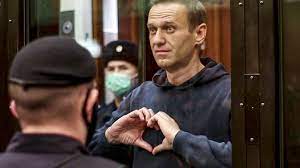
I immediately thought of the flowers at the scene of Nemtsov’s death when I heard that Alexei Navalny had passed away (very likely murdered). The effect of his death, coinciding with the Putin interview I discussed last week and the Munich Security conference, is chilling.

If any good comes of it, it will be to disabuse reasonable people of the notion that the Russian government is not a malevolent threat. In this context there is much to do – Germany must rid itself of Russian influence within the state, Austria, the UK and Switzerland should rid their financial systems of the tens of billions of Russian money and countries like Ireland need to take security and defense seriously.

Navalny’s death also sharpens the war on democracy that Russia has led. Here too, there is much to do. I will shorten this note by linking a TEDx talk I was privileged enough to give in Stormont, Belfast recently, where I lay out some of the measures needed to restore the credibility of democracy. One notable element is for governments in democracies to take a more aggressive, active stance against states like Russia who target our democratic processes.

The link is here, I hope you enjoy the Talk, and feel free to circulate.

Have a great week ahead,

Mike

Maskirovka’d

I am always keen to shamelessly remind readers that I am a man who can ‘see around corners’, as they say. In 2018, as I handed in the last draft of ‘The Levelling’ I wrote the following regarding Russia, its broad strategy of ‘total war’ and more specifically its tactic of ‘maskirovka’…

‘Some countries, such as Russia, are already practicing war by “many means”—that is, where traditional military force is mixed with covert action, propaganda, and disinformation. The Russian doctrine of maskirovka, has roots that go back to the fourteenth-century Battle of Kulikovo and was further developed more recently, beginning with its use in the Second World War.

In a very basic sense, it involves the use of decoys and deception to distract and destabilize an enemy, though the doctrine of maskirovka has broad applications, stretching to disinformation, propaganda, and politically related tactics. A significant element of the thinking that reflects the new doctrine of warfare in Russia is that wars do not follow the same boundaries and time lines as they did historically.

This means that they are not officially declared—in the way cyberattacks happen—and that they can rely on many different types of force (e.g., information, humanitarian, and media) and can rely on the  subversion of states on a continual basis using mercenaries and special  operatives’.

At the time (2018) Russia had aggressively interfered with elections in the Netherlands, Germany, France and the UK, to name a few episodes. This was a mere sharpening of tools for what was to come, and while Russia has isolated and weakened itself by invading Ukraine, it has not given up the tricks that have been honed since 1380.

This much was on display in Tucker Carlson’s interview of Vladimir Putin, which took advantage of Carlson’s craven character, the prevalence of social media noise, the gullibility of many in the West and of course the rottenness of Donald Trump. In the minds of many, Putin has thrown sand in the face of those in Congress who support Ukraine, suggested that a ‘win-win’ deal is soon available, and that Donald Trump is a reasonable man worthy of Putin’s respect. In each case, the opposite is true.

Worryingly, this particular episode of ‘maskirovka’ has damaged the outlook for Ukraine, the security of NATO countries (and vulnerable ones on the flanks of NATO like Ireland). Arguably it ups the ante in the US presidential election and suggests that Russia (with the tacit support of China) is bent on further vandalising western democracies in this critical year for elections.

It should be said that Russian is aided and abetted by many politicians in those same western democracies. There are a few that grasp the magnitude of the challenge, and they are mostly in countries close to Russia, and that have battled to revive democracy and the rule of law in their countries, notably Poland’s Donald Tusk who this week castigated the Senate in Washington for its failure to support Ukraine.

I have not found much literature by way of how to do ‘counter-maskirovka’ operations, and I am likely not looking in the right places. We may need a ‘playbook’ soon as elections approach around the world.

What is happening in Poland is instructive in terms of the repair work being done on institutions – the media, courts, civil service and central bank to name a few have become degraded and politicised, and while some argue that they are now being politicised in a different way, the program of work that Tusk is pursuing highlights the importance of independent institutions as a buttress to outside interference.

The politicisation of the Supreme Court in the US, and the failure of social media giants to counter manipulation emanating directly from Moscow suggest that America is opening itself up to ‘maskirovka’.

Speaking of which, the other, better-known facet of Russian manipulation is kompromat – the use of economic, political and personal secrets to rein in enemies (though a Russian journalist Julia Latynina is quoted as saying to keep kompromat on enemies is a pleasure. To keep kompromat on friends is a must’).

I suspect that one of the candidates for (US) president has quite a bit to worry about in this regard (its not Biden), the question is, will we ever get to see the evidence?

Have a great week ahead

Mike 

Bubble Brewing

I have seen and heard many things that have made me cynical about the investment industry, but nothing pricks my ears when I hear ‘valuation’ deployed as an entreaty for retail investors to buy  expensive assets (one of the best I heard is a former colleague who declared that a company was expensive on the basis of a price to earnings ratio (P/E) but cheap on the basis of the earnings yield (E/P)…they are the same thing!).

On that basis my credulity was recently stretched when I heard an analyst at Morgan Stanley, the large investment bank, declare that technology stocks are ‘attractively valued’ based on the ‘price to innovation’ ratio. Price to innovation is the ratio of the price of a company to its earnings plus what it spends on research and development – as such it is designed to make companies with scant earnings and large, risky investment budgets, look attractive.

As a rule of thumb, when the financial community start to invent new valuation measures, it is time to worry. In the early 2000’s analysts introduced valuation ratios such as ‘price to clicks’ for internet stocks, so as to try to give a veneer of respectability to bubble level valuations. Of course, it all ended badly.

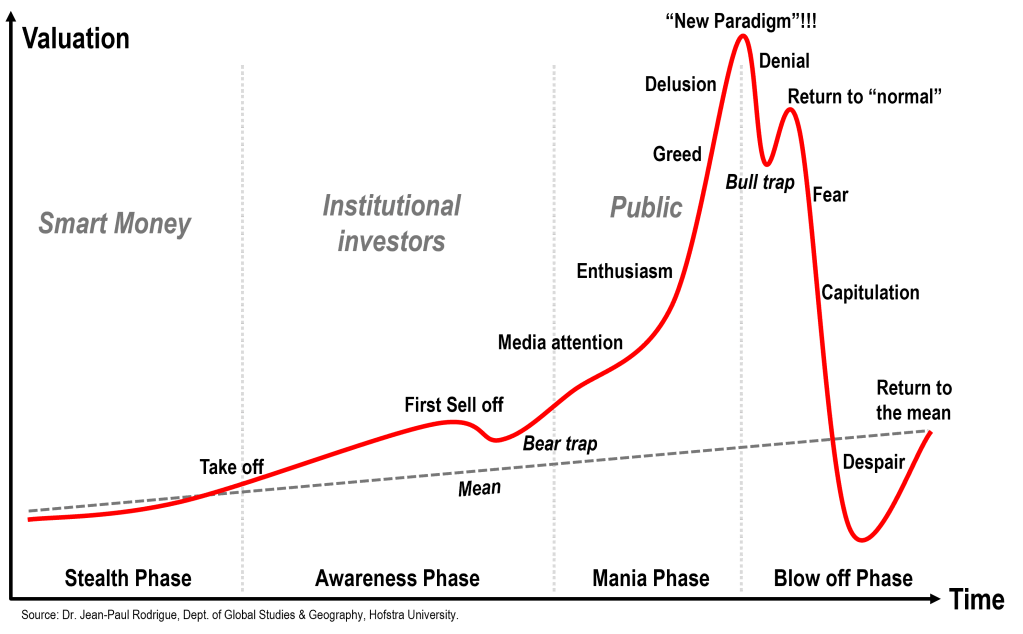
The introduction of the idea of a ‘price to innovation’ ratio to the market narrative should spark fears of a stock market bubble, notably in artificial intelligence (AI) driven stocks. Bubbles are hard to define, but to follow a famous legal opinion on pornography, ‘you know it when you see it’.

The ingredients of a bubble are usually based on an innovation (railways, the internet) doused with cheap money, and together they produce significant outperformance of a select group of assets that results in historically extreme valuation levels.

There is most likely the nucleus of a bubble in a group of mega-sized technology stocks, known increasingly as the Magnificent Seven, chief of which is the chip design firm Nvidia. To use a very simple valuation metric – the ratio of price to revenue, the European equity market trades on a price to revenue multiple of 1.3 times, the American market is 2.5 times (the large tech stocks drive this higher), Microsoft trades at a ratio of 13 times revenue and Nvidia at 33 times (for comparison UBS is on a ratio of 1.7 times and Siemens 1.3).

There is a similar valuation bubble in private markets where venture investors pay very high multiples for AI focused start-ups. The underlying rationale is that the potential sales growth of these large tech firms is so promising, that they desire a higher valuation multiple.

The past week has seen many of them report earnings, and whilst most of these tech firms have delivered healthy earnings, revenue growth is not impressive, suggesting an abundance of optimism regarding the future impact of AI.

In that context, if AI is going to be the organizing logic of the next bubble (in the past fifty years we have seen asset bubbles in gold, Japan, Asia, the internet, housing, China…to name the main ones) it will need the boost, or the ‘petit coup de whiskey’ (as New York Fed chair Benjamin Strong put it in 1927…guess what happened next).

In general, since the global financial crisis monetary conditions have been very easy, provoking inflation in assets as opposed to consumer inflation. That trend has changed recently as a burst of inflation begot a sharp rise in rates. Despite this, credit markets have been very well behaved (another bubble?). With inflation falling, expectations are growing that central banks might prune interest rates back, which might add further fuel to the AI bubble hypothesis.

In the days before quantitative easing there was a decent debate as to whether central banks aided and abetted the creation of asset bubbles. At the time, the orthodoxy was that bubbles were hard to identify and even if they could be identified, it was difficult for central banks to deflate them. The difference today is that few if any central bankers worry about this risk, and instead speak of the ‘wealth effect’ from asset prices.

The reasons for them to be more vigilant here are that asset bubbles usually destroy wealth, invariably transfer it from poorer to richer investors (the rich buy early and the poorer investors buy late it goes), they distort investment across economies and when they collapse, their aftermath can be costly (witness Japan’s lost decade(s)). Bubbles do often leave behind useful infrastructure – railways in the late 19th century, and the internet/telecoms infrastructure of the 2000’s, but at a high price.

In my view we are not yet in an AI bubble proper. So far, it is located in a small number of companies, who very unusually make up a huge proportion of the stock market. Calculations by BCA Research show that the top ten largest companies in the USA make up 75% of the stock market, something that has occurred only in 2000 and 1929.

For the AI bubble to grow and become a mania (Charles Kindleberger’s Manias, Panics and Crashes is still the best analysis of bubbles) companies in sectors that will be impacted positively by AI (such as healthcare and life sciences, financial data centric firms) will need to be captured by the AI narrative and see their share prices rise accordingly. In the same sense, AI mania will need to spill out to countries in Europe, Japan and maybe China.

Watch out for other indicators. When taxi drivers start to speak of error correction in quantum computing then we will most surely be in an AI bubble.

Have a great week ahead,

Mike