The Policeman Premium

I vividly recall seeing Imran Khan give a speech in the mid-nineties, in an era where many sportsmen had what was described as colourful backgrounds he stood out as particularly ‘Bond’ like – at the very top of his game as a cricketer and a ‘playboy’, as the saying goes (at the time he was engaged to Jemima Goldsmith). There are few people who have had such adventurous lives – and Khan’s is interesting for the ways in which he changed tack – towards Islam and politics (he served as Pakistani prime minister from 2018-2022) and his change of fortune (he is currently in solitary confinement in a Pakistani prison).

Whilst Khan’s rise and fall is complex, he ultimately fell foul of the Pakistani security establishment who allegedly became uncomfortable when Khan condemned foreign (US) influence in Pakistani public life. Khan was also the victim of an assassination attempt in 2022, something that has marked Pakistani politics (Benazir Bhutto was assassinated in 2007 and her father Zulfikar was executed in 1977).

In this regard one of the few constants in Pakistani politics has been the ever-present role of the security services in the affairs of the state, and specifically their tactic of creating private armies and terror groups. This has embarrassed them on at least two occasions – the discovery that Osama bin Laden was living in near plain sight in Pakistan and repeated attacks by the Taliban inside Pakistan. Add to that the 2008 Mumbai attacks perpetrated by Lashkar-e-Taiba, and the sense grows that Pakistan has been playing a dangerous game.

In this regard, India’s response to the killing of 26 people in Pahalgam (in Indian controlled Kashmir) took aim, it said, at terrorist infrastructure, in the most serious escalation between the two countries since the very early 1970’s. The subject of this note is not to predict how this conflict will play out – it could be costly, bloody and messy (India has reportedly lost five jets in its initial sortie) but to wonder why this confrontation is happening now and how much of this has to do with the alliances that the two countries have struck.

While India and Pakistan are both members of the Shanghai Cooperation Organisation, Pakistan is the much more active member and very close to China, Iran and Russia. While a lot of Indian hardware comes from Russia, its foreign policy projects the country as an independent actor, India is aiming for a close relationship with the US with whom it may sign a very high level trade deal (it has just completed a modest trade agreement with the UK).

It is very likely that in a different diplomatic regime the Pahalgam attack would have been met with intensive diplomatic engagement by the US, with India whom it regards as an ally and Pakistan, which it funds generously. This has not happened this time, and the tempo of involvement of the White House in this particular regional conflict has not been on a par with other administrations. It is so poor that vice president Vance has declared, in a most un-Kissinger like manner, that ‘it is none of our business’.

Indeed the recent death of Joseph Nye, the political scientist who developed the term ‘soft power’ and who wrote much about America’s engagement with the rest of the world is a reminder that one of the key elements in the old, globalised world order was America’s role as a policeman – with a near monopoly over deadly force and a very active, alert diplomatic corps. An example of this can be found in Brad Hope and Justin Scheck’s book ‘Blood & Oil’ that describes the rise of Mohammed bin Salman as the ruler of Saudi Arabia. For decades the US has steered Saudi diplomacy, and Saudi rulers have guided America in the region. However, the book describes in some detail the lack of strategic direction of the first Trump administration in the military and diplomatic affairs of Saudi Arabia, beyond the organisation of a lavish welcome ceremony for a Trump visit to the Kingdom.

The second Trump administration looks set to entirely do away the role of world policeman, and cynics might say, replace it with the role for rent collector. As such, the geopolitical risk premium will rise, and may help to explain why there are at least two conflicts where basic needs (water) are being weaponised (in Gaza and India/Pakistan). When it played the role of world policeman, the US kept the peace, much to its own advantage.

Now in the context of the very obvious dropping of moral guardrails around international relations, other countries will be less bound by a sense of world order, emboldened by an arms race, and will start to take risks and make mistakes. India-Pakistan is a very dangerous case of this, and one that draws into focus the trade-off between the cost to America’s role as world policeman, and the global ‘peace’ dividend it brought.

W.E.N.A

A few weeks ago, it would have been inconceivable to most foreign policy experts that Israeli aircraft could bomb Syria at will with their tanks apparently in shooting distance of Damascus, all the while a new Islamist regime installed itself there. This latest turn in the topsy turvy geopolitical world gives a glimpse of some of the regime shifts to come and the fragility of erstwhile brutal, long-lasting dictatorships.

I absorbed the implications of the event in Abu Dhabi, which in terms of its success and trajectory, underlines the view of some that there are ‘two middle easts’.  At the same time, Abu Dhabi has risen to a point of influence that it will be the lodestar in building the economic structure of the region once a viable peace plan for Israel/Palestine has been found.

The surprise departure of Bashir al-Assad will likely accelerate the reordering of the region and give food for thought to other ‘strongmen’. It may eventually be that a gang of them ends up living out of the Ritz Carlton in Moscow.

Indeed, a couple of academics have tracked the flight of deposed dictators and state that  ‘we find that dictators are more likely to go into exile in states that are close neighbors, have hosted other dictators in the past, are militarily powerful, and possess colonial links, formal alliances, and economic ties. By contrast, fleeing dictators tend to avoid democratic states and countries experiencing civil conflict’. More specifically, in Europe the top three destinations for dictators are Russia, the UK and France!

Despite Assad’s fall, Syria itself is not out of the woods – Hayat Tahrir al-Sham may be media sensitive, but they are also deadly, conservative Islamists. They have manifestly been given a firm helping hand by Turkey, which is re-establishing itself as a regional power.

Turkish foreign policy is an enigma, wrapped in a mystery. In the past I have written how, in the aftermath of the Arab Spring, many countries in north Africa wanted to follow the ‘Turkish model’ of development. Since then, Recep Erdogan has enfeebled the country’s institutions and its economic backbone and has turned a foreign policy that used to be based on ‘no trouble with neigbours’ to one of ‘trouble with neighbours’.

However, Erodgan is a key player now – especially in terms of how he negotiates Russia’s military withdrawal. There remain many open questions, notably how the fall of Syria further weakens Iran and what implications this has for Iraq. Larger regional countries like Egypt and Saudi Arabia will welcome the toppling of Assad and the further undermining of Iran, but now have to face up to the prospect of a regional peace deal where the strength of their support for Palestine will be tested.

If in 2025 a peace deal is struck that keeps in place the two-state formula, then the prospect of a regional economic recovery, led by the UAE (or Abu Dubai as some call it), may not be far off.

Visits to ministries, financial institutions (including Abu Dhabi Finance Week) and infrastructure players, with Prof. Afshin Molavi and several other economists and writers, gave a sense of the ambition of the region.  In particular compared to previous visits to the region, two things stood out as ‘new developments’.

The first is a growing sense of independence on the part of the UAE to go its own way in terms of how it makes policy (as opposed to being a policy taker from the US and the EU). This is evident in finance, infrastructure, labour markets and trade. On trade specifically, the UAE has to be geopolitically ambidextrous in how it builds relationships with the US and China, though when it comes to technology, the sense is that it is very much plugged into America.

The second element worth commenting on is the idea of ‘The Fourth Pole’. I have written on this in the last year, and the idea is that in a multipolar world made up of three ‘poles’ (US, EU and China) there is room for a fourth pole made up of India, the Gulf States and other players across the ‘region’ (which we could define as those countries a five hours flight away from the UAE, which includes some 2.4 billion people across Asia, Africa, Southeast Europe and the Eastern Mediterranean).

The notion of the ‘Fourth Pole’ is gathering pace around the very close relationship between the UAE and India (the very popular Hindu Temple in Abu Dhabi is just one sign), and the web of trade, finance and infrastructure deals they are engaging in across the region. This relationship may not ultimately become as deep as that of the EU countries, but it is beginning to look like a modern version of the ‘Coal and Steel’ community. The risk however, is that they overbuild capacity in the face of a forthcoming economic shock or recession.

As a final word, the best indication that I had that the UAE is feeling both confident and more independent is that some well-connected government advisors have come up with an acronym for the west – W.E.N.A (Western Europe and North America)!

Have a great week ahead,

Mike

Remaking a World on Fire

Notre Dame – a sign of the times?

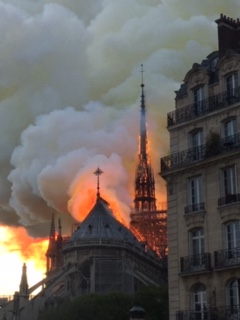
It has been an eventful year for me, but the most striking moment was witnessing the fire at Notre Dame cathedral. Having run towards it, I was unprepared for the extent of the conflagration, green and orange flames bellowing out of the church as the sun blazed angrily in the background. It was a traumatic evening, where thousands of onlookers were silenced by the significance of what they saw.

At the same time, it would be wrong of me to try to draw a parallel between such an apocalyptic event and the state of our fracturing world, though that thought is at the back of my head, not least given the way in which the ‘old’ world order is increasingly vandalized by politicians, not to mention the outbreak of protests around the world.

A better parallel, as supersized cranes moved around Notre Dame this week, is that the time it will take to rebuild and remake the church, some five or more years, will also be the period of time required to put the era of globalization behind us and have the makings of the ‘next world order’.

The roadmap towards this ‘order’ will look something like this – economically the world will grapple with the ‘next recession’ which will be more severe in indebted economic sectors (China’s economy, corporate USA and some emerging countries), and will eventually culminate in some form of world debt conference. Once this is accomplished, the quest for a model of organic economic growth will begin.

Politically, I hope that we will see more independent, bottom up efforts by individuals and new groups/parties to rethink what the contract between people and those who govern for them will look like. Then in terms of geopolitics, the world will be increasingly dominated by the ways in which the three great ‘powers’ – the EU, USA and China pursue different paths on issues like the internet, democracy, human development and finance. This is a limited, big picture sketch, the rest is of course in the Levelling.

Forecasting – really more a form of ‘macrotainment’ than a science – is easier on a five year view, but given it is the end of the year, I also want to offer up a few pointers on at least two events over the next few months.

First, I expect economic and political headlines to be first driven by the unravelling of China’s credit boom – we will hear more about defaults of indebted Chinese companies and resulting pressure on its banks. Expect ‘China is Spain’ to be a headline we see a lot. The policy task for China’s leaders will be complicated by ongoing protests in Hong Kong and importantly, the result of Presidential elections in Taiwan on January 11th. My guess is that one result will be a drop in Chinese interest rates in 2020.

Second, impeachment will deepen America’s divides. With the process now started, it looks for right or wrong, that the Senate will not vote to impeach President Trump. The trial itself, especially if likes of Mick Mulvaney and John Bolton are called as witnesses, will prove a spectacle.

If we bear in mind that Bill Clinton responded to his impeachment with airstrikes on Iraq, then Trump’s emotional letter to Senators is mild by comparison. He may try other means of weaponizing impeachment – link it to the stock market (Trump has sent 21 tweets about the stock market in the last 30 days, the most since 2018), trade policy with Europe or immigration.

The immediate political implication of the Senate not impeaching the President is that the Democrats lose their ‘silver bullet’ against Trump, and with it the sense that morality, the law and institutions are powerful buttresses against bad behavior. In turn, this will colour the Democratic Presidential selection process. The Democratic candidate will need to have a very clear policy message, an ability to scrap with Trump in the political gutter (see my October 13 blog ‘Don the Robber’, https://thelevelling.blog/2019/10/13/donthe-robber/). So far, none of the leading Democratic candidates is strong on these points (someone like Mike Duggan of Detroit could fit this bill in my view).

For Trump, and his supporters, a failed impeachment will open up the road to the acceleration of his policies on immigration, trade (EU) and on identity-based politics. Mounting, structural risks like climate damage and indebtedness will get worse. The next election will be driven by identity, race and values, and there is a very good chance that Trump could win.

So, enjoy this Christmas, there is plenty of disruption to come in 2020!

I am back in touch on January 12.

With best wishes, Mike

Demonstration contagion

Is this the beginning or end ?

In last week’s missive (link), I discussed the role of rising food prices as a trigger for public protest and I suspect, as a cause of future geopolitical strife. It is not a very happy topic but one that deserves some further analysis given that in recent weeks there has been a remarkable outbreak of protests across a range of countries – from riots in Honduras, to ongoing tension in Hong Kong to climate related demonstrations in India.

Were I one of the many apocalyptic writers who seize upon every misfortune as confirmation of their worldview I would tell you that this is the start of ‘The Levelling’, and that the ‘end’ will follow shortly.

Though I will spare my readers such a gloomy outlook, there is nonetheless a ‘Levelling’ like narrative that unites the motivation for the many international protests in the sense that most of them are provoked by factors that are associated with globalization (though in reality not usually caused by it).

For example, climate change has spurred Extinction Rebellion movements in Europe and environmental protesters in India. Factors that are associated with a lack of what I call ‘country strength’, such as corruption and weak institutions have been amongst the triggers for protests in Lebanon and Iraq, whilst the cost of living and rising fuel costs have brought people out onto the streets in Chile, Egypt, Ecuador and France. Inequality is also a driver, especially so in Chile, Mexico and Turkey.

Together these protests (by the way the number of Google searches on the world ‘protest’ is at a five year high) point to a world where there is limited patience for policy negligence and it negative socio-economic effects. I’ve had a look across the IMF and World Bank databases to find countries that are exposed to corruption, indebtedness, inequality and climate change. Many ‘candidates’ if I can put it like that are in Africa. One country worth watching – where inequality and indebtedness are high (as high as Jamaica), and where climate change is having a growing impact, is the US.  It still has strong institutions but consider what might happen in the context of a deep recession (with no fiscal buffer).

While there is no sense that the various protest movements are in anyway coordinated, they may still be contagious within and across countries.

Within countries, social media makes protests easier to organize at short notice, easier to spread (dis)information and easier to bring to the attention of the wider public. It was no surprise that in the aftermath of the Arab Spring, protestors faced massive social media and cyber counterattacks from the Egyptian and Syrian authorities.

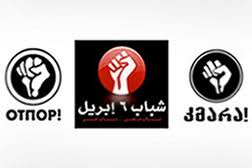
Protests are contagious across countries to the extent that social media can heighten sensitivity to issues and spread the ‘methodology’ of either violent or peaceful protest. For example, one image that crops up in protests around the world is the clenched fist of the Serbian peaceful protest group Otpor. There is also increasing contagion in financial markets in the sense that in emerging markets at least investors are reacting negatively to signs of political strife.

The troubling thought for the outlook is that the economic stresses underlying these protests will not go away anytime soon – inequality takes time to tackle, most governments are fiscally constrained, and many have high debt levels (i.e. Lebanon). To make matters worse, climate change points towards a more radically stressed environment.

However, the positive reading from all of this, at a time when it should be said that the quality of democracy and the rule of law internationally are deteriorating (according to the latest Freedom House ‘Freedom in the World’ report and the Rule of Law indicators in the World Justice Project dataset) is that people want less corruption, more equal societies and better balanced growth.

In that context, what is to be done? There are specific actions that can help, such as the relocation of the World Bank to Africa to act as an anchor against corruption and to spread best practice in institution building.

More broadly, I see a lot of space opening up for new political parties and movements, some that are interlinked across countries and others that are connected by their political methodology (i.e. use of social media). Then, eventually I see the such protests leading to efforts to remake social and political contracts along the lines of the Levellers’ Agreement of the People’, at least in democratic countries, so that policy issues such as climate change, inequality and corruption are more formally recognized and curbed at a policy level.

It will be a bumpy road politically, but the flourishing of protests around the world shows that something profound is occurring.

Have a great week ahead,

Mike