Pinning Blame

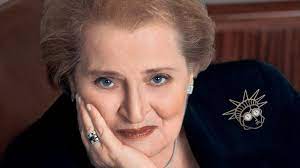
Vladimir Putin once observed that one could gauge the mood of American diplomacy by looking at the kind of brooch worn by the late Secretary of State Madeleine Albright. For instance, to parse her elegant book ‘My Pins’, she first wore a ‘serpent’ brooch as a message to Saddam Hussein after an Iraqi government newspaper referred to her as an ‘unparalleled serpent’.

When meeting Putin, Albright varied the message from her pins – ‘hear no evil see no evil’ monkeys to warn Putin over human rights abuses in Chechnya and then a spaceship brooch to mark the collaboration between the US and Russia in space. Interestingly, in the book (p. 110) she notes that Putin ‘was capable…but his instincts were more autocratic than democratic ..and single minded in his pursuit of power’.

Albright was Secretary of State at a time (1997-2001) when American power and by association, globalization, were very much in the ascendancy and Putin was the new kid on the diplomatic block. Before becoming Secretary of State, she was US Ambassador to the UN at a time when the UN had power. It was also a time when Alan Greenspan’s Fed was easily the predominant central bank (the Bundesbank was not far behind), and generally well respected or even feared by investors.

Greenspan’s utterances, usually mystic in comparison to the typically forthright statements of Albright, were carefully followed and scrutinized by investors. He cultivated ambiguity (‘if I have made myself too clear, you have clearly misunderstood me’).

Today, the Fed remains predominant, but in a somewhat different way – in terms of its size and market influence (the role its balance sheet plays in financial markets) it is overbearing, but in terms of the credibility of its leadership team it is increasingly impaired. A share trading scandal, and the appalling policy miss on inflation have degraded its reputation.

Today’s Fed Chair, Jerome Powell, has little suasion over markets (he has the worst track record in terms of equity market reaction to his press conferences). That is a pity, at least for the US, because today in the context of the invasion of Ukraine, central banking now is a critical part of the geopolitical landscape.

At a time when many people (notably this week Larry Fink and Howard Marks) are waking up to the ‘end of globalization’, central banks are raising interest rates and curbing quantitative easing, something they arguably should have done last year, but that now amplify geopolitical risks.

In this way, the end of globalization, the rise of geopolitical risk and the end of QE are all linked.

Quantitative easing tranquilized the (market) effects of many of the world’s troubles and arguably insulated decision makers from the long-run political effects of Donald Trump’s trade war on China for example.  QE helped to disguise the signs that globalization was stuttering from the mid 2010’s onwards.

It has also helped to skew moral and logical views of the world – the stock market doubled in value in the aftermath of the COVID pandemic which has resulted in over six million deaths.

Perhaps the greatest danger has been the dulling of the minds of central bankers, and to a certain degree the politicization of their work (in Europe, the US and Japan). Central banking is a notoriously closed environment where groupthink can dominate – this is reinforced through the job market for young economists, the pressures of markets and the institutional rigidities of many of the central banks.

Here the ‘sin’ of the central bankers has been to deploy an emergency policy tool on a permanent basis. QE1 gave way to successive QE programs and the highly supportive monetary policy enacted during the coronavirus period has been kept in place for too long.

The result of this is blisteringly high levels of inflation, made worse by the economic side-effects of the invasion of Ukraine (wars are typically inflationary). In particular, bond market volatility in the US and Europe is nearing historically very high levels, from which it usually spreads by contagion to other markets (equity volatility is comparably very low).

The geopolitical effect of this is to make Western economies more vulnerable at a time when they need to be robust. It is also to sow seeds of doubt in the predominance of the dollar (which I would nonetheless discount) and in general make markets more sensitive to geopolitical risk.

The overall effect is to create the disruptive financial conditions (higher trend rate of volatility, higher trend interest rates and potentially higher inflation for the near term) to accompany a disrupted geopolitical world. As we have noted in recent missives, these can feed off each other – negative wealth effects, high food prices and the trapping of new home buyers at high valuations are just some of the issues to contend with.

Central banks have badly misjudged the economy and mis-calibrated their policies, and the world is a more unstable place as a result.

Have a great week ahead

Mike

Ukraine: What does China see?

A neat explanation for why Vladimir Putin has found the suppression of Ukraine harder than he thought came to me from a very clever friend, who described how in recent years Putin has committed a series of outrages (assassinations in Berlin and London), provocations (Russian troops bringing ‘peace’ to Kazakhstan) and incursions (Syria, refugee influx’ through Norway and Eastern Europe, Russian money into Western politics) as a means of testing the West’s reaction function.

In most cases, the West had not reacted strongly to these incursions and the theory is that Putin read this and other events such as the disorganised retreat from Afghanistan, as signalling that there might be little international opposition to an invasion of Ukraine. He was wrong (many Westerners also could not have imagined the European response).

That he miscalculated shows that different ‘tribes’ or cultures can look at the same set of events and draw very different conclusions, something that has often struck me when hearing the Russian view of international affairs.

The question I now ask, is whether Beijing, given its cold, and apparently tone-deaf pronouncements on the invasion, have a view of international relations that is at odds with the Western view, and in detail, what lessons China is drawing from Ukraine.

I should preface my remarks by saying that really too few people in the ‘West’ have made enough of an effort to understand Chinese political culture and the forces that drive policy making. That is not made any easier by the veil of secrecy thrown up by the Chinese Communist Party, and the relative attractions for Westerners to live and study in China (I estimate that there are twenty times the number of Chinese students studying in Britain, as there are British students studying in China).

To that end, cultural differences mean that Chinese policymakers may simply not ‘get’ things we see, but that they may well be more keenly attuned to other aspects, such as the response of the emerging world to the invasion. It is also worth emphasising that people around Xi Jinping may draw different conclusions to him, such as the way in which Vladimir Putin is demonstrating the shortcomings of autocracy.

As a final caveat, most people will watch China in the light of its repeated threats regarding the place of Taiwan as a sovereign country (that echo the views of Putin regarding Ukraine) and the repeated sorties of Chinese fighter jets and bombers into Taiwanese airspace.

Broadly, China may notice several things.

First the rapid cohesion of European foreign policy, the increasing singularity with which (coupled with the re-election of Emmanuel Macron) European foreign policy has reformed, and the emerging power of eastern European countries like Poland, not to mention the ‘foreign policy tigers’ in the Baltic states. The immediate, concrete implication for all of this is that the extension of China’s ‘belt and road’ initiative into Europe and its ’16&1’ partnership with eastern European countries is all but dead. Chinese investment into Europe will also face even greater scrutiny.

The Chinese reading of America is more complicated. American intelligence and diplomacy have in my view performed well – and much of the latter has been sufficiently discrete. America has notably paid more attention to the Chinese reaction than Europe has (France will be glad it is not part of AUKUS now). Whether China realises it or not, its international stance on the invasion can see it move from a ‘strategic competitor’ to the US to an outright adversary. A profound breakdown in relations with the US would damage the international economy and international institutions severely, so there is much at stake.

One swing factor for China is the attitude of many emerging countries to the invasion. Several Asian countries – Bangladesh, Vietnam, Laos and Sri Lanka abstained from voting in the UN resolution on the invasion, while notably half of Africa did too (including South Africa) and India’s closeness to Russia is laid bare. To note, many of these countries – across Africa and Asia – have been targeted by Russian info ops.

The fact that the emerging world appears split on the question of Ukraine shows several things – the lure of the Chinese economy and the notion of a ‘managed democracy’ in many countries, and correspondingly the perception that the ideas of democracy and the liberal order may only be something for the West. Pessimistically, it suggests that the post-globalized world order will be a contest between the models of democracy and non or managed democracy.

If this is true, China is in a more comfortable geopolitical situation than it thinks. Equally, parts of Asia are now taking sides – Singapore’s move to condemn the invasion of Ukraine was brave.

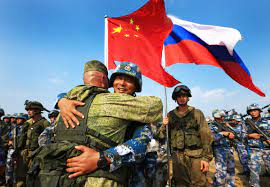
Geopolitics apart, there is also much China can observe on how this war is waged. In recent years the Chinese military and navy has undertaken several large-scale exercises with Russia, and the Chinese military is organised in a similar way to the Russians. Given that the Chinese have effectively no battle experience, they must surely wonder if they have the right training partner granted the poor performance of the Russian army (for instance multiple war games by the US Marine Corps University suggested that the Russians would have wrapped up the invasion within three days). Financially, China might well regard Russian assets as opportunistic and cheap.

China will also worry about the ability of the West, the US in particular to detail Russia’s moves before they happened and should be concerned that the US and Japan’s Public Security Intelligence Agency, in addition to other intelligence configurations (Five Eyes) have the ability to read its moves.

The area where China has the greatest scope to learn is in information wars, where President Zelensky and Ukraine have excelled. Globalisation has spread social media, which still retains its Western cultural bias internationally. I can think of very few Chinese media or social media outlets that have penetrated beyond China in terms of creating engaging, trusted content. In short, this means that in an increasingly contested world, China will struggle to ‘tell its story’.

In that respect, I suspect that China feels much less sure of its position on Ukraine/Russia, and will most likely continue to watch and wait, hopefully suing for peace.

Have a great week ahead,

Mike

Breaking Bread

The Salon de l’Agriculture that takes place at the end of February in Paris is one of the few places (in Paris at least) where you can witness French people tipsy at ten in the morning (they are normally more circumspect than their English and German speaking neighbours), and in general where the atmosphere is far more genial than the practiced nervy, combativeness of Parisien(ne)s. As with many events, this gargantuan festival (which I thoroughly recommend) resumed after an enforced break during COVID.

The Salon is remarkable not only for the displays of agricultural prowess, and the array of foods, wines and increasingly, beers on offer, but also as a political barometer. Since he was the mayor of Paris, Jacques Chirac embraced the event, and is still spoken of as someone who was truly attached to the ‘terroir’. Other politicians fared less well, notably Nicholas Sarkozy whose reply to an attendee at the Salon (‘casse toi pauvre con’) became infamous.

Contemporary French politicians still regard the Salon as an important stage, and a litmus test of their ‘closeness’ to the French people. My sense is that the younger generation of politicians fail this test, Emmanuel Macron has often looked awkward in a combination of suit and wellies, though at this stage I suspect French people accept him for the ‘intello’ that he is. In other countries, at similar events such as Ireland’s National Ploughing Championships, politicians such as deputy Irish Prime Minister Leo Varadkar have also looked ill at ease.

The point of raising the topic of food and agriculture is that it will become an increasingly important political issue, especially so in the context of the invasion of Ukraine. It is this event, rather than his performances at the Salon de l’Agriculture that has propelled Emmanuel Macron into a commanding lead in the forthcoming Presidential elections.

A critical part of the expectations set around the idea of the French president is that he or she can act commandingly on the world stage, and here Macron has delivered. The open question now is how he frames the mandate that the electorate will give him for his second term. He will be keen to take a second run at domestic reforms (pensions for example) and to also play an active part in the making of the ‘new Europe’ (he may well become President of the EU in the future). Once he is re-elected, one of the issues he will face is food price inflation and food security.

In recent notes (Ne vous melez pas du pain II) we have flagged how governments are trying hard to dampen the consumer impact of high commodity prices, as this has historically been fuel for popular unrest. To some extent policymakers can lay the blame for this on Russia and its president, but in many emerging countries where spending on staples makes up nearly 40% of disposable income (i.e. India, and large parts of Africa) this must be worrying from a humanitarian point of view at least.

Many industries are now feeling price pressure. In that respect, my own sense is that the spike in commodity prices is more likely to cause a recession (or demand shock) than an inflationary spiral (at consumer price inflation of 8% some might say we are there already), and there is a risk that markets and central banks overreact to this, having underreacted in 2021. One new trend we may see is popular fiscal activism, where the producers and potential beneficiaries of commodity prices spikes are hit with supplementary taxes.

In the longer term, the spike in food prices may do for food security and the food industry what the COVID epidemic did for digital commerce. COVID meant that we became used to shopping, working and being entertained from our homes. High food price inflation and the Ukraine are a reminder that food supply chains can not only be disrupted but can also become weaponized.

To that end, I can see a great many countries, especially those who do not have the agricultural arsenal of France and Ireland, examining their vulnerability to food security and acting accordingly to become more ‘autonomous’. Sadly, many of the poorer countries of the world that are exposed to weak food security (notably Nigeria, Egypt, Congo, Chad, Central African Republic, Afghanistan, and Somalia) do not have the wherewithal to become more ‘food’ autonomous.

Across developed countries, we can only speculate what this will provoke in terms of investment trends.  One will be a shift towards urban farming (underground farming for example), another is a drive towards ‘artificial’ and replacement foodstuffs (coconut sugar, oat milk) and most importantly of all a deeper emphasis on nutrition. 

We will also rightly hear more about food inequality – and how the food that different social groups consumer is a function of their education, conditioning and social status. An American dentist Mary Otto wrote an interesting book called ‘Teeth’ which shows the startling differences in dental health across social classes and reports that they spring from differences in education, diet, and upbringing.

The strategically important move will come from China, a large country with a relatively small amount of farmable land. China has, in general poor diplomatic relations with its neighbours and in certain cases food security might push them towards a more benevolent attitude to Indonesia and Vietnam and may see China launch a foods focused investment wave into South America.

Have a great week ahead,

Mike  

The First Financial War

One of the early, memorable experiences I had of how international economic policy is made came in the late 1990’s when Stanley Fischer, then the second in command at the IMF, came to the Economics Dept. (Princeton) to give a seminar on the manner with which the IMF disbursed money to Russia in the aftermath of the 1998 emerging markets crisis. I, doubtless like colleagues, was surprised that much of the funding to Russia was granted without collateral or what later (i.e. euro crisis) became known as conditionality.

Being the most junior and easily least clever person in that room, I dared not pitch a question to Stanley Fischer, but I still wonder how Russia may have developed differently had the IMF financing been structured differently (at the time it was widely suspected that some of the money found its way to oligarchs and politically active former KGB agents!).

Over twenty years on, some things have not changed. The IMF is still a discredited institution (Joe Stiglitz’ attack on the IMF ‘Globalization and its Discontents’ was published in 2002), and the Russian economy is still fragile, under-developed and riven by corruption. Russia still has the same president it had in 1999, and still has many, many nuclear weapons.

What is new is that from next week, the financial penalties and sanctions enacted on Russia and key Russians will begin to take effect, shrinking the Russian economy by close to 40%, financially freezing Russia and potentially setting in motion socio-political unrest and sadly, an escalation in Russia’s military tactics. As an experiment in financial combat this is unprecedented and will effectively ‘anti-globalise’ Russia (cut off the flow of people, goods, finance).

Here, the lesson of the conflict so far is that whilst many of us expected Russia to focus on unconventional/hybrid warfare, they have concentrated on ‘old fashioned combat’ where as the West has excelled in information warfare (in calling out the detail of Russian moves before they happened) and now in prosecuting a campaign to cut Russia off economically.

In that respect Russia may be glad that it is not a highly globalized country (that might be the fault of the IMF in 199!) but it is a good example that the currency of a country, in the long run, is a decent barometer of its institutional strength. Around 1870, the dollar and rouble traded close to parity, and from then to the Russian Revolution the Russian stock market outperformed the American market by a factor of two. Today, Russia is uninvestable.

The short-term effects of Russia’s financial freeze will manifest themselves next week. There are several elements to keep a focus on – how Russia will stabilize its currency (it may peg it to gold, or to a group of Asian currencies), the decimation of pensions, the political effects of a likely bank run, the operational effect on the economy of so many businesses either closing or being deprived of large chunks of their revenue base, not to mention the cost of the invasion of Ukraine.

Add to that a global financial system that is increasingly strained (funding stress is mounting), and undercut by high energy prices, my sense is that next week the focus may be more on markets than military. The key for that stress to lift a little, will be public proclamation by a number of Fed and ECB officials that the war risks a recession, and that therefore market liquidity needs to remain ample.

The longer-term effects will be more interesting. The response of the corporate world to the Russian invasion has in general been commendable in the sense that so many companies have cut ties with Russia.

In the near future, it is very difficult to see many governments and corporates trusting Russia again and this will entail a permanent hit to its economy, of something in the region of 20%. China and select other countries may try to make some of this up eventually and Chinese investors may try to buy cheap Russian assets, but strategically this will not sit well with the Kremlin.

There is also a growing debate that the West’s cutting of ties to Russia will usher in a race for the ‘next reserve currency’. I recall being in Moscow some years ago and overhearing a story where someone asked Vladimir Putin if ‘Russia is leaving the dollar’ and he allegedly answered ‘no, the dollar is leaving us’. He was right, but is on the wrong side of the trade.

In that context, the assumption is that the Chinese renminbi, currently 2-3% of international transactions, will pick up ‘fx market’ share. I am not so sure – the lesson for China from the Ukraine invasion is that it may want to be less financially connected to the developed world, a strategy that might heavily restrict the international usage of the renminbi.

The other assumption is that crypto currencies enjoy greater usage, and to an extent there has been a pick-up in trading in crypto currencies (though not much of it in Russia). A number of crypto exchanges, underlining their independence from the centralized financial world, have refused to cut ties to Russians. In my view, this will invite regulators to police crypto exchanges and investors will discount the value of companies such as Coinbase.

To stand back a little, the invasion of Ukraine remains brutally underway this weekend. It has (correctly in my view) led to an economic war, from which it is very hard to see Russia escaping financial catastrophe. And, this time, they won’t even have the IMF on hand to help.

Have a great week ahead,

Mike  

Taking Sides

A number of the leading scientists and philosophers of the 20th century – from Karl Popper to Per Bak for example, have spent time thinking about how systems evolve and break down. Their insights are useful today, as globalization disintegrates, and we wait to see ‘what’s next?’.

In the systems literature, frameworks that have become outdated or failed to evolve are undercut by often events. Per Bak framed this as a heap of sand, collapsing when a marginal grain is added. It is not the marginal grain of sand that leads to the collapse, but rather the growing instability of the ‘system’ over time (the fall of communism is an example).

The crisis around Ukraine is yet another grave case, and it helps to clarify several things – the erecting of another barrier to trade from west to east, the arrival of new geopolitical constellations and a deeper cleavage between the democratic and non-democratic worlds. The day after the invasion of Ukraine, the German foreign minister stated ‘we have woken up to a new world’, but the fact is that ‘new world’ has been in the making for some time.

We have seen other tests in recent years – the subsuming of Hong Kong’s democracy, and the many lessons that need to be learnt from the coronavirus crisis, notably the triumph of humanity and medicine and the failure of governments to collaborate. Taken together they point to the end of globalization, or rather the ‘way we lived’ for the past thirty years.

While there is a growing debate on this important topic, the risk is that politicians, commentators and policy makers remain cosily attached to the idea that globalization can continue and will suffer jolts to their consciousness of the sort that Vladimir Putin is administering. There needs to be a sharp focus on the ‘what’s next?’.

The chief element of the post-globalization world will be the emergence of a multipolar world, where instead of a singular (Anglo-Saxon) way of doing things, rival value driven approaches will emerge in Europe and China, to complement the American approach to political economy. The idea of a multipolar world is incidentally something Vladimir ascribes to, though beyond a powerful army his country has few of the ingredients – a strong economy, financial system or soft power – required to sustain a geopolitical pole.

The picture that emerges is of a more frictioned (i.e. higher inflation or less lowflation), fractured world, and regular readers will know that I have laboured this point!

What is new is that companies, financial institutions, international institutions and individual countries are being forced to choose sides as political-economic tectonic plates pull apart. The striking example is the Nordstream pipeline. The SWIFT payments hub could be another.

The deeper the crisis in Ukraine, the more (or less) wedded governments will be to alliances and values, and eventually the clearer the geopolitical map of the 21st century becomes.

For example, Japan has sanctioned Russia but China stands by it. India, a long-time ally of Russia, is an odd example of a democracy siding with a ‘strongman’, something that will cause tension in its relations with the US and UK. Poland is another example – this crisis and the security imperative it brings may present a chance to mend the differences it has with the EU over ‘values’. Turkey could play an important strategic role, and might ‘come back onside’.

Switzerland, which has potentially terrific financial power over wealthy Russians and Russian commodity dealers, has done little, and the quid pro quo for this may be a much tougher attitude by EU and US regulators to its banks. Internationally, fintech companies and payment firms will have to be more careful where, and with whom they do business.

In general, many large companies have tiptoed around widening diplomatic divides, will increasingly have to choose sides, not only with respect to Russia, but China too. This will be especially the case for those in strategic industries – semiconductors is the prime example, and for large multinationals with business ties to China (e.g. Apple). The flip side of geopolitical risk for large corporations is that in some cases, they feel it necessary to deepen relationships with governments, in strategic areas like AI and data.

On this point, the team at the excellent Longview Economics point out that the asset values of two of the actors that have undermined American democracy (Facebook/Meta and the Russian state – rouble etc) have collapsed in recent months.

In that respect it must be hoped that within political systems, there is a hardening of views around the sanctity of democracy, and that politicians on the payroll of foreign governments in the UK, US, France and many other countries (Africa as well as we noted last week) face sanction. It is also to be hoped that the funding of political parties by outside actors is scrutinised and penalised in a tougher way. In Russia itself, and perhaps more so Belarus, any signs of mass opposition to the invasion will be welcome.

As a final point, to all those European policy makers mugged by reality, is to think about what the new world should look like, and provocatively to think how they can turn events, such that in ten year’s time, Russia is applying to join the EU.

Have a great week ahead,

Mike 

The Man on Horseback

In 1962 Professor Samuel Finer published an original book entitled ‘The Man on Horseback’ a text devoted to the role of the military in politics, notably in the case of the military dictatorships of the time, and the prevalence of coups d’état. A few years later (1968), another ‘indispensable’ text, Richard Clutterbuck’s ‘Coup d’État: A Practical Handbook’ appeared.

That these two now classic texts on coups d’état appeared in the 1960’s speaks to the impact of the Cold War on poorer countries in Africa and Latin America, the willingness of mercenaries and world powers to supplant leaders to suit their own ends, and to the lure of mineral and commodity wealth.

To stay with the sixties, in 1966 there were 7 coups d’état in sub-Saharan Africa alone, followed by a cluster over the next decade, and this trend then petered out in the late nineties as democracy and globalization spread through the world.

What is new, and relevant today is that in the past year we have seen a rash of coups d’etat in sub-Saharan Africa (the highest number in over twenty years). Reflecting this France has announced that its anti-terrorism force will leave Mali – which itself has seen two coups in the last year.

This outbreak of coups is mysterious, certainly from the point of view of the French, and I am sure has the ingredients of a good spy movie. Some of the coups are driven by age-old factors – the venality of life long rulers, the negative side-effects of corruption and mineral wealth.

There is also, in some countries an undercurrent of dissatisfaction with democracy (surveys from Freedom House or the Mo Ibrahim Index suggest this) and the temptation of strong man ‘managed democracy’. In general, academic work shows that the success of coups depends on the international reaction to them, so the fracturing of the world order creates an environment that is arguably more permissive for coups.

There is also a more troubling trend, which in past notes I have discussed under the banner of ‘The Scramble for Africa’, after Thomas Pakenham’s book that detailed how the colonial powers despoiled Africa. The same is happening today, at the hands of mining companies, Russia and China (whose investment led conquest of Africa is well documented now).  

In particular, the incursion of Russia into Africa, very often at the expense of France is a noteworthy trend and one that remarkably, the French have not aggressively pushed back at. It takes many forms – in 2019 the first Russia-Africa Summit was held and a year later Russian arms companies Rosoboronexport were doing billions in arms sales in Africa (rest assured that Western arms companies are doing even more).

The chief element in Russia’s Africa strategy, is the Wagner group, purportedly a mercenary company with very strong links to the Russian security establishment. They are present in Burkino Faso, Mali, Libya and notoriously so in the Central African Republic (CAR). Oddly enough, there is a close correlation between the occurrence of coups, and the presence on the Wagner group, (to add balance many of the coups in question have been led by younger army officers with Western counter terrorism training). At very least we can say that the Wagner group is capitalizing on instability.

In the light of Russia’s current attempt to terrorise Ukraine, the incursions of the Wagner group across Africa and the Middle East (Syria) suggest that there is a new chapter in the Great Game (you must read Peter Hopkirk’s book), where large powers spread resources across continents in a strategic power game (the Horn of Africa has at least thirteen military bases). Russia, arguably emboldened by the behaviour of Western nations, is spreading its geopolitical reach, largely I suspect to bolster its leverage through mischief, and also to harvest strategic resources (i.e. commodities).

The great loser here is Africa. Foreign intervention, the ‘coups epidemic’ and the breaking down of democracy and institutions makes Africa weaker – economically and politically – and a source of angst to neighbouring regions (i.e. the flow of emigrants to Europe).More broadly, we discuss coups, we cannot avoid the ‘nearly coup’ in Washington last year, an event that highlights the fragility of even the greatest of nations and democracy. In that respect, the wildcard political event might be a coup of sorts in Russia, should Mr Putin miscalculate over Ukraine.

UnGraceful World

There is a cottage industry of people looking for signs that the Russian army is going to spring across its borders and attack Ukraine – evidence that the ground under foot is less muddy, groups of medics armed with blood supplies making their way to field hospitals on the border and the traipsing of Russian boats through the Black Sea. The latest warnings from Washington underline these developments.

The real signal however, was that a few days ago Vladimir Putin’s superyacht ‘The Graceful’ left the Blohm & Voss shipyard in Hamburg, which in its early days saw the construction of the battleship Bismark. That the ‘Graceful’ set sail for home suggests that the Russian President does not want one of his toys to fall under the scope of sanctions.

Last week, the image of the French and Russian presidents at opposite ends of a long, white table dominated the front pages. Putin has a habit of managing the ergonomics and choreography of meetings, usually arriving very late.

In 2014 Merkel had to wait 4 hours to see him, in 2012 Viktor Yankovich also waited for 4 hours, Shinzo Abe waited 3 hours in 2016 – interestingly, and this might tell us about Putin’s psyche – the two visitors who have only suffered a very short wait were royals, King Juan Carlos of Spain (20 minutes in 2006) and Queen Elizabeth II (14 mins in 2003). In addition, Putin likes to make his guests uncomfortable, for example bringing a dog to a meeting with Angel Merkel, who has a fear of dogs.

The reams of commentary on the meeting focused both on Putin’s psychology and on the role of Macron.

On Putin, the quip from the French statesman Aristide Briand that ‘people think too historically. They are always living half in a cemetery’ is worth considering in that Putin seems to think and act in the ‘blood and iron’ mindset of the late 19th century, an approach that today is brutish and dangerous (fittingly Bismark noted that ‘not through speeches and majority decisions will the great questions of the day be decided…but by iron and blood)

Macron is potentially more difficult to fathom than Putin. Despite the widespread belief that he is being played by the Russian president, the aspect that people underestimate most in him is that he is a risk taker. Moreover, he is singularly the only European leader with strong and coherent ideas, and political energy, on the future of Europe. What has however troubled some other European politicians (especially the Baltic and Eastern European ones) is that Macron deigns to speak for them.

In this respect, Macron is taking advantage of the poor design of European foreign policy – it has been expressly set up so that it does not have one single voice, or as Henry Kissinger put it – ‘who do I call if I want to speak to Europe?. In effect, Macron is solving Kissinger’s dilemma in that he is setting himself up as the go to person for the likes of Anthony Blinken, but he is not regarded by Europeans as the ‘voice of Europe’.

In that respect, the role of the EU’s foreign policy commissioner is one that is designed not to pronounce a singular voice. He or she (rarely a top flight, independently minded politician) is kept at a safe distance from power, usually imprisoned in an airplane (for instance in 2011, Javier Solana, the EU foreign policy chief flew over 430,000 miles, over three times that of his American counterpart Colin Powell). That is not to say that EU foreign policy is itself neutered, it’s just very complex, and designed to be at the mercy of large countries with a taste for foreign policy, like France. It is also game theoretically difficult to agree on a common foreign policy stance across twenty seven countries, at speed.

Yet, in policy areas where there is a very specific competence or topic – trade and Brexit are two good examples – the EU can be focused, competent and show solidarity across member states.

The question from here is whether stress tests such as the tension around Ukraine force a structural change in EU foreign policy, in just the same way that the euro-zone financial crisis catalysed a much better organized approach to EU economic and financial policy. Here, there are some tests ahead.

First there is an emerging pragmatism, especially around security operations where (the evacuation of Kabul was an example) missions are undertaken by ‘coalitions of the willing’ instead of having to cobble together a common stance across 27 countries. For military operations this approach is quicker, and enables cooperation with the likes of the UK, Denmark and Norway.

Second, assuming that there is no ‘hot’ conflict in Ukraine, there is a need for deep dialogue between the Baltic/Eastern European states on one hand, and France and Germany on the other. This dialogue may also become mixed up in the bigger debate around European values.

The Ukraine crisis is also a ‘discovery’ moment for Germany and its new chancellor in terms of his shameful ambivalence.

Thirdly, in areas where foreign policy becomes mixed with ‘megatrends’ like climate security, cybersecurity and data protection, the EU will have the time to take a more considered and deliberate approach.

As I send this note it is not clear what could transpire next week – I will grant that the US and UK are in control of the international PR battle, but the troubling private feedback from Macron’s visit to Moscow is that he found the Russian president more pre-occupied with history and more belligerent than ever before.

Ne vous mêlez pas du pain, II

I will not forget the moment I realized that the COVID epidemic was upon us, as it spread from China, then through Italy and the rest of Europe, and the lockdown came upon us. At the time I thought the lockdown might take two weeks, but in effect it has lasted two years (so much for my forecasting ability). That period has done so much to alter societies, economies and our outlook on the world. To a large extent, it has also scrubbed away some of the trends and memories of the immediate pre-COVID period.

Looking through my notes this was a period of very unusual strength in markets and economies – the stock market kept pushing new highs on near record low volatility, whilst the global economy was coming to the end of the longest expansion in modern economic history. There were, however, signs of distress under the bonnet.

In mid to late November 2019, I wrote two notes entitled ‘Ne vous melez pas du pain’ and ‘Demonstration Contagion’. In one, I flagged the sound advice that Robert Turgot, the 18th century French economic thinker and administrator gave to Louis XVI regarding food prices and unrest. It was good advice, which the King did not heed.

In the other, I highlighted ‘a remarkable outbreak of protests across a range of countries – from riots in Honduras, to ongoing tension in Hong Kong to climate related demonstrations in India’. At the time, the number of Google searches on the world ‘protest’ was at a five year high.

Granted the ‘hiatus’ of the coronavirus the question that I want to pose is whether, with inflation barreling forward at multi decade highs, unrest and discontent return (recall that some weeks ago we wrote that high inflation is a gift to populists) to break the general obeyance of the coronavirus period, and what kind of policy response this begets.

As context, for example, in the UK post tax incomes have dropped by 2%, the biggest fall since 1990. Housing affordability in the US is at extremes, and in parts of Europe inflation is out of control. So, in general we may be confronted with a world that, for some time, executes policy for political reasons, very much against the strictures of the textbooks.

Here are some thoughts on the likely fallout.

First, I can see a situation where central bankers face derision (or even more derision as some cynics might have it). As we noted last week, Jerome Powell’s Fed has got the inflation call badly wrong, and individual governors have demeaned the institution through their personal trading.

In Europe, the ECB deserves especial attention. Their record on inflation and rate forecasting is so appalling it is dangerous, driven perhaps by the fact that very few of the ECB governing council members have any experience of industry, finance or investing – occupations that might otherwise condition people to change their minds when proven wrong. If you take a peak at the photos of the ECB governors it a strikingly homogenous group, though even less diverse in the way they think and act.

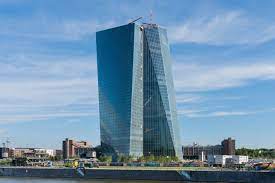
The tardiness of central bankers in combatting inflation means that for the next year, households will face rising rates, high prices and a negative wealth effect. This cocktail should be enough to turn public attention towards the Fed and the ECB tower in Frankfurt. In Europe an added element of complexity is the divergence of growth and inflation across euro-zone countries, and the unwillingness of euro-zone central banks to use macro-prudential policies to rein in inflation. In time we will also see central bankers dragged before senate/parliamentary committees to explain why they have allowed the inflation genie to escape.

As central bankers grow increasingly uncomfortable under the glare of public opprobrium, politicians may decide to ride heroically to the rescue of households. For instance, in the past few day’s governments in Ireland, the UK and France have issued compensation payments to help people pay energy bills. One estimate I have seen suggests that with this ‘cushion’ the effective rise in electricity prices for French households is only 4% compared to an underlying 45%. When we recall the Gilets Jaunes (a movement triggered by higher fuel prices) and the coming presidential election in France, the logic for such a move is clear.

The risk is that these measures simply sustain inflation and create a greater dependency on governments.

Another, more inventive avenue may be a re-appraisal of fiscal policy broadly in the sense that it can be used is break down bottlenecks in supply chains and in ownership structures. Here one important outcome from the ‘inflation crisis’ may be a greater policy focus on breaking down monopolies in industry and consumer goods, concentrations of ownership in property markets and an increased investment in critical industries like semiconductors.

In the meantime, markets are shifting to the next phase of the ‘inflation’ trade. With equities having had a very sharp initial sell-off, the worry now is that credit risk begins to rise – this is dangerous because it translates directly in the real economy and will continue to undermine other asset classes. Inflation may fall as this occurs, though for some time people will continue to pay ‘high prices’. When growth and wealth fall, there may be ever more discontent, and we might be back to 2019.

Have a great week ahead,

Mike

Stress Tested

This January has been the worst start of the year ever for the stock market, and specifically the market reaction to Fed Chair Jerome Powell’s Wednesday press conference is the worst in modern time with markets reversing to the tune of 3.5% (generally Powell’s press conferences get the worst market reaction… Ben Bernanke’s were the best). At the same time, the biggest invasion force mustered on the outer edges of Europe since the second world war stands ready for the battle cry.

If you are reading this on a Sunday morning, as prescribed, I’ll understand if you go back to bed and hide, it’s a depressing state of the world.

In this respect my intention is not to forecast where the stock market is going to go, nor on what day Russian troops will pour over the Ukrainian border (amongst other considerations it would apparently be considered bad form to eclipse the Winter Games in China, which takes us to late February – keep it close, but the 22nd is the day!), but to rather make the point that these two not unrelated events are stress tests, that reveal much about the world that is evolving before us.

Indeed, there are some common patterns. The first is policy mistakes.

The recent conversion of the Federal Reserve to a tightening stance comes after a decade of easy money that has conditioned investors and households that ample liquidity will continue unabated. Its no surprise then that asset prices and increasingly, consumer prices are extremely elevated. The Fed has many warnings that inflation was rising, and as recently as November officials were describing high inflation prints as ‘transitory’ (the latest inflation deflator released Friday, is at the highest since 1983). The Fed is now chasing its own mistake.

In prior years when the Fed had credibility (and its most senior officials were not dealing in the markets they oversee) a very hawkish tone by the Fed could be construed as the use of words to curb market exuberance rather than rate increases outright (more economically damaging). It is unlikely the case this time.

In and around the Ukraine, much is made of the tactical genius of Vladimir Putin. Without any special insight into how he operates (books like ‘Putin’s People’ and the ‘The Dragons and the Snakes’ help) the intention of his constant needling of the borders of Europe (from the border with Norway to angry Irish fisherman) is to gauge the reaction and readiness of NATO/European countries.

In this instance, even if we do not have a war, his actions are producing some interesting side effects – the readiness of Sweden and Finland to join NATO, the activism of small Baltic states, the dominance of American diplomatic power across Europe and the improving credibility of Tony Blinken, and the turning of even the most mild-mannering German politicians.

In that context, a full war on Ukraine might backfire badly on Putin, wealthy Russians and its economy.  

The second, related element is the way in which the two events – the prospect of higher interest rates in the US and the threat of war in the Ukraine are exposing system vulnerabilities. Here are a few – energy distribution networks, Ireland’s lack of military hardware, the gearing built up in financial markets in the drive to ‘democratise investing’, groupthink in monetary policy, and German foreign policy, to name a few.

In finance, two vulnerabilities that may come into sight later this year are rising credit spreads and weaker housing markets. The euro-zone crisis and the policy reaction to COVID tell us that system vulnerabilities get stress tested until people adapt.

Thirdly, the geopolitical and market stress tests tell us much about the new world order that is forming ahead of us.

To start with geopolitics, in his annual and very long news address in mid-December, Vladimir Putin declared the certain end of a unipolar world, and the advent of a multipolar one. He will no doubt be delighted to learn that this letter agrees with these broad strokes but dismayed that we think Russia is too weak economically, financially, politically and in terms of its soft power, to carve out a Russian zone in this multipolar world.

A defining element of this multipolar world is the greying of the demarcation between soft and hard power and more pointedly, the idea of total war (attributed to a Russian general). This has been on full display in recent weeks, notably the use of press, PR and propaganda by Britain and the US, the prospect of financial and economic sanctions, the threat of massive cyber attacks and the use of energy supply chains as a pressure hold. In the future, places that are on the faultlines of the multipolar world (i.e. Taiwan, Hong Kong, increasingly Africa) will be subject to ‘total war’ style tactics.

An additional point, which always struck me hard whenever I visited Moscow or St Petersberg, is that at the friction points of the tectonic plates of this multipolar world, different countries have very different perspectives on the same situation – markedly so in the way Russia views the situation in Ukraine and beyond, and the way say that British military leaders do.

Finally, to markets, which also have Russia in mind (look at the gap between the Russian stock market and the oil price for instance). At the start of the year we wrote that liquidity would be the dominant factor in markets, and the tightening in financial conditions betrays this with US markets behaving in a way that we have only seen in severe economic crises (2001, 2009 and 2020). This is a concern because it signals underlying risks and threats ahead, and the possibility of further policy mistakes.

For my part, I do not think that the Fed will raise rates as much as the Fed itself and many investment banks think (4-5 times this year according to some forecasts). The key issue is what level prices need to fall to such that markets become less vulnerable to tighter liquidity, and in that context we might see a second dip before the end of March. At very least, the first week of February may be less stressful than January, for markets and geopolitics.  

Have a great week ahead,

Mike

Fooled, Again

Fooled Again

In July 2018 Boris Johnson resigned as British foreign secretary, declaring that Theresa May’s Brexit plan (which he later more or less adopted) would only permit Britain the status of a ‘colony’.

The day after Johnson resigned as foreign secretary the death of Lord Carrington (at the age of ninety-nine) was announced. Carrington had been British foreign secretary from 1979 to 1982. He was generally recognized as an exemplar of integrity in public life, and without repeating myself, I had previously written (in the Levelling) a comparison of Johnson and Carrington, the point being to underline the shallowness and mendacity of Johnson.

At the time (2018) I wrote that ‘Johnson was seen as a natural leader of the Tory Party, but the way he has conducted himself since then has led many party colleagues to the view that, even by the standards of politicians, he is too self-serving, and he has lost support within his party.

That sentence could be used today. Johnson’s consistent traits have been to betray those around him and demonstrate unsuitability for office.  Moralizing aside, and while I was right about his character, the joke was on me (and many others).  

Since 2018, Johnson became prime minister, somehow executed Brexit and set about destroying all the things that are most admired in and outside Britain (the BBC, NHS, the rule of law, sovereignty of Parliament and democracy itself). Politics as a spectacle trumps politics as a serious pursuit.

I and many others (I count the unfortunate and very bitter Dominic Cummings here) were fooled into thinking that (poor) form could not triumph over substance for so long. It did, and we should ask why?

The lesson is not to high handedly denounce politicians of weak character, but to wonder what causes people to look beyond these characteristics and support leaders like Johnson. In his case the answers are on one hand easy – his charisma, ability to glad handle people past the truth and to rile his enemies, all of which proved useful during the Brexit process.  

When a crisis arrived that demanded sincerity, patience and attention to detail – he has been found wanting, and it beggars belief to think how he might behave in war (not least given the proximity of his party to Russian finance). Ironically, opprobrium towards Johnson has been triggered not by the enfeebling of the UK economy, or the human misery and death toll brought on by the coronavirus, but by a drinks party(ies). The FT have called it ‘government by stag do’.  

As I write, those who previously held positions as Johnson’s most fervent supporters are denouncing him, consistent with the ‘blood sport’ that is Brexit driven British politics. He is now spoken of as one of the worst prime ministers. Interestingly there is a range of rankings of modern prime ministers (by academic institutions (i.e. Leeds), the public (i.e. BBC/Newsnight), academics as well as newspapers/journalists).

In general, Lloyd George, Atlee, Thatcher, and Churchill, followed by Baldwin and Asquith do well, while the underperformers are led by Anthony Eden, followed by the likes of Balfour, Douglas-Home and Cameron. The role of prime minister has an allure and drama that has been captured in many works of literature from Anthony Trollope’s ‘The Prime Minister’ to more contemporary versions like Chris Mullin’s ‘A Very British Coup’ and of course Michael Dobb’s ‘House of Cards’.

In Johnson’s case, the risk of a coup is not yet high – senior colleagues are standing off in the hope that the Grey report delivers a killer blow, some backbenchers fear that a new prime minister might take the Tories back towards the centre and a hardy few still believe in Boris’ ability to avoid sanction.

My judgement is that Johnson may struggle on till the spring, but his credibility is now so badly damaged, and his enemies emboldened that he would find it difficult to implement meaningful policy initiatives. His behaviour so far in his career suggests that he is not a ‘resigner’ like Carrington but will need to be removed in a heave.   

Whoever becomes prime minister will have two principal challenges – repairing the economy, not just in terms of its cyclical health but structurally in terms of productivity and investment. The second challenge is reaffirming the rule of law and reversing policies that undercut Britain’s democracy.

A third challenge, and only for a very brave prime minister is how to sway the Tories away from their Brexiteer, right wing faction. Rishi Sunak, should he become prime minister may find that this cabal has little love for him, and might be the first Tory prime minister in decades to confront the faction that has done so much damage to Britain. In a recent note I wondered if it would be healthier for British politics if the Tory party would split, with the centre ridding itself of the right. It sounds obvious but in reality, will prove very difficult to execute but until it does happen, the Tories will prefer to be led by clowns.

Have a great week ahead,

Mike