Name-dropping

Chris Mullin was regarded as one of the most likeable MP’s in Westminster, serving well before it became poisoned and banalised by the Brexit bullies. He had many talents – a human rights campaigner and notable author. His book ‘A Very British Coup’ is very good and was turned into an excellent tv series. His political diaries are amongst the best of the genre.

Early last week, a particular phrase in those diaries came to mind. In 1997, when Tony Blair had come to power, Mullin wrote ‘To my surprise I notice that Blair is given to mild name-dropping. This week he mentioned that in Holland yesterday he had called on the Queen. The other day, he quoted something Hillary Clinton had said to him. On another occasion, he quoted the president of Brazil, on another that he was off to see the Queen.’

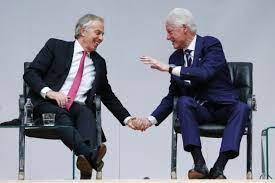
My memory of this diary entry was twigged on Monday night in Belfast at the dinner to celebrate the 25th anniversary of the Good Friday Agreement[1], by the sight before me of Blair, obscuring my view of Bill and Hilary Clinton.

‘Get out of my way man!’ I shouted, as I made my way to see Bill (I did not of course say this, but I did manage to snatch a minute of Bill’s time). 

Now that I have gotten my own name-drop out of the way, the real reason I bring up the topic of Bill Clinton is that the economic circumstances of the early part of his presidency give a steer as to what may come next this year.

In particular, with inflation ebbing from high levels fears of a recession are mounting, and institutions like the IMF and the Federal Reserve are warning of this. Macro-wise, lead economic indicators (NY Fed recession indicator, Philly Fed, Conference Board lead indicator) and bank lending data point to a contraction in growth.

While this is now one of the most widely expected recessions (given the debate amongst economists), we should be ready for that debate to amplify with commentators speculating on whether we have a ‘U’, ‘V’ or ‘W’ shaped recession.

In this context, there has not been a traditional business cycle contraction/recession in a very long time – the COVID recession was a ‘shock’ event, the global financial crisis was a calamitous financial system event, and the 2001 dot.com recession was – apart from the technology and banking worlds – not much of a recession. Then 1997/98 was again a mixture of a bubble and financial market crisis. This leaves the recession of the early 1990’s and its aftermath as one of the few recent examples of an ‘ordinary’ recession.

Of course, the oddity with this litany of financial crises is that central bankers (and their economic models) still think in terms of notional business cycles.

So, back to the Clinton years. Perhaps three things stand out. 

High inflation, a war, an oil price shock and rising interest rates all caused the recession of the early 1990’s, and helped deepen the Savings and Loan crisis (a crisis of incompetence and skulduggery). We have just about had all those already. Notably the beginning of the recession ended the political career of George H Bush, who went from having record approval ratings in the aftermath of the Iraq War to a stumble over ‘no more taxes’.

Financially, the aftermath of the recession was very complicated – the ERM crisis led to the ejection of the pound from the currency board, and in 1994 persistent inflation led to a huge unwind in bond prices in the context of ongoing tightening by the Fed. That the Japanese bond market was a significant factor here is worth considering today, given that higher Japanese yields could be the next ‘shoe to drop’.

To gather these strands together, the world is vastly more complicated today than it was in the 1990’s, and the set of risk factors is broader. Of interest also is that the US is not the dominant economy at a time when coordination between the large regions is difficult to achieve.

My expectation is that we are entering into a classic business cycle (U -shaped if you must) that will be greatly complicated by strains across the debt markets. The stark difference between one and three month interest rates in the US is a sign of things to come, and specifically of a messy debt ceiling debate in the USA. If interest rates remain at high levels in 2024, and if they rise further in countries like Japan and the UK, then we might even have a debt crisis.

On that cheery note, have a great week ahead.

Mike


[1] Thank you Garret

Fractured World, Part Deux

I had wanted to write on the nature of the coming recession, but something more important came up, and even though it concerns Emmanuel Macron whom we wrote about two weeks ago, it is central to the thesis of The Levelling that the world will be cleaved into three ‘poles’ each driven by different value sets and increasingly distinct ways of doing things.

One of the rules of political leadership is that when in trouble domestically, a leader should go abroad, or start a war. Emmanuel Macron effectively did both last week, when in the vapours of his visit to Beijing, he carelessly distanced the EU from the US, the international fight for democracy and the cause of Taiwan (Macron spoke as five dozen Chinese jets harassed Taiwan, and China war-gamed missile attacks on the Taiwanese mainland).

Macron’s comments on the geopolitical outlook have caused quite the stir and it is worth dwelling on them and on how others perceive and react to them, not least because they give important indications of how the world order is evolving and where points of sensitivity are. 

First, some context, from Paris. Most French people find Macron’s personal manner hard to take because either he reminds them of their boss or like the clever student, he gives lengthy, erudite replies to questions. That his personal style is beginning to grate was in some part behind the motivation behind the recent protests against pension reform.

Second, language and style are important. In French (see the Les Echoes interview) Macron’s comments are not quite as bad as English language headlines suggest. Many of those in apparent shock at Macron may not speak French nor will they appreciate that he speaks in long paragraphs rather than soundbites ready for media consumption. Having said that, Macron might want to speak less.

There were many things Macron should not have elaborated on – the dollar, his view of Taiwan and China’s belligerence towards it. In some respects his views on Taiwan begin to resemble the views of isolationist (mostly far right) American politicians on Ukraine. In many respects, this is a diplomatic victory for China and a defeat for the notion that there is a coherent view across the West on the sanctity of democracy.

There are important elements in Macron’s frame of mind for American diplomats to consider – the side-effects of AUKUS, the risks of another Trump like government in the US and the impact of the IRA Act on European leaders. Worryingly, Saudi Arabia has also taken a step away from its close relationship with the US. 

Further, Macron’s stated desire for Europe not to be a vassal of the US was very badly expressed.

I spent much of last week in Dublin and will be in Belfast next week – and while the visit of Joe Biden to Ireland highlights the extremely close cultural ties between the US and Ireland, the Good Friday Agreement (now 25 years old), the Dayton Accord and possibly German unification, could not have happened without the US. Most Nordic and Baltic states, together with Poland would rather have the US as a close ally, and that likely riles Macron.

However, the Biden visit to Ireland also demonstrated that Europe is changing – Ireland today bears little resemblance to the image of Ireland Biden grew up with, and the America of the Kennedy’s, Reagan and Clinton (all good Irishmen) is a distant memory when we think of the challenges Biden has to contend with.

European governments will not be happy with the expansive nature of Macron’s comments on the role of Europe in the world and on how strategic autonomy is defined, and most of them will feel that President von der Leyen is the correct person to pronounce on these issues. She is often the victim of casual sexism in that the men in the room downplay her views and role.  

However, part of Macron’s comments on strategic autonomy may have been deliberately disruptive. To date, few other leaders apart from Macron have tried to publicly elaborate on strategic autonomy. The time is come for others to step forward – possibly the Dutch prime minister or the Estonian prime minister and even the German foreign minister (also in China last week and who laid out a much firmer line).

Geopolitically, the friction caused by Macron’s remarks is part of noisy evolution of the multipolar world, where the three main regions – the US, China and the EU will fill out their geopolitical identities and frame relationships with each other. Europe in particular has more work to do in defining strategic autonomy in a practical way.

Economically, there are two very important points to make. First, in his weekly note David Skilling draws on recent data and research from the IMF to show that geo-politics is driving the foreign direct investment flows, with flows into strategic sectors and semiconductors now avoiding China.

As David puts it, the implication is that increased geopolitical tensions are likely to lead to FDI being increasingly concentrated within geopolitical blocs.  There are various geopolitical scenarios, but a ‘hard fragmentation’ into closed, competing geopolitical blocs will have a strongly negative economic impact as FDI flows are distorted – the IMF assesses ~2% of global GDP – as countries lose the economic benefits that come from FDI

This shows that the battles of words and ideas over Taiwan has real implications, and in time many corporates will themselves have to start taking sides, and in many cases, pronouncing a view on Taiwan.

My final point this week concerns the coming global recession. Having spent months denying there could be a recession the likes of the Federal Reserve and the IMF are now actively flagging this as a risk, not least as bank lending plummets. Amongst other things, the nature of the next recession will have geopolitical consequences – whichever region manages to come out of recession first, will have the edge in the ‘war by other means’.

Have a great week ahead,

Mike

Edmond Dantes?

n France, the latest production of the ‘Three Musketeers’ is hitting cinemas and it is feted for being the most expensive French film ever made. My attention however is focused on another of Alexandre Dumas’ works, ‘The Count of Monte Cristo’, where the main character Edmond Dantes, deviously wronged as a young man, eventually escapes prison on Château d’If, builds a fortune and then exacts revenge on his rivals.
 
The book was set around the time of Napoleon’s escape from Elba, but this time I associate it with another well known political figure, Donald Trump. If he reads books, Trump might fancy himself as a modern-day Edmond Dantes – he will prove his tormentors wrong when his case for campaign fraud is held at the end of this year, and then march back into power. Yet, I think that ‘The Donald’ is unlikely to enjoy the same triumph as ‘The Count’ but the great risk for America is that the court case turns out to be a damp squib and he manages to turn this to his advantage in the 2024 presidential race.
 
I hope that this does not turn out to be the case, and the media, social media and most of the Republican party bear responsibility for giving Trump the political oxygen he craves, and not the shame and censure that someone who has debased American institutions deserves.
 
The prospect of a second Trump presidency and the fragility of American public life is a key reason why European governments now worry publicly about the US as a political partner. More seriously, it has caused some countries – Saudi Arabia as we noted last week – to start to bet against American decline. American declinism is a growing cottage industry, matched by the ‘Europe will fall apart’ brigade, and led by the ‘end of the dollar’ crowd.
 
This group was out in force last week, forecasting the end of the dominance of the dollar. I think this is unlikely. China – allegedly the coming financial empire – makes up barely 3% of world fx reserves. It has yet to be tested by a full recession and it continues to make the wrong sort of geopolitical friends (fragile states like Russia and Iran). Chinese monetary policy is still opaque, and surprise currency devaluations are a live risk. Further, few Westerners or professionals from countries like Indonesia, Bangladesh and India want to live there and the barriers to doing so are high.
 
If developed world currencies are likely to lose their place in the world trading system it is likely to be smaller ones like the pound and the Swiss franc. Brexit is making the pound less relevant in a number of ways, and the Credit Suisse debacle will sow fears regarding trust in Swiss laws and the durability of its banks. Traditionally, one reason that the Swiss franc remained strong was that capital flowed into the country and did not flow out. At the margins, this may change – possibly to the benefit of larger American banks.
 
So, if the dollar is safe for now, there are still two issues to worry about. The first is that whilst it is financially the most dominant nation, America’s diplomatic power is much reduced. One illustration is to think of how it was the central, organising force behind most of the financial and economic rescues of the past fifty years – from the Brady bond solution to Latin America’s crisis to Alan Greenspan’s ‘Committee to save the World’ after the Asian crisis. When the next crisis comes, America will be the most significant player but not the dominant one and the risk for the US, is that the solution to that crisis may tilt financial power away from it.  
 
The second more profound worry is that at the heart of American society there is a disturbing set of socio-economic trends. America today is debatably the most unequal (in terms of wealth) society ever (I have even compared it to the Roman empire)
 
Gravely, life expectancy and adult health have dropped sharply – a highly unusual development in a rich country, and one more associated with some kind of emerging market socio-economic shock (Russian life expectancy dropped by nearly five years from 1990 to 2005 for example)
 
An important paper by Anne Case and Angus Deaton (2015 Nobel winner), “Rising Morbidity and Mortality in Midlife Among White Non-Hispanic Americans in the 21st Century,” highlighted the deterioration in health conditions, especially those relating to mental health, for middle-aged white men and women in the United States.
 
The mortality rate for this cohort has increased sharply owing to drug and alcohol poisoning, suicides (the United States is seeing a sharp rise in suicides, according to the Centers for Disease Control and Prevention) and related diseases such as cirrhosis of the liver. Groups with lower levels of education saw a sharper rise in mortality. Gun violence is of course another problem (witness the debate in Tennessee).
 
The worsening of inequality, social and health conditions in the US is a sign that politicians should pay much greater attention to health in public policy. If a serious politician is looking for a mantra and a program to run in 2024 he/she should try ‘Make Americans Healthy Again’.  
 
Have a great weekend,
Mike 

War and Peace

I have flown over Mecca a few times on the way to Jeddah and in particular, flights during the Hajj are memorable. Usually, the pilot played prayers on the intercom as the plane approached the holy site, and most of the passengers were taken up with prayer – in a way that perhaps only an Irish Catholic could appreciate. More impressively, sights of the enormous infrastructure that spans Jeddah airport to Mecca gives a sense of the hundreds of thousands of pilgrims that visit Mecca every year from across the Muslim world.

Notably, in a few months Iran’s Shia Muslims may be made welcome to Mecca following the agreement between Iran and Saudi Arabia to reestablish diplomatic relations, under the diplomatic stewardship of China. I am not sure that this event immediately heralds a geopolitical revolution in the Middle East but it is significant in many ways, and will at the margins reduce tension between the countries of the region (‘no problems with neighbours’), though may also provoke stress between the regions beyond the Middle East.

For Iran the deal brings several positives – even more trade with China, the mantle of a ‘responsible’ regional actor, the chance to consolidate its overwhelming influence over Iraq and Syria, a lesser commitment of resources to Yemen and less intense pressure on domestic Iranian politics from Saudi related media outlets (notably those in London). Also, the prospect of a visit by President Raisi to Saudi Arabia will add legitimacy to the Iranian government at a time when protests there have been widespread.

For Saudi Arabia there are also multiple benefits. Notably, a calming if not an end to the war in Yemen and by association, attacks into Saudi Arabia itself. Its oil infrastructure and access to drinkable water will be more secure now. Closer commercial ties with China will be welcomed at a point where the Kingdom’s currency has weakened and when inflation is high, and a corollary of this will be pressure on the US to ‘charm’ Riyadh.

Diplomatically, Saudi Arabia now has a dangerous hedge- it plans to join the SCO (Shanghai Cooperation Organization – about which we have written much in ‘The Levelling’) as a ‘observer’ member, which we might think of the SCO as a China led anti-NATO gang. The motivating force behind this deal is Saudi Arabia’s Crown Prince Mohammed Bin Salman (MBS). He is hugely ambitious for his country, and while young people in Saudi Arabia enjoy far, far less freedom than those in Iran, the relative change in their lives and expectations in recent years has been very significant.

Broadly for the region, the reestablishment of diplomatic ties should see a shift in emphasis from local geopolitical tension to economic growth. For China, it is a major win, notably in terms of trade – it accesses oil from both Iran and Saudi Arabia, will promote the use of its currency in the region (similarly a recent trade deal with Brazil will boost use of the yuan) and will invariably sell more Chinese goods into the region, not to mention access its real estate markets.

China will also host an Arab-Iran summit in Beijing later this year, a move that underlines the view EU President Ursula von den Leyen expressed last week in a keynote speech that ‘China’s clear goal is a systemic change of the international order with China at its centre’.

If China is a winner, then in this increasingly bifurcated world, the US must be the loser.

The announcement of the deal came at a time when Western banks were collapsing, and strikes and riots disrupting European capitals, so to an extent it has passed under the radar. It confirms my view of rapidly changing geopolitical tectonic plates, and China’s aim to realign the world along autocratic/East v democratic/West lines. The Chinese may well feel that twenty years on from the invasion of Iraq, the West’s grip on the Middle East has decisively loosened. They should also be careful not to think that meddling in the Middle East is a prerogative of great power status.

There are maybe three tests of this new alignment. One is very simply the extent to which the reopening of diplomatic ties produces any real ‘warmth’ between Iran and Saudi Arabia. The second is whether the coming global recession further weakens local currencies and specifically will lower the price of oil, and thus local economies.

The third test may come from Israel and focus on Iran’s quick march towards acquiring a near functioning nuclear weapons program. The war in Ukraine has seen Iran emerge as a sophisticated producer of military technology and granted that it is now producing a very high grade level (84%) of enriched uranium, Iran could be considered to be in the antechamber of nuclear powerdom. This may prove a threshold too far for Israel and many armchair wing commanders

In this respect, the protests that have dramatically gripped Israel in recent months in the light of the Netanyahu government’s attack on Israel’s institutions have thrown the country into disarray at a critical moment. This is nearly entirely Bibi’s doing, and it may just become his greatest mistake.

Have a great week ahead,

Mike

On est là Macron!

At the beginning of a recent journey to Ireland from Paris, the French taxi driver asked me how our new king was getting on (many of them think Ireland, Scotland and England are the same place). I immediately launched into the obligatory, angry lesson in Irish history for his benefit. When I calmed down, I told him that his majesty was doing fine, or least a lot better than the prime ministers who have served him.

I even mentioned that well over ten years ago I met Charles III, ahead of a momentous visit by the late Queen to Ireland. The Queen’s visit went very well, despite obvious security concerns, and it played an important part in reconciling Ireland and England. Since then, Charles III has visited Ireland a number of times. Given this experience, Charles could at least have crossed the Channel.

With the French state having marked the passing of Elizabeth in an elegant and warm way, Charles had nothing to fear for himself, save that an arrival into France might seem like stepping into a scene from Les Misérables (not so long ago London was a grumpier town than Paris). Piles of rubbish, fires and violent riots are the order of the day, all it seems, because Emmanuel Macron has in the eyes of the French people, been behaving like a king.

I have a lot of sympathy with Macron’s desire and need to drag the French pension system into the 21st century, and he has the heft of demographics and France’s weak financial state to back him up. That pension reform has become a battle ground, has much to do with other factors – deep frustration at an inflexible labour market, the use of article 49.3 to pass the pension reform law and the perception of Macron as ‘Jupiter’, an imperious, aloof ruler.  

I think he has missed a significant political trick in not making more of the fact that his government has managed to bring unemployment down to multi-decade lows, and there have also been some improvements to gender income inequality.

However, the pension reform debate has jaded Macron, which given his role as the indispensable European politician, is not good. It has also started to draw into focus what French politics will look like when he ‘retires’ and how his party will fare.

Given the role of France in the world, I have no doubt that a crisis or two will pop up where he can prove his mettle.

A bigger, ambitious project for him is how to improve French democracy. Granted his personal aura and the use of article 49.3, many French people would believe that he is not well suited to undertake this, but at the same time, there are very few French public figures who have the ideas and will to change the way its democracy functions. Indeed, it seems to me that, like many other countries, there are more French politicians who are content to make political capital through the vandalization of the democratic apparatus.

The task, given that there is such a gulf in trust between the French state and its citizens, may lie in giving more power to them. Citizens juries and citizens assemblies have been tried, but unlike other countries where these mechanisms have worked well, there is little appetite on the behalf of the state to implement the recommendations of the citizens assemblies. Macron has notably not done so.

For the moment, he should heed the words of Thomas Jefferson (a statue of whom is not far from the Assemblée) that ‘The spirit of resistance to government is so valuable on certain occasions, that I wish it to be always kept alive. It will often be exercised when wrong, but better so than not to be exercised at all. I like a little rebellion now and then. It is like a storm in the atmosphere’.

Macron and colleagues may also want to challenge their opponents to come up with realistic solutions to solving France’s financial weaknesses and to enlivening its democracy. So far there are all too few willing to do so, and the longer their silence endures, the greater the final crisis will be.

For his part, Charles could at least have held his nose and carried on.

Have a great week ahead,

Mike

Automata

Portrait of René Descartes (1596-1650), philosopher and scholar. Artist Unknown. (Photo by Heritage Art/Heritage Images via Getty Images)

Philosophers amongst you will be familiar with the work of Rene Descartes – a mathematician, epistemologist, and rationalist – much of his work laid the ground for modern philosophy and in particular the strand that has grown out of Hobbes and Locke that informs a lot of the 17th century and the formation of states and societies thereafter.

There is one eerie and unsettling aspect of his life that is gaining greater attention. Descartes had a relationship with a servant (Helen van der Strom), and their relationship produced a young daughter Francine, to whom Descartes was very attached. Tragically, Francine died of scarlet fever, aged five, and so distraught was Descartes that he had a robot or automata (clockwork, lifelike doll) built in her likeness.

He transported this ‘doll’ with him whenever he travelled (in a casket), and on a trip to visit Queen Christina of Sweden, the crew of the ship on which he was travelling became so alarmed (it was a stormy night) by the robot and Descartes murmurings with it, that they invaded his quarters, seized and broke the ‘doll’ and threw it overboard. Descartes was further traumatized, and whilst it is not clear the incident immediately impacted his health, he died soon after.

Descartes ‘doll’ is enjoying renewed attention for what it suggests about the relations between humans and machines, how robots can potentially replace and even supplant humans in different ways and for the manner in which this can cause consternation.

The relationship between human and machine is a theme that will cut through the advance (or decline) of the world, and we have written about it frequently (i.e. ‘Talos’). As my limited vision can perceive,  will attempt a classification that says there are at least two aspects of this megatrend – the risks that machines take over our (human) world (AI), and the risks that machine led worlds start to exist outside the human one (Defi, Web3/metaverse).

The bad news is that in the case of the former, there is an unknown risk that machines could injure the human race (weaponized AI, the use of AI by ‘bad’ humans and the use of robots in war not to mention the creation of chemical and biological weapons by AI that I referred to in ‘The Final Problem’).

The good news is that ethereal new worlds – Web3 and Defi (decentralized finance), whose architects had boldly proclaimed were independent of the ‘old’ system, now look like they will be adjuncts to it.

While much of the early hype around Web3/metaverse suggested it was a place that humans could stay in for considerable amounts of time, it now looks like a country they can visit or ‘pop in to’. This much was made clear to me as I attended the Validify digital retail conference in Hertfordshire last week, where the consensus view is that Web3 can help consumers (try clothes or mock up house decors) but will not necessarily become a domain that rivals ‘our world’.

Much the same is true of decentralized finance, which has so far failed to rival in the incumbent financial system, but where its most useful elements such as digital asset infrastructure, are being adopted by incumbent financial system players.

In both cases the growing modesty of new ‘inventions’ is correlated with rising interest rates (and falling market liquidity), highlighting that (as with Descartes time in the Dutch Republic in the 1630’s and 1640’s when the Tulip Bubble took place) many triumphs of innovation are to a large extent cheap money in the drag of new technologies.   

In some cases, cheap money and – good design/branding – allows new technology led companies to grab market share, to build new supply chains and to generally make consumer life easier (a small number of fintech and consumer platforms do this). What cheap money also does is allow investors and the wider commercial marketplace to believe that ‘new commercial worlds’ (like the Metaverse) can be created and will have corresponding commercial potential as the human world. The tide is going out on this idea.

To some extent, as expectations of the potential of the metaverse and decentralized finance are deflated, investors and analysts should become more circumspect about AI. AI, the metaverse and defi are very different things – though all driven by the same capital markets, venture capitalists and evangelists.

To my own experience, AI is rooted in data regression analysis – which makes me cynical about it given the time I have spent on econometrics. I do think it is different to Web3/metaverse and defi in that AI can potentially operate in and build out both of these ‘worlds’, as well as ours. AI driven computer programing is an example of such a productivity enhancing application.

What potentially makes it interesting and deadly, to my earlier point, is that it can evolve and enhance the way it has been structured by programmers, to the extent that, to quote Descartes ‘it thinks, therefore it is’. That’s something to worry about.

Have a great week ahead,

Mike

Brexit peters out

Brexit might be over, at least in the sense that the ‘Windsor’ framework brings much of the legal and political wrangling to an end and opens up the vista of better relations between the UK and the EU. Economically and strategically though, Brexit lives on.

One of the accomplishments of Brexit has been to set very low standards in political behaviour and a very high benchmark for the absurd, so it was no surprise to hear Rishi Sunak praise Northern Ireland’s newfound status in that it enjoys open trade with both Great Britain and the EU, though I did blink once or twice. The risk for Sunak is that Scotland and Wales might want the same, not to mention England.

The Windsor framework was also a coming out of sorts for Sunak as an independent political creature, one that is analytical (the first prime minister to have an MBA) and unusual, in that he does not have the same amount of political baggage as other Tories. In that context he is less attached to the unionist point of view and slightly more rational than some of his predecessors.

Politically, the Windsor deal means several things.

First, the bad blood between London and Brussels is likely over and there will be a more pragmatic, productive approach to working together on defence/Ukraine, innovation and border policing. The EU will now have more political time to spend on ‘strategic autonomy’ and the reordering of its defence and foreign policy, while Sunak will have more time to spend tending to the British economy. Despite ‘Windsor’, Britain still owns Brexit and its economy will still be handicapped by it and still suffers poor productivity, a weakening housing market and anemic investment.

Second, speculation about the breakup of the Union – the reunification of Ireland and Scottish independence, will be tempered for the moment. As soon as Brexit happened my first thought was that it would catalyse dramatic, and hopefully constructive political change in Ireland and Scotland. As we noted last week, Nicola Sturgeon’s departure from Scottish politics plus the

recent ruling from the Supreme Court limiting a Scottish referendum have sapped the moment of the independence movement.

In Ireland, there is also the realization that the case for unification needs a stronger and arguably different basis in the sense of their being more cross border tourism, investment, commerce (this is picking up) and shared public goods (similar health systems for instance).

A lot of imagination needs to go into conceiving what a united Ireland might look like (Brendan O’Leary’s recent book on this is good), ultimately the structure of a united Ireland could well look like a Swiss style federation (see ‘Ireland and the Global Question’ (2006)!). What is also interesting is the role of demographics in changing Scotland and Ireland. This is noticeable in the sense of younger populations that are less rooted in traditional politics, as witnessed by the successes of the Alliance Party in Northern Ireland, and to a large extent the SNP in Scotland.

A third reason to be cheerful is for Northern Ireland itself. More than many other regions in Europe it has suffered the backwardness and intransigence of its own politicians, and the careless neglect of many in London. Whilst politicians in the Major and Blair eras had a sense of the complexity of the North, and in general were careful with this, a string of recent secretaries for state and prominent Brexiteers have displayed a shameless ignorance of Northern Irish politics and society, whilst at the same time treating it as a political pawn. That still seems to be the attitude of Boris Johnson.

My sense is that the vast majority of people across Northern Ireland desire a return to normalcy and I hope that the Stormont’ assembly now sits and the North enjoys a period of uneventful calm, and enjoys the benefits of close ties to the EU. The assembly members may have come comfort in the existence of the ‘Windsor’ brake, but some trepidation that it was designed by the same people who crafted the ‘backstop’.

In that respect, that Rishi Sunak referred to Northern Ireland as the ‘most exciting economic zone in the world’, which is probably an exaggeration that stems from his days as a hedge fund salesman. However, a friend of mine is leading a social impact real estate project to revitalize the centre of Belfast, and as I help along, I can see the potential there is for the city to grow (especially compared to other UK cities).

As a final word, Brexit cannot end until the villain at its centre stage is slain. Sunak now needs to take on Boris Johnson and the ever-delusional Liz Truss – by for example canceling the resignation honours lists of both former prime ministers, by cooperating with civil servants who are investigating multiple breaches of ethics and security by Johnson, suspending Johnson’s part membership and potentially by steering the Tory party away for awarding Johnson a safe seat at the next election. Labour will probably win that, and they could then remake British politics by changing the electoral system (introducing proportional representation for instance). Such a move might well shatter the Tories and produce a new party of the centre and a (far) right one.

If that happened, Brexit might well and truly be over. Though we might also miss it.

Abandon Hope!

In the past year, two specific political interviews have struck me as being particularly interesting. Recently, Emmanuel Macron gave an interview to a group of autistic journalists where they posed questions that might not normally be aired in everyday press briefings. Macron to his great credit, was open and frank, in a way not normally so in everyday briefings (he tends to speak for too long and always gives the ‘bonne réponse’).

The other interview that caught my attention was Micheál Martin, until recently Ireland’s Prime Minister (Taoiseach) under the Fianna Fail/Fine Gael led coalition. When he became Taoiseach, it is fair to say that Martin did not have a strong public persona in Ireland and to many, his interventions appeared too mild and often controlled.

However, in February of last year he gave a long interview to the Two Norries podcast. This is one of my favourite podcasts because of its complete honesty, the colour it gives on the complexity of social problems and mental health, and of course the strong flavour of Cork city.

In brief, Martin’s interview in an untypical setting, gave a highly personal view of his family life, background and political convictions, in contrast to his far more stilted public briefings. My feeling on listening to the podcast was that the initial part of Martin’s premiership would have gone more smoothly if he had done such an interview earlier and given the public an opportunity to ‘know him better’.

The Macron and Martin interviews are instructive about the way politicians live, behave and are treated by both the media and the public. They speak to a political class that, for various reasons, regards the media as both a foe and as part of the arsenal of political tradecraft, and also of the growing mental health strain on politicians.

This point was made volubly with the resignations of Jacinda Ardern and Nicola Sturgeon as prime/first ministers of New Zealand and Scotland respectively. Both are accomplished leaders, and as women have had to endure troubling levels of sexism, and abusive commentary about their personal lives in a political climate that has at the same time long seemed immune to the appalling personal behaviour of the likes of Boris Johnson and Donald Trump.

That both Sturgeon and Ardern pioneered the ‘Wellbeing Economy Governments’ that seeks to measure a country’s progress through a broader range of measures than GDP, suggests that they had a more balanced vision of society, economies and politics – which they perhaps struggled to implement. Unfortunately, the halt to their political careers suggests the opposite – that politics is becoming a blood sport where only the very tough and singular can participate (especially in parliamentary systems). The media treatment of Kate Forbes candidacy for the leadership of the SNP is potentially a test of this. She is an untypical candidate, educated in India, and then through Gaelic in Scotland, and unconventionally openly religious.

More broadly, the political climate is now not unlike professional sports, where politicians need to practice their art to the exclusion of all else. I had flagged this in The Levelling

the personal characteristics of politicians have become less traditional, less family-centric…which suggests that the intensity (and perhaps cruelty) of the political game makes it increasingly difficult to enjoy both a family life and a political career’.

It would be naïve to suggest that life was rosier for politicians in earlier times, but the intensity that television and now social media have brought to politics is becoming debilitating, not just for the time it takes but the bad behaviour it engenders. This development risks creating an environment where bad actors can thrive – and to a degree the rise of ‘strongmen’ politicians has been enabled by social media and by an environment that is intensely contested (note the current debate on the American right regarding a ‘national divorce’).  

This trend tallies with last week’s note on the need to emphatically bring an end to the democratic recession. There is an opportunity for (effectively centrist) politicians to reduce the impact of social media in politics, deploy deliberative democracy better and to devolve power to more local levels. Switzerland is a good example here – though admittedly hard to replicate. Doing so will create platforms that are not as demanding in terms of time and emotion for people to become involved in politics.

If public service has to come with the caveat of ‘all hope abandon ye who enter here’ to quote Dante, then the public will bear the consequences. Brexit is an example. Another contemporary one is Peter Obi’s entry into the Nigerian Presidential elections (the first round is taking place as I send this). He is, compared to Bolu Tinubu, Atiku Abubakar and Muhammadu Buhari, and untypical candidate in a hugely consequential election for Nigeria and Africa in general. Let’s see how he fares.

Have a great week ahead,

Mike

Democracy’s Keynesian Moment

With the one year anniversary of the war in Ukraine passing, the media will doubtlessly be filled with analysis of the military and geopolitical lessons (so far) from the invasion. One aspect that is perhaps underestimated but nonetheless vitally important in the context of growing strategic competition between the West and East is the bottoming out of the democratic recession.

This phrase was coined by Prof Larry Diamond to describe the end of the wave of democracy that begun with the fall of communism and likely peaked before the global financial crisis, and that has now left the world at a multi decade low in terms of the number of ‘full’ democracies and the greatly diminished quality of democracy. Starkly, the last EIU Democracy Index Report notes that only 8% of the world’s population lives in a ‘full democracy’ and 37% live in autocratic regimes.

The quality of democracy is intrinsically linked to the debate over the end of globalization, and the three factors that have marked its demise – high inflation, rising rates and war in Europe – will further stress test democracies and their leaders. Notably, they might also catalyse responses from governments that could help repair democracies, whilst also making for further misery for autocrats.

This possibility, taken together with the fact that the ‘centre’ is generally speaking holding across European governments (note the relative calm of Italian politics), and growing marginalization of the clowns and the corrupt of the populist right (Trump, Bolsonaro and Boris) suggests that democracy is steadying whilst autocracy is crumbling.

In economic recessions, when negative growth looks like it is bottoming out, there would usually be a call for a stimulus. Democracy, at this critical point, should be no exception, and the time has come for a dose of ‘democratic Keynesianism’, where states will invest in the quality of their democracies, public goods like education and act to limit ‘subprime’ elements like rogue funding of political candidates, corruption and the use of social media and cyber to meddle in elections.

This can take several forms. For instance, the EU has launched a Democracy Action Plan but this will have little credibility if its Parliament is structurally prone to corruption, nor if individual states do not implement telling policies on campaign finance, freedom of the press and better civic education.

On a more positive note, there is a renaissance in the use of deliberative democracy – at a local level in many countries, and significantly at a national, constitutional level in the case of Ireland’s Citizen’s Assembly whose work has led to a number of changes to its constitution. The challenge of deliberative democracy for many incumbent governments is to cede power to the people, and to trust their judgment. This has proven problematic in France, where there is a gulf in trust between the state and its citizens.

Then, there are areas for policy coordination between the US and the EU, notably in marshalling the role of global social media companies in politics, in using multi-lateral institutions (i.e. World Bank) to support democracy, and in working aggressively to limit outright attacks on democratic systems (e.g. cyber security and money flows).

At a country level there are several questions to be answered before a democratic recovery is truly underway. One relates to the political identity of the Republican Party and whether it as an entity is ready to come in from the hard right and actively support the rule of law, or whether it may split. The isolation of Liz Cheney in this respect is not encouraging here.

The other is the UK, where there has been a measurable decline in the rule of law, respect for institutions and a rise in corruption since the early 2010’s. The worry is that this has not triggered a broad realization of the damage that these trends are doing to the UK’s democracy, economy and place in the world, nor has it led to the arrival of a ‘democratic white knight’ figure in British politics (though Sir John Major’s speech ‘In Democracy We Trust? is well worth a look).

Then finally, the interesting long-term question is how governments and electorates in large populous emerging nations will regard democracy. Any causal link from autocracy to higher growth  – visible for some time in China and Turkey – is broken, whilst the trend relationship between economic stability, the rule of law and human development and investment remains in place. While Iran is an extreme example of a population ambitious for a more open society, there are other countries where the pressure on leaders to provide greater prosperity and representation will grow and optimistically, may spur a new wave of democracy.

MONIACs

A rule of thumb of mine (the O’Sullivan Zombie Rule of Economic Modelling) states that once a model has been written off as dead by the economics profession, it makes a comeback. The ‘death of budget deficits (under Clinton)’, the ‘death of value investing’ and a ‘this time is different approach’ to debt are some examples.

The latest one I have in mind is the Phillips Curve – an economic relationship researched by the New Zealand economist Bill Phillips that maps an inverse relationship between unemployment and inflation, and subsequently developed by prominent economists like Milton Friedman and Robert Lucas.

Over the past decade, a period characterised by low inflation, low interest rates and low unemployment, a number of economists have sketched the obituary of the Phillips Curve. James Bullard, a prominent Federal Reserve official, has stated ‘If you put it in a murder mystery framework – “Who Killed The Phillips Curve?”– it was the Fed that killed the Phillips curve’. Peter Hooper and Frederic Mishkin have pondered ‘The Phillips Curve – dead or Alive’, while a 2022 discussion paper from the Fed wondered ‘Who Killed the Phillips Curve? A Murder Mystery’.

There are some good reasons as to why the death of the Phillips Curve has been declared – falling rates of unionisation in the US have diminished the bargaining power of workers. In the UK in the 2010’s the sharp increase in the gig economy – where many workers effectively privatised themselves – also meant that a large number of workers had little wage bargaining power. An environment of generally falling productivity also laid bare the weaker claim that workers had to higher wages.

Though empirical evidence suggested that in many countries the Phillips Curve is dead, it still remains an important and well-worn policy setting for the major central banks, and many of them devote considerable resources to researching them as this paper from the ECB shows.

For instance, in recent years, in the US Janet Yellen as Fed Chair repeatedly spoke of driving down long-term unemployment to help spur a little inflation. Central bankers are typically very conservative, slow moving creatures – hence the logic of my ‘Zombie Rule’ is that by the time they reject a model, it is time to bring it back.

The reason I think this to be the case now, is that many developed economies are perched between multi-decade highs in inflation, and multi-decade lows in unemployment. The prevailing view is that inflation is now decelerating, and strong employment means that we will experience a ‘soft landing’. This appears to be the view that financial markets are extrapolating from recent comments by the Federal Reserve Chair Jerome Powell.

In this context, the risk is that the Phillips Curve makes a Lazarus-like comeback in policy circles, and in practical terms that tight labour markets lead to very sticky, high inflation. One mystery in this respect is the ways in which the labour market is changing because of demographics, the post COVID economy and the attendant changes in the geographic location of labour, as well as the impact of ‘strategic competition’ on supply chains and thus labour markets.

Most of these factors however should lead to upward pressure on wages and it is striking that economies that have seen high inflation, are those where labour market participation has changed. To that end we will very likely hear more about the ‘revival’ of the Phillips Curve as we enter into a highly noisy macro environment characterised by highly pessimistic readings from lead indicators and very competitive labour markets.

A clue to how this plays out may come from my favourite piece of work from Bill Phillips.

Well before he was celebrated for the ‘Curve’, Phillips built an extraordinary machine that pumped colored water through glass vessels in order to demonstrate how money flows around an economic system. The machine named MONIAC (monetary national income analogue computer) included parts salvaged from a Lancaster bomber. Levers in the machine permitted users to simulate the effect on the system of fiscal (budget) policy changes for example, and such was the intuitive appeal of the machine that major universities like Harvard and Oxford ordered their own versions.

In today’s algorithmic driven economies and markets, such a simple contraption might seem well out of place, but the time might be ripe for the major central banks to install MONIAC’s.

At very least their use might help induce further humility to a central banking community that has gotten the inflation call badly wrong in the past two years, and that is now presiding over a premature easing in financial conditions and ‘animal spirits’ in the context of still high inflation, and very low unemployment.

Have a great week ahead,

Mike