Two Week War?

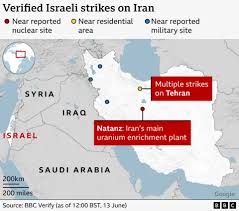
Just over twenty years ago I had lunch in a roadside café near Natanz in Iran (on the way back from Isfahan to Tehran). At the time, it was well known that Natanz was a nuclear research site, and a location that was becoming more of a geopolitical focal point given George W Bush’s inclusion of Iran in the ‘Axis of Evil’ (despite large ‘Death to America’ murals in Tehran, it had offered to assist the US in the war against the Taliban).

Up until then, Iran was the host of one of the larger Jewish populations in the world (roughly 80,000 then) and historical ties between Iran and Israel were strong, as I outlined in a note last year entitled ‘Persepolis’, and I still believe that socially and culturally the populations of Tel Aviv and Northern Tehran have more in common than many would think.

This speaks to the potential that Iran owes to its heritage, but that has been smothered by a small, inward looking and harsh theocracy, aided and abetted by the Revolutionary Guard who exert de facto control over the Iranian economy as well as other sectors. They were notoriously responsible for the death of Masha Amini in 2022, and on average the Iranian state has killed 2-3 of its young people every week, something that should really elicit more anger from students across Europe and Asia.

What happens to Iran is now an open question. During the week I had the benefit of hosting a call for a group of investors with Ambassador Dennis Ross, the authority on the region from a Western point of view. His sense is that granted Israel views the threat from Iran’s nuclear programme as existential (the jawboning of the former Iranian president Mahmoud Ahmadinejad did much to reinforce this), the permanent dismantling of Iran’s nuclear program is the de minimus goal of Israel.

It is reported that Iran has been reaching out to other countries in the region to signal that it is ready to negotiate, and a negotiation process that is stewarded by Russia for example would help the Iranian regime avoid embarrassment (I recall the advice of Seamus Mallon, a key participant in the Good Friday Accord, who said that a good negotiator makes sure that his opposite number ‘can get up with his pants on’). If Iran is ready to offer serious, verifiable concessions, it is possible that this conflict can come to an end, something that may please Donald Trump who has been quicker to associate himself with the success of the Israeli operation than to offer Israel unconditional military support.

Indeed, the next few weeks are a test of Trump’s mettle and credibility. In reality his two week pause is yet another sign of indecision.

A joint US/Israeli strike on the Fordow mountain nuclear centre, near the holy city of Qom, and strikes across the wider Iranian theatre may provoke a counter-reaction by Iran, notably so against the Emirates and Saudi Arabia and might ignite a response from other quarters that have been relatively quiet (Iraq and Yemen for example). There is very energetic communication from the Gulf to Washington that a US strike could have very negative consequences for the region and might lead to a broader, less predictable conflict.

The tail-risk for the regime in Iran is a deeper recession, financial crisis and internal political strife, though it is most likely that the succession around Ayatollah Khamenei provides the best opportunity for a political turning point. Most Western observers vastly underestimate how difficult it would be to foment regime change in Iran, as much as that is highly desirable.

On a more positive tack, an agreement from Iran that removes the existential risk to Israel might also provide the geopolitical climate to bring an end to hostilities in Gaza, and for a meaningful calm across the region with the potential of an economic recovery. This might well be the catalyst for my ‘Fourth Pole’ thesis of an increasingly coherent economic zone in the Middle East, whose diplomatic centre is Abu Dhabi, geopolitical and technological power is Israel, and where the populations of Saudi Arabia, Turkey, Egypt and Iran, to name a few, contribute to a growing regional economy.

Europe would likely benefit from this, though my sense is that it is increasingly less relevant as a diplomatic power in the Middle East. Emmanuel Macron for instance has lost enormous sway in Israel, Lebanon and Saudi Arabia. In this regard, there are two lessons for Europe to bear in mind relating to Israel’s operation in Iran.

The first, in parallel to Ukraine’s resistance to Russia, is the demonstration that Israel has offered in military strategy and the multifaceted uses of technology. The second lesson is that Israel’s action is also illegal and contributes to an increasingly lawless international geopolitical climate.

Finally, Russia and China have been discretely critical of Israel, though they will be dismayed at the ease with which Iran’s defences have been dismantled, and they should be cognisant of the role that corruption has played here. Losing Iran as a member of their club (the ‘Shanghai Cooperation Organisation’) would constitute a major blow, but in the short-run their attention will be focused on how America responds to Israel’s move.

Have a great week ahead,

Mike

The Power Algorithm

As the ‘end of globalization’ thesis plays out in dramatic form, some of the more speculative views I had laid out in the ‘The Levelling’ book are coming into focus. One of these is that we would see the emergence of new political parties to meet, and in some cases to exacerbate, the challenges of the 21st century, especially in the US and UK, and even in China.

Unlike say, France, where political entrepreneurship is relatively easy (in the sense of forming a new party), two party systems dominate the two large Anglophone countries – the dominance of fundraising in the US makes it difficult to break the Republican-Democrat nexus, whilst the first past the post electoral system in the UK has made it hard for new parties to gather the mass and momentum to dent the influence of Labour and the Tories (Duverger’s Law).  

That ‘wall’ now seems to have been broken by the rise of the Reform party in the UK, and a renaissance of sorts for the Liberal Democrats. Both parties still have relatively few seats in parliament but have won recent by-elections and if opinion polls are to be believed, the British political system is about to be fragmented into four parties.

In the context of a world where only 6% of the population live in ‘full’ democracies, according to the Economist Intelligence Unit, it should be a worry that the tendency in Washington is towards a contest between autocracy and oligarchy, as witnessed by the spat between President Trump and Elon Musk.

What struck me as an interesting, though tenuous development was the threat by Musk to set up a new political party the ‘American party’ and such a move, if it occurs, is part and parcel of the transition to a new world order.

In the UK, there has already been an attempt by an entrepreneur to set up a new party. Back in 2018 Simon Franks started a new party called ‘United for Change’. He had reportedly raised GBP 50M to support the launch and having attended some of their early meetings I can attest that a decent roster of candidates was being lined up.

The project soon fizzled out, a sign that political life requires a certain set of skills, and that there was little appetite in the UK for a centrist party – the battles have been taking place at the margins of public life, and even Keir Starmer now regards Reform as the party to beat. This is a mistake in my view and the centre should not be evacuated but populated by parties willing to tackle difficult issues head on.

In the US, it looks like difficult issues are inspiring difficult people to enter politics, Musk being an example.

In the Levelling I had speculated that several new parties might be spawned by the end of globalization – a right wing ‘Heimat’ party, pan-global environmental party with a large Chinese membership called the ‘Diggers’, and a traditionalist ‘Pilgrim’ party to give a few examples. One idea that might materialise soon is what I had called the ‘Governance Party’, whose core philosophy is that technology should be put at the centre of public, social and economic life and that it can be used to shape human behaviour. Governance ID cards and governance scores will become part of life in this vision, and artificial intelligence will penetrate our everyday activities. I paste the full description from the Levelling below.

When I wrote this description, it was a throw-away, speculative idea, but in an age of big data, fast AI and the rise of exceptionally powerful entrepreneurs it is a distinct possibility.

The infusion of social media into our social and political lives has shaped and also muddied perceptions of reality, and social media is, in many political systems, the best way to quickly reach voters and understand their preferences. In this sense, social media helps to ‘soften’ voters up (the Reform Party has mastered TikTok for instance).

Whether this means that electorates would accept a ‘Governance’ style form of government is not at all clear. In a way, China with its social scoring system is a precursor, and a good number of the China hawks (geopolitically) in the US are thought to be admirers of China’s approach to governance.

DOGE and some of the prospective projects in the department of Defence give an inkling as to the vision for technology within the state. If the idea of a ‘Governance’ Party is to become a reality then the signs to watch out for are a further digitisation of the official economy (such as a digital central bank currency), the digitisation of identification and democracy (to the point where voter ID is an iris scan), and the use of the digital in law enforcement.

On the other, pro-democracy side, the struggle to protect open democracy will increasingly have the equal and opposite aim – the curbing of the effect of social media on political debate, the restriction of social media use for young people and the encouragement of active participation in public life.

Have a great week ahead, Mike

Appendix.

The Governance Party

The Governance Party started life as a virtual or online party, inspired by debates among academics, bloggers, and tech entrepreneurs on the role of technology, data use, and government. The budding use of blockchain in healthcare and social welfare systems opened up a whole range of new possibilities for the ways in which countries might be run, and the early promotors of the Governance Party, primarily from universities and the technology sector, were responding to those possibilities. They found that incumbent political parties had little by way of response to their ideas on how to use technology and data to better run countries.

The Governance Party preaches that technology should not be feared and should be actively used by government. The party’s early successes came in some European city councils, parts of India, and the West Coast of the United States and led to the formation of a fully fledged party.

It believes in codes of conduct in public life, society, and business and that these can be overseen through technology. With this approach, corruption should be wiped out. Blockchain is the favourite technological modus operandi here. In addition, citizenry is closely tied to electronic-based identity systems so that nearly all forms of behaviour—consumption, voting, contribution to pension plans, to name a few—can be monitored and optimized. In some countries a citizenship card (“Governance card”) is in issue, and in certain countries citizens are awarded a Governance score.

The Governance Party believes strongly in equality and believes that it can be optimized through the use of technology in society and the co-option of large technology enterprises by the state. It has introduced two recent innovations: first, a proposal for a cybercurrency through which a central bank could optimize household and company balance sheets, and

second, the use of artificial intelligence programs in the running of cities (e.g., in transport networks, police resource deployment, and environmental efforts).

Robotic Elegy

Detroit used to be the richest city in America, some said it was the wealthiest in the world (in the early 1950’s). Within a period of fifty years, it became the USA’s poorest city, ignominiously falling victim to the largest municipal bond default in 2013.

I visited the city some eight years ago, to witness the kick-off of an ambitious plan to revive the city, led by Mayor Mike Duggan, with the support of local business leaders. For instance, Dan Gilbert, an insurance firm owner bought and then gave away inner-city apartments to encourage people to move back into the city.

Having spent a couple of days in Detroit last week I am pleased to report that the renewal of the city centre is bearing fruit – it is a hive of construction activity, iconic buildings have been impressively scrubbed up and there are plenty of stylish restaurants and shops.

My initial visit to Detroit sticks in my mind for two reasons. The first is that I did a speech there alongside JD Vance – my topic was how small European countries managed to achieve high growth rates and social cohesion (as an example to Detroit), and his emphasis was on the need to focus resources and policy on ‘forgotten’ parts of America like Michigan. 

Our double act was good enough that we were invited to do another event in the new World Trade Centre in New York. At the time, I recall he was anti-Trump, pro-innovation and very much an advocate of third level education. A lot has changed since, but his book ‘Hillbilly Elegy’ is still worth a read.

My second memorable Detroit experience was a visit to the Ford factory in Dearborn, to witness the full power of a robot-based manufacturing line, which at times was quite intimidating. I am tempted to say that in the next ten years, robots will have a bigger impact on America’s society and economy than JD.

The rise and fall of Detroit, and its wide hinterland out to Michigan towns like Flint has been undercut by many factors – immigration, the exit of the wealthy to other America cities, a failure to renew skill sets and an industrial base, and the economic side-effect of the rise of China as a manufacturing zone.

The issue worrying people in states like Michigan is whether AI and robotics will have the same effect on the local economy, as the model of globalization was perceived to do (by the likes of JD Vance) in recent years. Indeed, there has been a flurry of articles in the US press in recent days warning that AI will wipe out swathes of jobs (for example a pwc report on Agentic AI promises cost cuts of up to 40% in the software and legal sectors).

My instinct is that new technologies do not necessarily ‘kill’ jobs but shift them to other sectors and value chains, a process that is usually contingent on the quality of education systems and government policy.

Much of the research on the potential impact of AI on work (from McKinsey for instance and most notably David Autor at MIT and Carl Benedikt-Frey at Oxford) points to a nuanced view that sees AI and robotics helping less able workers participate in the workforce, and emphasises reskilling.

The risk to this enlightened outlook is that AI is unique in the sense that its take-up is rapid, especially so within large services firms, and this may give corporations greater power over labour (and downward pressure on wages). Equally there is not enough commentary on the fact that the critical AI projects are owned by a small, connected set of investors.

In the emerging world, AI will likely have the greatest positive impact on public administration and on healthcare (through better and broader diagnoses), though employment in service sectors (especially where those services are exported) may take a hit.

With professional and specialised workers in mind, I would also like to re-state my ‘One Man and His Dog’ hypothesis as a model for how professionals can use AI. ‘One Man and His Dog’ was a cult British tv show based on sheepdog trials. In this context the sheepdog is an intelligent, non-human actor helping the human to solve a complex problem – which is what AI does. Like a dog, if mistreated or provoked, AI can bite back but in general the idea is that like the sheepdog, AI can make the professional (doctor, commando or researcher) do their job in a more effective way.

Those who worry about the labour market should instead focus on debt, and the perilous finances of the developed world. The global financial crisis demonstrated that debt can kill millions of jobs when it provokes a deep recession. To that end, the Trump budget will prove increasingly controversial, and arguably what America needs is a very different fiscal approach.

The lesson from Hillbilly Elegy is that the spoils of globalization went to the few – bankers in New York, scientists in Boston and tech firms in California. Arguably they should have paid much higher taxes and this then used to bolster education, training and infrastructure across America.

The same logic is true with AI – its commercial benefits will accrue to a very small number of people, but millions will need help readjusting to the side-effects it has on labour markets. The debt outlook makes this doubly the case and the Trump budget, which will add USD 2.4 trillion to the national debt by 20234 (according to the Congressional Budget Office) will not only break the bank but break the labour market.

Have a great week ahead, Mike 

The End of Privilege

In the last week, I have fielded questions from audiences in Frankfurt and Dublin on the net effect of Donald Trump’s economic policies on investment portfolios. Such is the day to day rhythm of policy chaos that many investors likely overestimate the effect of Trump on markets, and the oddity is that as I write, US equity and bond markets are at roughly the same levels they traded at in March….though investor confidence has taken a battering.

Indeed, the luxury of financial markets is that some of the risks that Trump has unleashed can be hedged, whereas it is harder for societies, economies, and the body politic to offset the implications of his behaviour on foreign direct investment flows and the quality of political debate for example.

From an investment point of view, I term the net effect of Trump on portfolios as ‘The End of Privilege’ which is to say that the idea of US assets in general and the dollar in particular befitting from what Giscard d’Estaing had famously referred to as ‘exorbitant privilege’ is coming to a slow end. In concrete terms we can expect investors to question the role of US Treasuries as a safe haven, and for the dollar to slowly weaken (from a very expensive level) over time.

The set of economic policies that Trump is pursuing are confusing and damaging to long term American growth and the fabric of its society (his ‘big, beautiful’ budget bill will disproportionately favour wealthy over poorer households). Moreover, any sense of accountability has been snuffed out and corruption is shamelessly creeping into public life (Evan Osnos’ article in the New Yorker on this topic is excellent). In short, America risks taking on the economic traits of a badly run emerging economy (look at how the Turkish lira and bond market have performed in the past five years as an extreme comparison).

To take the long view, Trump has decisively smashed the Bretton Woods system that had elevated the US financial system to be first amongst equals. The Bretton Woods conference was a tussle between Britain and America to shape the new world financial order and with it, bodies like the IMF. The US was very much the winner, and effectively the meeting formalised the transfer of ‘world power’ from Britain to the US, or as Keynes (Britain’s chief negotiator) wrote to his mother ‘In another year’s time we shall have forfeited the claim we had staked out in the New World and in exchange this country will be mortgaged to America’. Keynes job

was to negotiate a deal for Britain that would rescue it from ‘losing face altogether and appearing to capitulate completely to dollar diplomacy.”  

From this point onwards, American financial dominance grew, manifested in the broad international use of its currency which has risen to a very particular place as the linchpin of the financial system. Indeed, one of the most important tenets of the twentieth-century  world order and the rise of globalization has been the position of the dollar as the international reserve currency.

The dollar has become so important to the financial system, that two economists (Pierre-Olivier Gourinchas and Hélène Rey) have taken the notion of ‘exorbitant privilege’ a step further in a relatively recent paper, and  introduced the idea of ‘exorbitant duty’, which refers to the role that the dollar and US financial system play in times of crisis as the provider of a safe haven, even when those crises emanate from the US itself. Alarmingly, there is a section in the trump budget (sec. 899) that permits the administration to tax holders of US assets in certain circumstances, which can only erode confidence further.

The question then is which assets and currencies stand to benefit from a less ‘privileged dollar’. First, my sense is that when something goes wrong in emerging countries like Turkey, capital flows to countries like Switzerland (simply because much of it is held by a small number of individuals). As far as much greater institutional flows are concerned, the obvious destination should be the euro-zone. But, this is not the case. At the end of 2024, I spent a week in Singapore and also the UAE and was surprised by the number of investors who considered the euro-zone as barely investable, this might reflect some ignorance on their part, but it is also redolent of a greater problem of international credibility for the euro-zone.

In that context I was interested to see that Christine Lagarde, the president of the ECB gave a very good speech on currencies in Berlin on Monday 26th, entitled ‘Earning Influence – lessons from the history of international currencies’. In the speech she noted three properties of dominant currencies – they are issued by large economies (zones), they have deep pools of financial assets which foreigners can buy and they are backed by sound legal systems.

There are two important contemporaneous facets to the speech – the first is the expectation that the actions of the Trump administration will structurally weaken the dollar and the second is the very grown-up admission by the ECB president that the euro-zone (Bulgaria will become a member in 2026) has failed to deepen its capital markets and become the provider of safe assets in an increasingly unsafe world.

The backdrop to these comments is a renewed push by the euro-zone on capital markets union, or the savings and investment union (SIU) as it is now called. In essence it has three components – single regulators across EU financial services, the creation of poles of expertise in different EU financial capitals (i.e. Amsterdam is the equity hub, Paris is where PE is, etc) and the sanctioning of retail savings and pensions flows into private assets.

In many respects, SIU is a strange phenomenon – a policy critical to the future of Europe that most Europeans have very little attention span for (who would blame them). Apart from the releasing of hundreds of billions of euros in German savings banks for example, into private and private investments, what Europe also needs is a structural shift in the appetite for risk. For that to happen, we might need a European Donald Trump.  

Have a great week ahead, Mike

The Grecians

In 2013 President George W. Bush referred to the Greeks as ‘Grecians’. At the time the ‘mis-speaks’ of the second Bush president provoked much amusement and some concern, though by comparison to the current occupant of the White House, the author of the disastrous invasion of Iraq is a strategic genius. The ‘Grecians’ came to mind this week when tuning into commentary by the Japanese prime minister Shigeru Ishiba who compared his country’s fiscal situation to Greece in the early 2010’s as he rejected calls for tax cuts. By the staid standard of Japanese political pronouncements this is controversial and will help draw attention to the rise in Japanese interest rates in the past two weeks.

Ishiba’s comments are a harbinger of what is to come as we head into the ‘Age of Debt’, an era where indebtedness will dominate politics, economics and geopolitics. I have spent enough time in Greece over the years to know how brutally painful the consequences of austerity were, and how reckless economic policy had become in the late 1990’s and early 2000’s.

Indeed, I recall the late years of the (Andreas) Papandreou period, when the social debate in Athens revolved around his younger, second wife ‘Mimi’. Papandreou was a very interesting character, and an example I often deploy to show that an education in economics is no guarantee of good policy – before he entered politics Papandreou was the Dean of the economics faculty at Stanford.

Often a finance minister will need political as well as policy skills. In his book, Stress Test, Tim Geithner, who was appointed Treasury Secretary by President Obama and who as head of the New York Fed had very good technical skills, worried aloud that he did not have the political skills for the role (arguably Robert Rubin was the master here) and the Obama team spent some time coaching him in this field.

There is a small but interesting literature on the backgrounds of finance ministers, which hypothesises that more left leaning governments (like Obama?) will choose economics experts to bolster their economic credibility, while right leaning governments often choose a finance minister with a financial services background – Donald Trump’s two Treasury Secretaries, Steven Mnuchin (ex Goldman Sachs banker) and Scott Bessent (hedge fund manager who worked with George Soros for some time) fit this profile.

The point of my dragging up the cv’s of finance ministers is to state that difficult times are ahead, and will require political courage and policy acumen, most of all in the US as President Trump takes aim at the budget deficit. Unfortunately, his lead policy manoeuvre on tariffs have shown that he has neither of these attributes.

In the US, President Trump has driven hard to have his budget (Big, Beautiful Bill) passed by Congress. It contains some elements that are quite sinister such as the ending of an excise tax on gun silencers, and one particular policy I agree strongly with – the introduction of MAGA (Money Account for Growth and Advancement), whereby the Treasury would create tax preferred savings accounts for children and give each one an initial deposit of USD 1,000. Europe should do the same!

However, the broad strokes of the budget look like they could rob many Americans of what they need most, notably MEDICAID. Worryingly from an economic point of view the budget is expected to add nearly USD 3.5 trillion to the budget deficit over the next ten years, according to a range of bodies from the Penn Wharton Budget Model to the Joint Committee on Taxation, and the implication is that the indebtedness of the US will rise further (estimates point to a historic debt to GDP ratio of 125% in ten years’ time). The Congressional Budget Office publishes an intimidating chart that puts this in perspective and shows that the debt to GDP ratio in the US has only been higher (going all the way back to 1790) in the post-World War II period.

This is the daunting backdrop to two poor bond auctions last week (demand for US and Japanese bonds was well below the norm). In this respect, the case of Greece is instructive – notably the devastating effect of forced austerity, the difficulty in trying to make policy when a government has lost the confidence of markets and the reality that once this confidence is lost, it can take time to regain it.

Ultimately, Greece was a small economy in the scheme of things, though its membership of the euro made it systematically important. The US and Japan are on a different scale altogether.

We are all Grecians now.

Have a great week ahead,

Mike

Orientalism

It is likely that many of the people protesting for Palestine in US universities will have read Edward Said’s book ‘Orientalism’, or at least will have an idea who he was. It is also likely that they will have heard of Donald Trump, whose ire at these protesters has led to an unexpected fiscal crackdown on many prominent US universities including Columbia, where Said used to teach (see our recent note ‘University Challenge’).

In brief, the tack of Orientalism was to criticise the construction of a superior, Westernised view of the Middle East (the term was coined by navigators in the US Navy), that is then internalised by members of the Middle Eastern elite. At this broad level the theory was  attractive, but runs into many practical difficulties such as Said’s downplaying the role of women, and the failure of many Middle Eastern countries to develop economically and to nurture the kinds of open society that Said liked to live in. 

As with many facets of the debate around the Middle East, ‘Orientalism’ has become a badge of honour for many, and a contentious identifier for others, and there is a risk that many people who hold the ‘Orientalist’ view, have not updated their outlook for say the rise of Al Qaeda in the broad region and the effective domination in the last decade, of Palestinians by Hamas.

I doubt that Donald Trump has read ‘Orientalism’ (I think his speechwriter might have though) but in the light of the Western perspective of the Middle East, his visit to Saudi Arabia was striking in two respects.

First, like any clever politician, he confirmed the view that several countries in the region want to have of themselves

– ‘this great transformation has not come from Western interventionists … giving you lectures on how to live or how to govern your own affairs. No, the gleaming marvels of Riyadh and Abu Dhabi were not created by the so-called ‘nation-builders,’ ‘neo-cons,’ or ‘liberal non-profits,’ …instead, the birth of a modern Middle East has been brought about by the people of the region themselves’

To a degree, Trump’s view is not correct. The economies of the UAE and KSA were built on Western know-how (see David Mulford’s ‘Packing for India’ for example), and many of the financial institutions at least have mimicked those in the US and UK. Also, a large number of army officers from the region have been trained in imperialist bastions such as Sandhurst.

At the same time, the miraculous growth of these countries can be ascribed to local vision and leadership, on a scale only matched by Lee Kuan Yew in Singapore. And, consistent with the ‘Orientalism’ thesis, many people in the West do not acknowledge the rising institutional role that Abu Dhabi plays in the region, or the extent to which Mohammed bin Saman has become a hero for the youth in his country. In that regard, we might say that the model the Middle Eastern countries have followed is the ‘Sinatra Model’ (‘do it my own way’) with a slight American twist.

The President’s address struck a chord because in the Emirates and the KSA in particular, there is a growing pride and independence in what these countries have achieved economically, and on my last visit there a few months ago, I found that there was little patience on the part of government officials to for example, have EU regulatory standards imposed on joint investment projects. In a note I wrote at the time I flagged how locals had developed their own acronym of the West (W.E.N.A.), surely proof that the ideas in ‘Orientalism’ are dated.

Trump’s speech will be a big disappointment for those who believe in institutions and the idea of nation-building, and in that regard will turn on its head the efforts of so many in the State Department and other institutions. Neither does it augur well for current day American institutions.

The speech also brings into focus what Prof. Afshin Molavi refers to as the existence of ‘two Middle Easts’, namely a geopolitical one (sustained by American defence agreements) and an economic one. Chillingly in the context of the annihilation of Gaza, the Trump speech has tilted the momentum towards the economic version, and I feel that many people in Europe vastly underestimate the focus that governments in the region have on the economic prize, as opposed to the humanitarian catastrophe.

Various countries in the region from Qatar to Syria, may now find themselves the beneficiaries of Mr Trump’s lack of attachment to history and the democratic model, and it is very likely that the region known broadly as the Middle East will be one of the very few in the world to profit from his presidency, and will spearhead a move towards a model of materialistic, technocentric non-democracies, that some of Mr Trump’s supporters have in mind for the USA.

The emergence of the ‘Fourth Pole’, a prospective multipolar zone that will become the beneficiary of trade tensions between the ‘older’ multipolar zones (US, EU, Asia), is still very much on track, but as it develops it will increasingly need institutions, markets, rules and means of binding people to the region, none of which Mr Trump can help with.

The Policeman Premium

I vividly recall seeing Imran Khan give a speech in the mid-nineties, in an era where many sportsmen had what was described as colourful backgrounds he stood out as particularly ‘Bond’ like – at the very top of his game as a cricketer and a ‘playboy’, as the saying goes (at the time he was engaged to Jemima Goldsmith). There are few people who have had such adventurous lives – and Khan’s is interesting for the ways in which he changed tack – towards Islam and politics (he served as Pakistani prime minister from 2018-2022) and his change of fortune (he is currently in solitary confinement in a Pakistani prison).

Whilst Khan’s rise and fall is complex, he ultimately fell foul of the Pakistani security establishment who allegedly became uncomfortable when Khan condemned foreign (US) influence in Pakistani public life. Khan was also the victim of an assassination attempt in 2022, something that has marked Pakistani politics (Benazir Bhutto was assassinated in 2007 and her father Zulfikar was executed in 1977).

In this regard one of the few constants in Pakistani politics has been the ever-present role of the security services in the affairs of the state, and specifically their tactic of creating private armies and terror groups. This has embarrassed them on at least two occasions – the discovery that Osama bin Laden was living in near plain sight in Pakistan and repeated attacks by the Taliban inside Pakistan. Add to that the 2008 Mumbai attacks perpetrated by Lashkar-e-Taiba, and the sense grows that Pakistan has been playing a dangerous game.

In this regard, India’s response to the killing of 26 people in Pahalgam (in Indian controlled Kashmir) took aim, it said, at terrorist infrastructure, in the most serious escalation between the two countries since the very early 1970’s. The subject of this note is not to predict how this conflict will play out – it could be costly, bloody and messy (India has reportedly lost five jets in its initial sortie) but to wonder why this confrontation is happening now and how much of this has to do with the alliances that the two countries have struck.

While India and Pakistan are both members of the Shanghai Cooperation Organisation, Pakistan is the much more active member and very close to China, Iran and Russia. While a lot of Indian hardware comes from Russia, its foreign policy projects the country as an independent actor, India is aiming for a close relationship with the US with whom it may sign a very high level trade deal (it has just completed a modest trade agreement with the UK).

It is very likely that in a different diplomatic regime the Pahalgam attack would have been met with intensive diplomatic engagement by the US, with India whom it regards as an ally and Pakistan, which it funds generously. This has not happened this time, and the tempo of involvement of the White House in this particular regional conflict has not been on a par with other administrations. It is so poor that vice president Vance has declared, in a most un-Kissinger like manner, that ‘it is none of our business’.

Indeed the recent death of Joseph Nye, the political scientist who developed the term ‘soft power’ and who wrote much about America’s engagement with the rest of the world is a reminder that one of the key elements in the old, globalised world order was America’s role as a policeman – with a near monopoly over deadly force and a very active, alert diplomatic corps. An example of this can be found in Brad Hope and Justin Scheck’s book ‘Blood & Oil’ that describes the rise of Mohammed bin Salman as the ruler of Saudi Arabia. For decades the US has steered Saudi diplomacy, and Saudi rulers have guided America in the region. However, the book describes in some detail the lack of strategic direction of the first Trump administration in the military and diplomatic affairs of Saudi Arabia, beyond the organisation of a lavish welcome ceremony for a Trump visit to the Kingdom.

The second Trump administration looks set to entirely do away the role of world policeman, and cynics might say, replace it with the role for rent collector. As such, the geopolitical risk premium will rise, and may help to explain why there are at least two conflicts where basic needs (water) are being weaponised (in Gaza and India/Pakistan). When it played the role of world policeman, the US kept the peace, much to its own advantage.

Now in the context of the very obvious dropping of moral guardrails around international relations, other countries will be less bound by a sense of world order, emboldened by an arms race, and will start to take risks and make mistakes. India-Pakistan is a very dangerous case of this, and one that draws into focus the trade-off between the cost to America’s role as world policeman, and the global ‘peace’ dividend it brought.

Grasshopper

I had intended to write about universities this week but, strolling through the City of London, I was surprised, shocked even, to find myself on Trump Street, and then amused to see that it is joined by Russia Row.

My first thought was that this was part of a grand plan by the British establishment ahead of President Trump’s visit to London in September, the idea being to stage an event at the nearby Guildhall and to then tell the president that a nearby street had been named after him. Trump Street was apparently named so because several trumpet makers lived there in the 18th century, but let’s ignore that for the time being.

Yet, the far more meaningful coincidence of Trump Street is its proximity to Gresham Street.

Sir Thomas Gresham was a trader and financier in 16th century London, at a time when coffee houses in the lanes around the Royal Exchange formed the basis of what is known as the City. Gresham was an important player in Queen Elizabeth I’s economy, and his emblem – a grasshopper – is still present in various parts of the City (there is a giant-sized golden grasshopper on the roof of the Royal Exchange….if you can dare to make it up there).

While Gresham’s imprint can be seen across the City, he is remembered by Gresham’s Law which was named after him and states ‘bad money will drive out the good’. Gresham’s Law which echoes similar observations from Copernicus and other scientists through the ages is founded on the idea that in an economy where coins with the same face value but that are made from different base metals (say nickel and copper) there is a tendency for traders to hoard the coins made of the more valuable metal and to circulate lower quality coins. Bad coins stay in circulation, good ones are re-commoditized. From an economics point of view the law is conditioned on all the coins (of variable quality) having the same face value.

Unlike the 16th century, today, coins have the same physical consistency and in general there is little incentive for people to shave bits off coins (historically coins have serrated edges to prevent this) but broadly the Gresham’s Law is applicable in different domains.

Think of how cheap goods (made under questionable labour conditions) have forced quality players out of markets, or how in the run-up to the global financial crisis, low quality financial institutions offering generous loan conditions caused better quality banks to step back from lending. In both cases, regulation or policing of markets is necessary to ensure that ‘bad’ actors do not gain an advantage over good ones. Social media is another example, where it seems a lot of nonsense thrives at the expense of information.

Additionally, the idea of Gresham’s Law is applicable to politics, where in many countries it appears that political actors with extreme views and extreme modus operandi are forcing out ‘good’ ones in the sense that most normal people would be terrified of a career in politics.

Readers will guess that my argument is leading back to Washington. Bad behaviour, bad ideas and bad policies are infesting themselves in public life, the economy and markets – to the surprise of many ardent supporters of President Trump. What is not clear is whether this will result in an evacuation of capital and talent from the US, or whether there will be a counter-reaction. Gresham’s point in describing how bad money drives out good was to avoid the debasement of the currency (schilling), which when Elizabeth I came to power, was already in a bad state. She appointed Gresham as a finance minister of sorts in 1560, and within a year he had ‘bad’ coins taken out of circulation and replaced them with money made from precious metal, the result of which was a dramatic improvement in Britain’s status as a trading and economic power.

The lesson of this should be very clear today. As a final point, it is interesting to note, from the point of view of coins and money, that the ratio of gold (precious metal) to a cyclical commodity (copper) is the most stretched it has been since at least the 1980’s, suggesting that markets at least are thinking of Gresham’s Law.

Have a great week ahead

Mike

Watching and Waiting

N’interrompez jamais un ennemi qui est en train de faire une erreur.

During the Battle of Austerlitz, Napoleon quipped to one of his commanders (General Soult) that one should never interrupt an enemy when he is making a mistake. Austerlitz was one of Napoleon’s tactical triumphs, but some seven years late the Emperor gathered one of the largest armies ever assembled and crossed Russia. The Russians burnt Moscow, harassed the French army and then patiently waited for the cold weather to cruelly teach Napoleon the error of his way (Sylvain Tesson’s book ‘Berezina’ offers a lively account of the retreat from Russia).

In a similar vein, as another modern-day, would-be emperor careens from financial calamity to geopolitical catastrophe, my sense is that the world beyond America, is best served by waiting and watching.

In the next two months the economic damage to America from the tariff campaign will become clear. The corporate earnings season has just started – some of the large banks have done well from the trading volumes created by market volatility – but as the focus turns to technology and other export focused firms, we can expect to see significant drops in earnings, a development that will make the still high valuation multiples for the US stock market hard to sustain. Relatedly, while investment banks are profiting from volatility, most of them are reporting that capital markets activity (public offerings, mergers and funding rounds for private equity firms) have stopped dead.

This is a shock for Wall St. With president Trump having installed a market trader as commerce secretary, a hedge fund manager as Treasury, a private equity titan in the defence department, and so on, capitalists might well have thought that the White House was on their side, but the annihilation of up to 8 trillion dollars in market capitalisation has proven them wrong. There is I imagine, a limit to Wall St’s patience and the pushback on policy will grow.

As it does, the hard (as opposed to ‘soft’ survey) data is likely to worsen dramatically, and the US will enter into an economic breakdown. At the start of this year I had sifted through the IMF GDP forecasts for 2025 and 2026, where uniquely they expected nearly all of the world’s economies to register positive growth. From this starting point, a global recession was a very low probability, but the Trump administration has blundered into one.

Now, policy makers in the US and abroad are realising that watching and waiting is the best way to entice Trump away from his tariff policy. There were signs of this on Wednesday when the Federal Reserve chair declared that tariffs would augment inflation and make it much harder for the central bank to cut rates. This statement represents quite the departure for a monetary authority that has greeted every flicker of economic trouble with lashings of cheap money. Mr Powell knows very well that it is not the job of a central bank to fix the mistakes of an errant policymaker, and very likely that a short, sharp market shock now might deter a great fiasco (and the credibility of the dollar) later.

In contrast, other central banks, who are unburdened by any sense of conflict of interest with Mr Trump, can feel much more free to cut rates into a coming recession, as the ECB did on Thursday. In that context, we may see the dollar strengthen in coming weeks, and much of the stress of the White House policies on the economy, transferred to the corporate bond market.

Then a key, patient player in this unfolding drama is China which, whilst it has deep economic faultlines of its own, is politically and socially coherent enough to weather the onslaught from Washington. Like the Russians who took on Napoleon, China’s strategy is partly one of endurance, partly ‘guerrilla’ (think of rare earth export controls, supply chain manipulation leading to shortages of goods in the US) and a patient attitude to the market turmoil that is starting to undermine the financial credibility of the USA.

Europe may follow suit. Giorgia Meloni spent Thursday in the US with president Trump and then raced back to Rome to host JD Vance. Her visit was useful in terms of Italian and EU diplomacy, but the EC is carefully signalling to Washington that any negotiations on trade will have to be done through Brussels alone, which as the Brexit process revealed, is a hard defence to breech.

Napoleon left Moscow in the middle of October 1812, eventually to creep into Paris just before Christmas. His army was devastated, only 100,000 or so men from an initial force of 600,000 survived. Donald Trump is no Napoleon. In two months’ time the US economy may well be in a state of disarray, consumer confidence and confidence in the president will likely have plummeted further, and the world will be watching and waiting for his capitulation.

Have a great week ahead

Mike

Did no-one see it coming?

In November 2008, in the darkest hour of the global financial crisis, Queen Elizabeth II asked an audience at the London School of Economics ‘Why did no one see it coming”. We might ask the same question today in respect of Donald Trump’s tariff war, where he has diminished the things that he was reputed to hold dear – the economy, the stock market and the dollar.

One disturbing template that might offer insight into the path that the American economy takes is Brexit. As noted by the current prime minister of Canada, Brexit was not the solution to the problems that Britain faces. Certainly, the disengagement of the US from the world trade system is becoming as soap operatic and sometimes ludicrous as Brexit was.

An even more pertinent example might be Britain at the turn of the 19th century when there was a palpable sense that the might of its empire was peaking. At the time tariffs and trade were widely debated, and leading politicians like Joseph Chamberlain proposed the idea of an ‘imperial preference’, a lower tariff on trade with its colonies, to create a trading zone that would buffer the rise of the US and Germany.

To a certain extent, tariffs and trade became the issue of the day, but in the 1906 general election the public voted overwhelmingly for liberal, open trade (less restrictive tariffs) candidates. This I suspect was also the intention of those who supported Donald Trump in November last – keep the economy and markets strong, whilst evening up the status quo (a little). That tariff rates set by the US (and China) are at levels only last seen in the 1920’s completes the shock, and rhymes with history.

One reason tariffs were a popular policy tool one hundred years ago is that the fiscal side of the economy was not well developed (only a small proportion of Americans paid tax) and, in some cases, central banks did not exist. Today, tax systems are well developed and as small, open economies show, they are the best mechanism to reduce inequality, and to entice investment, both stated objectives of the Treasury secretary.

This particular market crisis is interesting because it is nearly entirely man-made. Turkey has taken a similar path in recent years, all but eviscerating its bond market and currency, but these are inconsequential compared to the depth of US markets. Whilst the president has stepped nimbly and profitably (some say) away from the financial brink, he still risks contagion of his actions in a number of respects.

Two such risks loom on the horizon, an economic war with China and a crisis of credibility in US financial assets.

We are now led to believe that ‘it was China all along’, but it would have been easier to tackle China with the support of America’s former allies in Canada, Japan, the UK and Europe.

For its part, China has plenty of tools to respond to the US with – it can allow its currency to weaken further and through supply chain disruption can inflict higher consumer prices, shortages of goods and lower (Chinese) demand on the US. Informal boycotts of American goods, investigations of US service firms and rare earth restrictions are just a few other tools at China’s disposal.

Should an economic war between the US and China materialise, my sense is that a supportive response from the Federal Reserve has been made less likely by Wednesday’s tariff capitulation by the White House, which demonstrates how arbitrary policy is under this administration.

In the longer-run, the actions of the Trump team could manifest themselves in a capital crisis in the context of the way they have undermined confidence in the US and by extension its financial system. What the likes of Peter Navarro seem not to have grasped is that the quid pro quo of America’s trade deficit is its enormous financial power – the role of the dollar and Treasuries as lynchpins of the international financial system, the dominance of US financial systems and its integral role in the fabric of capital markets, and the capital that overseas investors provide them.

With Mr Trump behaving in the way that some might caricature as ‘emerging market’, If we apply an emerging market stock market valuation rating to US stocks, the SPX index would be half its current size for instance. Equally, the mid-week selloff in Treasuries which was most likely the result of hedge funds unwinding positions, but the poor performance of bonds underlines the sceptical view that markets are starting to take on the administration.

In this context, we may be at the beginning of a great unwind of American financial power.

Have a great week ahead,

Mike