Donald, Part Deux

I had thought that early March could be crucial from a political economic point of view. On March 4th Donald Trump goes on trial for trying to overturn the results of the 2020 presidential election, and on the 5th the republican party holds its primary elections for the 2024 presidency. The scene would be set for Trump the martyr to march to power.

It seems that the sense of drama is now largely redundant, Trump is well ahead of his nearest rival Nikki Haley, and he has started to control the policy agenda on the republican side. His very obvious weak point is that beyond the most steadfast ‘right wing’ republicans, he seems to have few votes to garner. This may ensure that some donors help Haley to stay in the race longer than many think.

Yet, a second Trump presidency is now a high probability, and in the US, activists, lawyers and the policy community are preparing for this scenario and the likely cleaving of public life in the US (it can get worse than it is). Beyond the US, the knee-jerk assumption is that Europe is unprepared for a second Trump presidency, and that Europe will ‘fold’ in a world where the leader of the ‘free’ world is an aspiring dictator. I am not sure that this assumption is a good one.

Much of the debate around the impact of a second Trump presidency on Europe, centres around defence, the assumption being that the US would pull out of NATO, leaving Europe at the mercy of Russia. Indeed, in recent days a chorus of European policy makers have sounded off on this.

For example, last week the defence ministers of the UK and Germany, Norwegian and Swedish generals, as well as the head of NATO’s military committee, have made pointed warnings of a war between NATO and Russia. There have also been calls for an EU army (‘European pillar of defence’) and for the EU to have its own nuclear deterrent (the only independent European nuclear capability is that of France), and a public musing by a British general on the virtues of conscription.

If Europe is serious about preparing the political and security ground for a Trump II world in which Russia becomes more belligerent (I am not sure), then it can do a number of things, which in themselves become tests of intent.

First, to repeat a point I have made in this note many times, it needs to make member states like Slovakia and especially Hungary (as well as prospective member Serbia) choose sides. Trump is the only political figure in the western world who lauds Viktor Orban (Putin simply controls him), and Orban in return pushes the case for Trump’s re-election. Orban’s corruption and Russo-philia are becoming institutionalised in Hungary.

Matters might come to a head at an EU leaders summit late next week, where the aim is to sign-off a funding package for Ukraine. Hungary has obstructed this and there is now a sizable group in the European parliament and a smaller group amongst European leaders in favour of using Article 7 to deprive Hungary of its voting rights. Beyond Hungary, there is much the EU can do to prepare for a more hostile approach from Russia – aggressively bolster support for Belarus’ opposition, credible trade and financial sanctions against Russia, aggressive sanctions against banks in and on the old periphery of the EU (i.e. UK and Switzerland) who hold the assets of Russian individuals, and very severe controls on the movement of Russians into and in the EU.

Before I get too carried away with preparations for war, let’s return to the impact of a second Trump presidency for Europe. My view is that beyond the grotesqueness of Trump as a character, the real concern is that his second term in office would be marked by the abandonment of the rule of law and the ethos of democracy by a majority of Americans, to a degree never seen in America’s long history as a democracy and not even fully anticipated in the Federalist Papers.

If this is the view that Americans and the rest of the world draw, then it will have significant implications for the role of American companies in the world economy, the perceived safety of US assets and the role America as both a superpower and a benign ‘godfather’ to world institutions. In this scenario, where there is less respect, confidence in and fear of America, Europe has an obligation and an opportunity to bolster the international order.

Indeed, one could imagine that the role of Europe in the world (as the liberal, democratic and cultural pole) could become clearer – should Europe’s leaders rise to the challenge in framing this, and in investing in it. Here, one opportunity that has gone begging is capital markets union – perhaps there are no votes in such a project for European politicians – but Europe has failed to follow through on one of the implications of the euro-zone crisis. As a financial system it needs more ‘safe assets’ and risk capital. If Europe had deeper, more joined up capital markets it would be in a much stronger place geopolitically, and in terms of funding its ‘strategic autonomy’.

As a final point (I suspect I will be returning to this topic) Europe’s politicians, and I would argue its voters, need to examine the reasons behind Trump’s persistent popularity and ensure that Europe does not make the same mistake (particularly bearing in mind the current controversy over the AfD in Germany, where senior party members hosted an offsite led by a small, Austrian fascist that touched on topics such as mass deportation). In particular, the sense that politics is disconnected from people and run by an ‘elite’, the high cost of living, the poisoning of political systems by social media and the need for greater education specifically around democracy, are just some of the things that spring to mind.  

Have a great week ahead,

Mike

Labouring on

Last Sunday’s lunch was made up of a pint (or two) of ale and a packet of pork scratchings, in the inimitable Peveril in the Peak, in Manchester. It was the start of a week-long tour of the United Kingdom, taking in Manchester, London, the Cotswolds and Belfast, from where I am sending this note.

In the Peveril we soon got chatting to a couple from the Wirral, and after a discussion on football and rugby, the conversation soon turned to politics, and specifically the question of why British people are not more visibly upset at the state of their country. Growth lags all European rivals, multiple corruption scandals are bubbling to the surface of political life, public services (i.e. NHS) have been degraded, and in particular the regions outside London are suffering.

Opinion polls suggest British people are ready for a change of government – Labour is eighteen points ahead of the Tories, far more so when it comes to younger voters. Indeed, a recent poll by YouGov (commissioned by a group of Brexiteers, allegedly) pointed to a 120 seat landslide for Labour. Yet, if British people are upset, they are nonetheless ‘keeping calm and carrying on’.

They may soon get their day at the polls. In a recent interview, prime minister Rishi Sunak suggested that the next UK general election (which must happen by next January) would likely occur in the second half of 2024. This has set commentators guessing the date of the election.

An important date to watch is the Tory party conference which will be held in the first week of October (1st, 2nd), and could thus point to an election just before or more likely after the US election (potentially around Nov 14th). At the same time, the risk of ‘noise’ from the US election might even push the UK election to earlier in the Autumn.

My sense is that Sunak will wait as long as possible given how far behind the Tories are in the polls and may try to engineer a low turnout (every UK general election going back to 1931 has been held on a Thursday, but Sunak could aim for a Friday election, hoping that low turnout could rob Labour of younger voters). Other factors and dates to bear in mind are the UK budget on March 6th and local elections on the 2nd May.

We might also bear in mind that Sunak may no longer be master of his own destiny. The Tories’ promise to send asylum seekers to Rwanda, which has become the organising idea within the party, was nearly ‘sunk’ by a rebellion by the very right wing of the party (reportedly prompting one MP to declare ‘my party has gone mad’). Sunak survived, but is at best a fledgling leader.

The Tories face two more by-elections – in Kingswood and Wellingborough – in coming months, and these will provide a good benchmark of how they are faring (there is a low probability that someone may try to unseat Sunak as leader if the by-elections go badly).

In that context, the election is now Labour’s to lose.

Labour have on several occasions performed less well than polls suggest, notably when the Tories under John Major snatched a victory in 1992 having been behind in the polls. The Blair led ‘New’ Labour (1997) was much better at campaigning and there are signs that Blairites are making a comeback in the ranks of the party now, and that their sense of discipline is holding.
 
While it is generally accepted that this Labour frontbench is neither as dazzling nor potentially transformative as that of the first Blair government (Starmer is less charismatic and less ’bullish’ than Blair), they are starting to behave in a Blairite manner.

So far, Labour’s strategy has been to allow the Tories to make mistakes. The Labour policy manifesto is, publicly, very dull, and does not give away much. I expect that they will launch more specific policy options in the immediate run-up to the election. This steady, cautious approach belies the fact that Labour has had only six prime ministers in its modern history – while the Tories have had five in just the last eight years.

With regard to the election and its aftermath, several issues will matter.

First, similar to Donald Tusk’s first months in power in Poland, Labour will emphasise a return to the ‘rule of law’ and the rooting out of corruption. Institutional reform (i.e the abolish the Lords, with electoral reform a wild card) and tougher policing of the behaviour of politicians and their associates will be prominent, and we expect there will be further inquiries into the behaviour of Tories/Tory donors.

Labour cannot (immediately) reverse or renegotiate Brexit. But there is scope for the EU and the UK to adopt a less antagonistic and more pragmatic stance with each other on trade oversight, financial services and the regulation of new technologies. Military and security cooperation might well grow even closer. In foreign policy, the UK should be easier to deal with (there is an outside chance that one of the Miliband brothers returns), and the most difficult issues for Keir Starmer will be Israel/Palestine, China and relations with the US (if Trump is elected).

Labour will inherit a difficult legacy in terms of the damage to the UK economy and the rising deprivation in the regions. The biggest task facing Labour is to rebuild the UK economy, re-equip and re-engineer social services and to achieve a sense amongst British people of a sense of ‘fairness’ (equality) across British society. Whether this will imply higher taxes (the Tories will likely cut taxes to low levels, trapping Labour) on individuals and companies, or even the introduction of a wealth tax, is not yet fully clear. Tax breaks, such as ‘non dom status’ would likely be phased out under Labour.

Labour’s economic policy will likely be more state driven – and privately financed, such as the issue of ‘green gilts’ to fund new green energy infrastructure. Rachel Reeves, the shadow chancellor is close to the Biden team and an admirer of ‘Bidenomics’. Also, like Gordon Brown, he is keen to emphasise fiscal discipline and as a potential chancellor will be keen to avoid a Truss style bond market wobble.

Labour are being very careful to guard their lead in the polls, and to not allow themselves to be held hostage to specific policies. They had best save their energy for the lengthy challenge ahead.

Have a great week ahead,

Mike
The Pitts

There are several interesting rankings of British prime ministers, notably from the BBC and the University of Leeds. They mostly relate to prime ministers of the modern era. Several other rankings (by the BBC and journalists in the politics field – notably Matthew Parris, Iain Dale and Peter Riddell) go back further in time to Robert Walpole, effectively prime minister in 1721. These rankings suggest that one of the greatest prime ministers was William Pitt the Younger (his father William Pitt the Elder was also prime minister).

As a character, Pitt was considered aloof, unsociable, and allegedly, didn’t like girls. Of the main issues to cross his desk (he served as prime minister for nearly nineteen years) were the reaping of commercial fruits of the post-Independence relationship with America, the rebuilding of Britain’s financial strength and the sapping of India’s economy through the East India Company. Today, India is on the rise, the US might have peaked, and Britain’s finances again need remaking.

The reason that Pitt the Younger should be of interest to us today is that he is acclaimed for the way he navigated Britain through a series of geopolitical events emanating from France (the Revolution and the Napoleonic Wars), and that he first became prime minister at the tender age of 24 (for those readers who wish to learn more William Hague has written a good book on Pitt).

It was one of a number of sources I leapt to on hearing that Emmanuel Macron had appointed 34-year-old Gabriel Attal as prime minister. Attal, like several other appointees to the new cabinet, has effectively no experience of government, or indeed of much else. Macron himself had relatively little experience of government when he made the daring decision to run for President, as did Sanna Marin, elevated to prime minister of Finland at the age of 34 also.

However, France usually likes its politicians to be (too) clever, experienced and capable, and in this sense the new government is a break with the past, and not necessarily one for the better. Whether, like Pitt the Younger, Attal has a long distinguished career and vanquishes France’s adversaries I do not know, but his appointment highlights several trends.

The first is that Macron is a risk taker. I don’t feel that this aspect of his behaviour receives enough commentary, but he is one of very few political leaders (populists don’t count here because they don’t care about the consequences of their actions) to take big risks. Pension reform is one, which didn’t quite pay off, and the result is that he has decided that a more political, activist and showy government is the answer.

Attal will be more the impresario of the government, and less the ‘driver of the bus’ in the sense of Jean Castex, or the near-presidential term in office of Edouard Philippe. His cabinet will be a difficult one to manage. Several of the political heavyweights (Le Maire, Darmanin) were against Attal’s appointment, as were other influential figures (Francois Bayrou, Philippe and Alexis Kohler the top civil servant at the Elysée). Some ministers have little experience in government, and the joker in the pack – the appointment of Rachida Dati as culture minister, will likely prove an ongoing distraction (she is hard to describe).

I am lucky to know many of the different corners of France well, and if I was to judge the reshuffle from the point of view of people in for example Charente-Maritime, it all looks like the Parisien elite (of which Attal is the archetype) carving up political roles for themselves, with little radical change in terms of what this means for the lives of French people. Indeed, the reality of France’s perilous fiscal situation makes it very difficult to do so.

My suspicion is that the Attal government will look and sound less like previous French administrations, and more like the recent Tory cabinets (and that is not a good thing). What I mean here is that the personality, private life and ‘showbiz’ allure of the Attal and ministers like Dati could take precedence over policy. French politics will also become more combative, like Westminster. The team that Macron is sending out is crafted to take on the far-right, to be more vocal and aggressive in parliament.

The great error here is that (I believe) French people do not want politics to become like day-time tv, but rather want politicians to trust and understand them better, and to reshape the political machine so that people (regions, departments for example) have more access to power. That is the message of ‘L’Accord du Peuple’, which will be published next week. It might be the only beneficiary of this new government. 

Have a great week ahead,

Mike
Restoring Democracy

A happy new year to all readers, where the start to 2024 has been marked by numerous articles in policy journals and the press about the importance of 2024 from the point of view of politics and democracy, never mind that some of these newspapers have in recent years done their best to promote the vandalization of democracy and the rule of law.

Regular readers will know that the ‘democratic recession’ is a major preoccupation of mine. In this respect, I intend to leap, feet first, into the debate on democracy. In a week’s time L’Accord du Peuple (Calmann Levy) which I have co-authored with the great Pierre-Charles Pradier, will be released in France.

While the book should, I hope, resonate across Europe, our target is France and our aim is to find practical ways of bringing democracy closer to French people. One pragmatic idea is to deploy citizens assemblies at the regional or departmental level, where they have more relevance and where they are perhaps less of a threat to national politicians, who it seems have deplorably little trust in the opinions of French citizens.

Then on January 20th I have the privilege of a TEDx Talk on the topic of ‘restoring the credibility of democracy’. The Talk takes place in Stormont (Belfast), a symbolic location in so many respects for democracy, and where the ‘lights of democracy’ are currently ‘turned off’.

While it is remarkable that nearly half of the world’s population will vote in elections this year (Bangladesh today 7th January, Taiwan next week, and then in order of importance the US, UK (September now likely), India, South Africa, the EU parliament, Mexico, Indonesia and Russia (but we already know the result there)), there are two new elements that are not discussed enough.

One is the fact electoral outcomes in different countries are correlated – for example, what happens in Taiwan next week can impact the US presidential campaign and might even alter the ways in which elections in India and Indonesia are held.

In addition, there are now common global issues (inflation, climate damage) as well as two polarising wars that are colouring political debates in individual countries. The other factor that is common across many of the aforementioned countries is the tug of war between the sanctity of democracy and the belief in ‘strongmanism’. India, South Africa and Russia are in the latter camp. Yet, Indonesia is exceptional here in that Joko Widodo will leave the political stage (he was first elected in October 2014) with exceptionally high approval ratings and broad respect (though his son is involved in the race to succeed him).

There other factor worth emphasising is the industrial-level interference in elections across the world. In this context, Richard Daley’s ‘vote-stuffing’ in favour of John Kennedy’s 1960 presidential campaign or even the Tammany Hall tactic of plying voters with alcohol and then leading them to the voting booth, appear quaint. It will be a busy year ahead for the team at ‘Fancy Bear’ the Russian hacking group alleged to have interfered in elections in the Netherlands, Germany, the UK, US and France amongst other countries. 

There are signs that democracies are responding to this interference. For example, yet more evidence has been uncovered of Russia’s support for Marine Le Pen. In addition, the EU has deployed its Digital Services Act for the first time to launch multiple investigations into X (Twitter) specifically that X has been spreading misinformation and diffusing hate content. Indeed, under Musk’s stewardship X has tried hard not to live up to the requirements of the Act – in May it disengaged from the EU Code of Practice on Disinformation and has scaled back resources for monitoring of content. 

In the year ahead, I suspect that EU policymakers and national governments will take a tougher line on social media and will be more demanding on the social media giants’ willingness to police content.

However, there is a need for democratic governments to be even more muscular. In Europe two thorns in the democratic side are Hungary and Serbia. An EU leaders’ summit at the start of February, whose goal is to sign off aid to Ukraine, may be the final straw in terms of their patience with Hungary, a country that enables attacks on European democracy and the rule of law. There is now talk of suspending Hungary’s voting rights.

Another bad ‘democratic’ actor is Serbia, a potential EU member state. Serbia recently held general and local elections, the latter were marred by apparently very obvious vote rigging. This has triggered large protests in Belgrade against Alek Vucic’s government. Recently there occurred a brutal, sinister assault on the leader of the opposition leader Nikola Sandulovic. In my view, in the light of the ambivalence of Serbia’s relationship with Russia, the EU should suspend its passage towards EU membership.

In short, until the leaders of the democratic world adopt a more aggressive approach to those who attack democracy, they will continue to be mugged by autocrats. There is plenty they can do if they use cyber, social media and economic warfare to push back on attacks on democracy. One initiative that helped to bring down the Iron Curtain was the mass purchase and distribution of photocopiers into Eastern Europe by George Soros. This provided the mechanism by which ideas and information could travel around countries like Poland, Hungary and Romania. It is time for the West to think like this again.

Have a great week ahead,

Mike 

A Spectre is Haunting Europe …

A couple of weeks ago I found myself strolling through Soho in London, at a respectable hour, behaving in an entirely respectable way.

I popped into the Coach and Horses on Greek St to pay homage to Peter O’Toole and Jeffrey Barnard, and on my way out passed through Dean St. Unusually maybe, my thoughts turned to Karl Marx and Charles Dickens. Marx lived at 28 Dean St (at the time the area was populated by doctors, architects, publishers and lawyers) and Dickens had worked in a theatre nearby (73 Dean St).

I wondered if they had ever met – there is no record of them having ever done so, though both had the same pre-occupation, the social and economic side-effects of the industrial revolution in Britain, especially the plight of those cast aside by the locomotive of what was then the world’s most powerful economy.

For example, Dickens’ book ‘A Christmas Carol’ published in 1843 was followed a few years later by Marx/Engels’ Communist Manifesto. There is evidence that in his own writing, Marx referred to some of Dickens’s work (and characters like Mr Pecksniff in Dickens’ 1842 book Martin Chuzzlewit, with Dickens later coining the term ‘pecksniffian’ to denote someone of high moral principles). Yet, even though their attention was grabbed by the same problems, Marx was an advocate of revolutionary solutions, and Dickens a fan of a more measured, benevolent approach.

If they were to meet today, I wonder what their collective passions might be fired by?

At the beginning of the ‘Manifesto’ Marx wrote ‘a spectre is haunting Europe—the spectre of Communism. All the powers of old Europe have entered into a holy alliance to exorcise this spectre’. What for example might that spectre be?

They might discuss how the two large communist countries have become authoritarian states and the ways in which they are weigh on and actively impinging on European democracy. Dickens would surely hold Marx to task for ‘how it all went so wrong’.

Marx might try to correct the error of communist ways by writing ‘A Democratic Manifesto’, abolishing the concentration of power in small groups, tight ownership of media and social media and much greater use of collective decision making. Dickens might plot the trials of naïve leaders (there are still a few judging by the courting of Viktor Orban) as they struggle to negotiate the obstacles put in their way by the former communists.

If poverty was the greatest obstacle of the mid 19th century, perhaps the biggest challenge in developed countries is from the ways in which, for the first time ever, technology is permitting enormous changes and variability in the ways we socialise, we think, are educated and the ways we look. Two of the stock market trends of 2023  – AI and obesity drugs – betray this.

For his part Marx, who greatly valued the social aspect of human life, and who feared that capitalism might destroy society (not yet), might well take against the power of social media and soon AI firms. He might build up an impressive book of evidence – the ways in which social media leads to deteriorating sociability (apparently most couples now meet online, and there is a loneliness epidemic), societies appear more divided than ever, especially on questions of identity and values. It is also now possible to control and manipulate humans through technology than ever before.

For his part, Dickens might have difficulty writing about an atomised world, where people are so easy to take offense and where, despite material wealth, human development is regressing (Oliver Twist might choose an entirely different path – perhaps continuing life in a gang of scammers and David Copperfield would vault from poverty through the prism of TikTok).

If we needed proof of the prowess and relevance of either man, they are still part of public life. Marx remains prominent in the discourse in international political economy (David Skilling and I have coined the current business cycle as ‘Marx’s revenge’ because of the countervailing forces of capital and inflation) and this Christmas, various works of Dickens will appear on tv channels.

As a final recommendation, one of my favourite Dickens themed books ‘is ‘Drinking with Dickens’ , a set of yuletide drink recipes from the time of Dickens, authored by his great-grandson Cedric Dickens.

Mike 

The Big Vote

I have mentioned previously that I spent a good deal of time this year writing a book on how to reinvigorate French democracy (co-authored with Pierre-Charles Pradier, L’Accord du Peuple’ will be published in mid-January by Calmann Levy).

As we started the book in 2022, France was calm and I wondered if I had the wrong subject but two bouts of violence in early 2023 have convinced me that French democracy needs mending. One way we proposed to doing this is to follow some of the innovations in Irish democracy (i.e. deliberative democracy). No sooner than we had sent the book to our editors, violent riots erupted in Dublin.

All of this suggest two things. First, I am not good at forecasting and in fact curse whatever subject I write about. Secondly and more seriously, the world is still in a democratic recession, and in particular Europe, as the epicentre of the democratic world is challenged and under attack from multiple angles.

Against this backdrop, next year will be a crucial one for democracy as it is a year of consequential elections (as David Skilling and I note in our recent 2024 ‘Scramble for Supremacy’ note), with voters in countries representing over 50% of the global population going to the polls.

Last year we expected to see a stabilisation in the ‘democratic recession’ and increased stresses on autocrats. This has largely played out.  In Europe, where we have EU level elections in June, the centre has largely held, but shifted to the right somewhat.  Indeed, in several countries the far right has surrendered power to the centre (Spain, Poland).  

Immigration and the shadow of Russia’s war on Ukraine are the two motivating forces on European politics and in general we have seen the centre adopt a tougher stance on immigration and values.  Robert Habeck’s speech in the aftermath of the attack on Israel and the collaboration amongst the Nordic countries on deportations are two signs of this.

The likely accession to power by Donald Tusk in Poland is a significant positive, though we do not expect the Sanchez government in Spain to endure.  German politics is in flux and in both Germany and the Netherlands new parties are emerging that mix left wing socio-economic policies with stringent policies on immigration.   

As Europe shifts to the right, we expect the UK to move to the left.  The next UK general election is now Labour’s to lose and despite the recent cabinet reshuffle, the credibility of the Tories is so badly damaged that we consider the outstanding issue to be the magnitude of a Labour victory.

If European democracy is more stable, a series of elections in Asia and the US have the potential to reset the democratic and geopolitical debate for the next decade.

Chronologically, we highlight Taiwan’s presidential election in January, Indonesia in February, Russia in March, and India in April. A general election in South Africa will then likely follow and on November 5th the US votes for its next president.

The US Presidential election is obviously the key event.  The risk is that not just that Donald Trump is re-elected but that American voters demonstrate disregard for the constitution, the rule of law and the reputation and role of the US abroad.  This event would create a constitutional and political crisis (not least as Trump’s retribution committee becomes active) in the US, and would likely upset economic and investment activity, and alter the balance between the democratic and ‘non-democratic’ world.  

In other key elections, Vladimir Putin will almost certainly win the Russian vote – though turnout and the protest vote will be interesting to watch.  In India, Narendra Modi is likely to stay in power next year – India’s economy and notably its geopolitical position are in the ascendant, and with a fragmented opposition (we are watching five state elections in December) he stands a high chance of being re-elected.

Finally, Taiwan’s election in January bears watching for its global implications – from the risk of war to global semiconductor supply chains.  As we write, the two opposition parties have failed to cement a coalition, and it is likely that the DPP’s Lai Ching-te will be the victor, something that would displease China.  This election could influence the geopolitical tone for the year.

These elections in 2024 will have implications for markets and for economies.  Expect more government spending as governments seek to strengthen economic activity – and the prospects of re-election.  And there is the potential for ructions in markets if there are unexpected political results – and there are particular market risks around the US Presidential campaign and elections.

Specifically, and with a financial markets hat on, ‘Losing America’ would have enormous implications for bond markets.  In times of crisis, Treasuries and the USD rally, but a ‘rule of law’ crisis of confidence in the US could lead to prolonged weakness. Corporate investment (with less room for tax cuts this time) would be curbed, and ‘American division’ could spoil the economy.

In such a scenario, geopolitical risks – emanating from Russia and China – would rise, vulnerable and contested sectors from semiconductors to vehicles would be volatile, and we expect that a ‘supply chain’ wobble might well reoccur.  In response, we expect the EU to focus more on defense and security, and that ‘strategic autonomy’ would be deepened.

Let’s hope the voters do the right thing!

The Scramble for Supremacy

To start with a quick follow up on last week’s note, my BBC 4 radio documentary on ‘Waking up to World Debt’ is now out and available to listen to on this link. Then to continue the theme of looking into the future, regular readers of this note will know that David Skilling and I produce, amongst other strategy work, outlook notes.

Last year we wrote that 2023 would be a year of ‘war by other means’, with multi-spectrum strategic competition between the big powers across trade, finance, technology, as well as military domains.  And this is what we have seen over the past year: friend-shoring and economic de-risking is evident in the data, with trade, investment, and technology flows being shaped by geopolitical alignment. 

As we look into 2024, we expect that intense strategic competition between countries will become even more pronounced.   There is a self-perpetuating, expansionary logic to strategic competition as big powers respond to each other and reduce their exposure to rivals. 

This strategic competition may be managed but, in our view, it will not be reversed: global economic fragmentation will intensify as countries are forced to pick sides.  Competing in the law of the jungle, with a more adversarial, less rules-based system, will be particularly challenging for small open economies.

And competition between ‘friends’ will become increasingly common: there is growing economic competition between the US and the EU, with competing industrial policies; and expect tensions between China and emerging markets as China exports over-capacity.  Protectionist measures will become more common as competing growth models increasingly cause geopolitical frictions.

Outside of geopolitics, competition will be seen elsewhere across the global system through 2024.  It will be a year of the great political contest, with multiple deeply consequential elections happening around the world – about 40% of the world’s population votes in national elections in 2024.  The US Presidential election is the big one to watch, with major global economic and political impacts likely. 

Competition between monetary and fiscal policy will become more evident, with higher for longer interest rates creating stresses around a highly-indebted world.  The global financial system has been relatively robust, but stresses continue to accumulate.  Don’t relax too quickly as inflation and rates come off.  Structural inflationary pressures remain, and unconventional policy choices are increasingly likely.

And there will be growing competition between labour and capital, as labour markets tighten both in the near-term and increasingly over time as working age populations contract in many countries.  The balance between labour and capital is changing, and firms, investors, and policy-makers will need to adapt.

Increasingly sharp, visceral competition – much less defined by norms established over the past few decades – is the common theme behind these five dynamics that we expect to characterise 2024.  Politics will continue to be at the centre of global developments through 2024, reinforced by economic tensions: sluggish growth, high debt levels and sticky rates, and cost of living pressures.

In a more fluid global economic and geopolitical environment, tail risk events become much more likely: few picked the Russian invasion of Ukraine in 2022 or the scale of the Hamas attacks on Israel in 2023.  So we conclude by suggesting several wild cards to watch in 2024 – not predictions, but events worth considering – as well as identifying several risks that we don’t think merit too much concern.

The world may be due a quiet year after a succession of crises and shocks: pandemics, wars, inflation, and so on.  This is possible: geopolitical guardrails may be established; immaculate disinflation may occur; the political centre may hold; and policy decisions may manage fragmentation costs.  But the strategic dynamics at work make a quiet year (unfortunately) unlikely.

In coming weeks, I will share specific parts of the note, and if you would like a copy of the full note, do let me know.

Have a great week ahead,

Mike

Waking up to World Debt

Christmas has come early for readers of ‘The Levelling on Sunday’!

I want to give you a heads up that my programme ‘Waking up to World Debt’ will air on the BBC 4 on Monday evening (8pm UK time, and again at 11am on Wednesday – I will also circulate a link). It is my first and hopefully, not last radio project, and I can admit having had great fun making it (with thanks to the production team and my guests Prof Raghuram Rajan, Prof Barry Eichengreen, Ruchir Sharma and Joyce Chang).

The idea for the programme came from The Levelling where I mapped out the contours of the post-globalization age, the logic being that a new world order will be very slow to form until the imbalances created by globalization – such as climate damage, the democratic recession and indebtedness – are repaired.

One of the parallels with history we invoked was the 1924 Dawes conference where amidst a greater discussion on reparations and geopolitics there was a round of debt-forgiveness (to Germany by Britain and France, and in turn to them by the USA). I don’t want to spoil the surprise but ‘Waking up to World Debt’ starts in Horse Guards parade in London, not far from where the Dawes conference was held. The idea is that as the centenary of the Dawes conference approaches in 2024, that we may well need another world debt conference to reduce what are unsustainable levels of indebtedness across the major economies.

Indeed, since I wrote The Levelling, world debt levels have climbed rapidly. In the US and UK, stereotypes of financial strength and rectitude, debt to GDP levels are now above 100%. In the past, the two main Anglo-Saxon economies have only been as indebted in times of war (the Napoleonic Wars and the aftermath of the Second World War), and to an extent we are currently in a ‘war by other means’ in terms of the geopolitical competition between nations.

We are used to the EU being castigated for its high levels of debt and France and Italy remain burdened with debt, though the core countries and Ireland are in much better shape. China today looks like Ireland in 2006, government debt to GDP appears modest, but that could change very quickly if unemployment rises, and the government is forced to intervene in the heavily indebted private sector (wisely China has studied what happened in Ireland).

I am mindful that ‘predicting the next crisis’ is a low quality and very crowded perch and that is not the objective of the programme, but I increasingly worry that high interest rates and sticky inflation could ignite the vast pile of debt across regions. I am also mindful that the economist Rudiger Dornbusch observed that crises happen much more slowly than one might think, and then rapidly.

The fascinating aspect of world indebtedness today is how it has become complicated by geopolitics and national politics.

Over the past fifty years, all financial crises have been brought to a close by a ‘committee to save the world’ led by US policy makers. It was the case in Latin America in the 1980’s, Asia in the 1990’s and the US itself in the 2000’s (with help from Gordon Brown). This time is different, as they say. COVID showed that collaboration between the large regions is de minimis, with relations between the two largest economies especially frosty. Indeed, with all three of the regions that make up the multi-polar world (EU, China and the US) facing a substantial debt load, the competitive logic is that the one that unburdens itself first will have an advantage in the race to dominate the 21st century. Hence the incentive to collaborate through a debt crisis is very limited.

The situation is ever more complicated when national politics are considered. Even when it is the author of a financial crisis, US assets (Treasuries and the dollar) play the role of safe havens. This time, as they, might be different, again. I

In the same way that a large section of the Americans is apparently ready to discard the strictures of the constitution, the guidance of the Federalist Papers and the norms of American politics, and vote for Donald Trump, it is possible that this sentiment is contagious to the bond market. If investors begin to fear deeper chaos in the US economy and an end to the rule of law (this is what Trump prescribes) the Treasury market and the dollar may no longer serve the role of safe havens. We may get an inkling of this in early March when Trump’s arraignment in Georgia coincides with the republican primary.

This is just one potential scare story. With credit markets pricing little risk of a debt event, and debt levels at multi-decade highs, the risk of an accident is high. You’ll have heard it first on BBC 4.

Enjoy the show,

Mike

A Bank for Space?

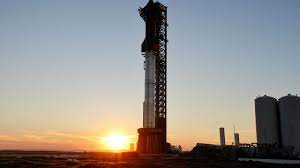
An important contribution to the future of space engineering came on Wednesday when the US Fish and Wildlife Service gave their thumbs-up to the launch of SpaceX Starship IFT-2, which blasted off from Texas on Saturday. The IFT-2 is one of the largest, most powerful spaceships ever made, and completed its launch following a failed run this April (this time the ‘ship’ completed its initial launch phase though the booster rocket exploded and the ship was destroyed). Many readers will know that the Starship is ‘re-useable’ in that the ‘ship’ element can slow horizontally and then flip to perform a vertical landing.

Starship has all of the elements we now readily associate with Elon Musk – disruptive genius, oodles of capital and a tense relationship with government – Starship will ferry satellites to space (Starlink satellites will account for about 40% of Space X revenues) and is also intended to taxi astronauts to the moon, and eventually Mars, and in so doing it creates a dependency of NASA and to an extent, the US military on it.

The test flight is a reminder of the competitive interest that privateers and states are showing in the scramble for rare places, that is, the desire to unearth, control and harvest (pillage might be a better word) the deep seas, outer space and the Arctic, for example. Each of these rare places is a source of bounty, but also a potential theatre for warfare, and space is no exception.

Satellite warfare – whether satellites are either bumped out of place, smashed to smithereens in kinetic attacks or lasered – is something that militaries and their space wings (e.g. SpaceForce) prepare for. For instance, French has developed bodyguard satellites that can protect its own military and commercial satellites from attack.  Indeed, satellites are massively underestimated in terms of the reliance we place on them – to guide supply chains, telecommunications, military targeting and weather mapping to name a few uses, and any future conflict between large regions would very likely involve a ‘war on satellites’.

Each contested ‘rare place’ will soon be granted its own specific vocabulary, to the extent that we now speak of astropolitics and of the evolution of the rule of law of sorts of space (i.e. the Outer Space Treaty), a polity for space, I am waiting for someone to coin the term ‘the spolity’.

One aspect, where I am on more solid ground in terms of my grasp of the laws of gravity of markets and economies, as opposed to space technology, is the space economy, which covers many aspects – from space tourism, to mining and resource harvesting to the very promising rents to be garnered from satellites.

For the US the space economy is already rooted in the military, aerospace and telecoms industries and has a ‘blue sky’ element in the sense that Washington has bought into the strategic value of the space and this view is shared by entrepreneurs and enough investors to make a difference.

If we had to map the share of the space economy on to share of gdp back on Earth, the US, China and Japan would, have chunks of the space economy that might be commensurate with their ‘Earth’ gdps, and Russia would have a chunk of the space economy that is well above the role its flailing economy plays, while India might play an important role. The EU, which accounts for over a quarter of world GDP, likely has a smaller share of space GDP (the Space Foundation puts the size of the space economy at close to Eur 500 bn). Europe’s space industry has a smaller footprint than Fiat (roughly 200,000 people are employed in the space industry according to the European Space Agency, with roughly Eur 60bn in direct and indirect revenues).

It is not without key assets though – the Ariane and Vega rocket ships, Galileo navigation system and the Govsatcom secure communication system. Across Europe there is a rising number of growth companies forming a commercial eco-system, in the production of food and water in space like environments, in mineral mining and notably in satellites, which is where the money is in space commerce.

Europe’s problem in space commerce is not unlike its banking industry, still nation centric and the common capital market is not deep enough. To make things more complex, the speculative nature of many space-oriented projects makes them difficult to finance, even for risk taking venture capitalists (space tech venture activity is back down to 2018 levels). In time I suspect that Europe may need to adopt new forms of financing for select space tech projects, that bring entrepreneurs together in pan-national projects and that combine public and private money. It might be too early for a Bank for Space, but the EU needs to realise that succeeding in space is as much about the right kind of capital, as it is about technology.

For their part, Europeans may just prefer to sit and wait it out, glad not to have funded Space X.

Getting from Denmark

In his book, the Origins of Political Order, the political scientist Francis Fukuyama grapples with the issue of building quality institutions, which he coins as ‘getting to Denmark’ in the sense that ‘For people in developing countries, ’Denmark’ is a mythical place that is known to have good political and economic institutions: it is stable, democratic, peaceful, prosperous, inclusive, and has extremely low levels of political corruption’.

Fukuyama traces the quality of Denmark’s socio-economic pillars to the Protestant Reformation. I am not sure he is right here, but that is a debate for another day. In general though, the model of the small, advanced economies (not just Denmark but also the other Nordics and smaller leading nations from Singapore to Ireland to the Netherlands) is the exemplar for policy making internationally, as David Skilling and I continue to stress.

Now however, there is trouble in the ‘Denmarks’.

Whilst the Nordic economies are famous for their socio-economic balance they are increasingly known for their struggles in integrating immigrants. Against a background of violence and gang led crime, Sweden’s prime minister has referred to a period of ‘political naivety and cluelessness’ and has even sought to involve the military in curbing violent crime.

In this context the five Nordic countries (Finland, Denmark, Norway, Iceland and Sweden) have signed an agreement to collaborate more closely in deporting illegal immigrants (for example in pooling deportation flights). In the background, individual Nordic countries have been tightening their policies on immigration – towards the relatively tougher Danish approach.

Though this is a specific measure, it highlights a turning point in the Nordic countries’ tolerance and approach to illegal immigration, and potentially migration on a larger scale. As harbingers of socio-political change, this is potentially an important development on the European stage in that it signals progressive European countries have reached a limit in terms of the scale and nature of migration they are willing to permit.

If this is the case it may have several implications.

One is that in the context of very tight labour markets, European countries will try to be more selective in the immigrants they welcome. In Ireland for example, central bank data shows that Indian women are one of the best paid migrant cohorts in the labour market (they work in the IT sector), while even Hungary whose illiberal government rails against immigrants, needs to take in half a million migrants over the next two years. Broadly, it is worth emphasising the point that employment is considered the best means to integrate new arrivals in societies.

We may also see some European countries make labour markets more flexible, notably finding ways to involve older people in labour markets (in Denmark the retirement age is 67 and from 2030 will increase by one year every five years, depending on life expectancy), and it is also possible we see the EC study how Japan manages its economy with few immigrants.

Politically, the notion that we are at ‘peak Denmark’ may have at least three interesting effects.

In many European countries, immigration is the leading, and most contested political issue, with the tone set by ugly rhetoric from the far-right. Suella Bravermann’s offensive courting of controversy – from promising to send illegal immigrants to Rwanda to describing homelessness as a life-style choice – is an example. The fact that governments are reacting more forcibly to illegal immigration may well move the debate back towards the political centre and arguably, make it more policy focused.

At the same time, I expect that we will see many European politicians focus on the notion of European values, and what this means in terms of the responsibilities they place on both Europeans and immigrants. Robert Habeck’s impressive speech on this theme is such an example, and I believe that we will hear more voices from the political centre echo his words.

 The other interesting trend, that is consistent with progressives reaching the limit of their patience with immigration is the rise of new ‘mongrel’ political parties. I say mongrel in the sense that they (Sahra Wagenknecht’s Alliance for Justice and Reason in Germany and Pieter Omtzigt’s New Social Contract party in the Netherlands) mix left wing economic policies with tough stances on migration and ‘values’.

It points to a major turning point in policy and politics in Europe, with serious implications for the developing world.

Have a great week ahead,

Mike