

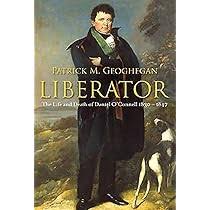
Readers of the ‘Levelling’ might be looking for a destination to visit during the Christmas holidays, and if so, I want to recommend Caherdaniel in Co. Kerry (southwestern Ireland for those of you reading far away), with its gorgeous, long beach, woodlands and often – blue skies. It is also the home of one of Ireland’s best pubs – the Blind Piper.
Caherdaniel is most famous for Derrynane House, the home of Daniel O’Connell (born not too far away in Cahersiveen)– one of the grand figures of Irish history – a man that King George IV called the ‘uncrowned king of Ireland’ – also known as the Liberator or Emancipator (his main accomplishment was the emancipation of the Catholics in Ireland in the 19th century). Derrynane is also famous as the place where President De Gaulle spent six weeks after his resignation in 1969 – and he may well have been inspired by a biography of O’Connell, written by his maternal grandmother Josephine, which he read as a child.
My linking of De Gaulle and O’Connell is motivated by the fact that this year is the 250th anniversary of O’Connell’s birth, and last week I moderated a debate on democracy and European politics between a group of Irish and French experts in Paris as part of an ‘O’Connell’ conference.
In trying to explain O’Connell to a French audience today (not to mention the Irish audience – where he is somewhat forgotten), three defining traits stand out.
The first one I would highlight is that he was European in his outlook. I frequently visit Caherdaniel, and the recurring thought is of O’Connell setting off in his carriage to travel Ireland or to go to Westminster or further to Rome – or back to France, where he was educated.
The second element that is interesting – was his internationalism – Marx, Dickens, Balzac, Bismarck, and John Quincy Adams in the US, all had something to say about O’Connell – and he was ardent in his support for other causes – against slavery in the US and, when he first took his seat in Westminster – he campaigned for the emancipation of the British Jews.
The third element we note about him is his political method – he spoke at enormous mass rallies – one at the Hill of Tara is said to have attracted 1 million people, he was an orator and a skilled political organiser, but also someone who believed in peaceful protest – perhaps because of what he witnessed in France during the Revolution. In today’s terms, O’Connell was one of the first democrats, a defender of civil rights, and in some respects a beacon for liberal democracy in Europe and England – he was a founder of the Reform Club in London.
The point of raising his example today, beyond the simple fact of his anniversary, is to make the link with last week’s note on the changing of the political guard in the US (Change of Guard) and the grim backdrop that Western democracies face in terms of the rise of populism, vexatious impact of social media on public life and the vandalisation of Europe by countries like Russia. For example, in the past week a train line in Poland was sabotaged, and controversially the head of the French army warned people to be ‘ready to lose their children’ in a war.
Three strands came out of the debate on modern democracies, under the shadow of O’Connell, that are worthwhile flagging.
The first, is to find ways of breaking the polarization of political arguments, or the phenomenon where political debates quickly become corralled into opposing camps, leaving little room for considered debate. Arguably, politicians are part of this problem given the tendency of governments to constantly spin news developments.
Ironically, the second strand is a demand from politicians (in this case both French and Irish deputies) to curb abuse on social media, in particular its use as a channel to threaten public representatives. Every political figure I know has suffered abuse on social media, of a kind that if it were repeated in person, would most certainly result in a criminal conviction. The question then is whether and when politicians are ready to take a tougher stance with online abuse.
A final thought that relates directly to O’Connell is whether today’s mild-mannered political leaders – I am thinking of the likes of Friedrich Merz and Sir Keir Starmer – should be more enthusiastically populist in pushing their centrist causes. O’Connell was a complicated character and as stated a clever speaker and was a master in getting the ‘crowd’ on his side. The thought experiment is that democratic leaders ditch their anodyne, carefully crafted communications and let their oratorical skills off the leash. It would make a nice change and might well make the role of politician less frustrating.


 The Levelling