

Regular readers will now be well aware of the thesis of the Levelling – that globalization judders to a halt and is replaced by the unsteady formation of a multipolar world.
In 2018 we wrote that ‘Geopolitics will be dominated by three significant players: China-centric Asia, the Americas, and Europe. India may constitute a fourth pole, but its time has not yet arrived. These will be the players in the Great Game of the twenty-first century. (Peter Hopkirk’s book The Great Game: On Secret Service in High Asia, on the strategic battle between Britain and Russia in the nineteenth century, is a must-read as background.) For example, China’s One Belt, One Road infrastructure and trade project is a definitive Great Game–like manoeuver.
Reflecting on this, the Belt and Road is now fading into the past (Italy is leaving soon) and I would still strongly recommend Hopkirk’s book. The new development is the ‘seeding’ of a potential ‘Fourth Pole’ of the world order around India and the Gulf states and Saudi Arabia.
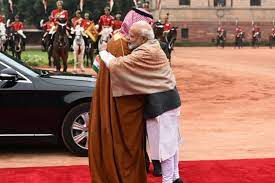
One of the key developments of an otherwise disappointing G20 meeting in India was the announcement form the US, India, Saudi Arabia, the United Arab Emirates, France, Germany, Italy and the European Union of a project to create a new India-Middle East-Europe Economic Corridor (railways to ports) as a pillar of the G20’s Global Infrastructure initiative. Amidst the rally of India as a geopolitical player and economy, and the rapid and historic remaking of alliances across the Middle East, the key question is whether the combination of India and the Gulf/Arabian states could become a bona fide Fourth Pole on the geopolitical landscape.
This notion is still in its ‘venture’ stage and there is much that could derail it – from climate change to Narendra Modi’s antagonization of his muslim population to a collapse in the price of oil.
However, if the progenitors of the ‘Fourth Pole’ are reading, there are two broad criteria to watch – the first is a coherent mass and the second is a coherent method or way of doing things.
In terms of the first, Europe, the US and China have ‘mass’ economically and financially (single markets, currencies), diplomatically (Europe is increasingly coordinated, and we know what China is thinking even if its foreign minister disappears for weeks on end), industrially (Bidenomics, Strategic Autonomy and state driven Chinese entrepreneurship) and militarily (all three are nuclear powers with sizeable armies). By comparison, Russia for instance is not a ‘pole’ as it is not significant economically, industrially and has a toxic foreign policy.
India and Saudi Arabia, to take two of the Fourth Pole players, are meaningful economically though much less so as financial players (though Saudi Arabia’s reserves given it clout), and apart from India’s nuclear arsenal are not in the top division of battle-ready militaries (India has a large airforce but it would likely not perform well against say the Finnish airforce). Building ‘mass’ would take time and investment and would demand a coherence in strategy between very disparate countries, and currently there are few policy areas where there is policy collaboration at a detailed and well-coordinated level between India and say the UAE.
The second and essential element of multipolarity is that each pole has a defined ‘method’ or way of doing things – Europe is a liberal social democracy with increasingly coordinated policies, China has the ‘China Dream’ social contract between the Chinese people and the communist party while the US is making itself great, again. Each one has a distinctly different approach to technology, the internet and lately to regulating AI.
The India to Saudi Arabia corridor is yet very different in terms of its cultures and development models and is very far from have a common method. This is something that can arrive after at least forty years of close trade and cooperation, and in my view will be highly influenced by the Indian diaspora in countries as diverse as Kenya to Dubai.
In the context of this new project, there is a great deal of talk about the global south – effectively the fast growing, populous countries of Asia, Africa and Latin America. It does their individual cultures little justice to group them together, and the idea of the ‘global south’ vastly overestimates the ability of these countries to act as a single entity. The primary challenge for the ‘global south’ countries is to find ways to increase the level of trade between themselves. In the long run it may be that the India-KSA-UAE corridor becomes the organizing locus for the global south.
These countries can take heart from the early days of the United States (for example the ways in which Alexander Hamilton bound individual states together during the Whiskey Rebellion) and the fact that the EU itself started off as a trade and infrastructure project (Coal and Steel community). For the moment, they need to be patient, not over-reach and concentrate on trading more together.
 The Levelling